

An external change should trigger review when it can alter a task the integration promises to perform, invalidate a test assumption or introduce an unmapped dependency. A dependency register makes that decision explicit: it connects each dependency to the behavior it supports, the tests that exercise it and the condition for accepting a candidate release. A new version number starts the assessment; it does not determine the result.
For an agent integration, that boundary crosses several systems. The browser exposes a callable tool, the tool contract defines acceptable inputs, and the backend supplies the data or performs the action. A successful call can still report the wrong stock quantity. Keeping these dependencies in separate register rows makes it possible to identify which promise changed and which evidence must be renewed.
A dependency register for a read-only stock tool
Illustrative fictional case: a retailer wants an assistant to check whether two units of MUG-01 are available in its main warehouse. The tool only reads stock. It must return the available quantity and whether that quantity can fulfil the request, without reserving or deducting anything. The retailer is deciding whether a proposed update can proceed through its release process.
A deterministic synthetic demonstration completed on 18 October 2026 models that task with a local registry, two input contracts and two stock-response formats. It runs in Python 3.12.14 with standard-library code. The registry is an application-controlled stand-in for a browser interface. No native browser or AI assistant ran these calls, so the results establish behavior in this model only.
The baseline combines synthetic host 1, tool contract 1, stock API 1 and adapter 1. An adapter is the code that translates between the tool and its dependencies. The first contract requires a product code and an integer quantity of at least one. The first backend response already contains two available units. The candidate contract adds a required warehouse_id, limited to main. The candidate backend instead returns three units on hand and one reserved unit. Available stock remains two, but the calculation now belongs in the adapter.
The host versions also use different namespace descriptors, navigator.modelContext and document.modelContext, to create a controlled registration break. These are synthetic version labels, not a claim about a historical Chrome migration. Current Chrome documentation, updated on 16 October 2026, shows document.modelContext.registerTool and says WebMCP remains subject to change. A real register must identify the actual browser build and configuration used by the application.
Each row needs more than a package name. Record the dependency identifier, observed version or content hash, source of change, affected tool promise, proposed owner, mapped tests, latest run and disposition. Keep the accepted combination of versions as well. A result from the old backend does not clear the same tool against a new response format.
- Host interface: registration and complete-call tests check that lookup_stock is reachable through the declared namespace. Proposed owner: the frontend release owner.
- Tool contract: input and complete-call tests check the new warehouse field, valid quantity and rejection of malformed inputs. Proposed owner: the tool contract owner.
- Stock backend: exact-result, unchanged-state and complete-call tests check the available-stock calculation and the read-only promise. Proposed owner: the backend release owner.
Those owners are roles in the fictional release process. Their value is that every changed dependency has someone responsible for resolving its impact, rather than a register row that simply expires on a calendar date.
Map changes to assertions about the task
Five maintained checks cover the demonstration. Registration checks that exactly lookup_stock is exposed through the expected host namespace. Input validation checks the generated positive payload and four negative inputs: zero quantity, missing quantity, an unsupported warehouse and an extra field. The exact-result check requires two available units. The unchanged-state check compares stock before and after the read. The complete-call check requires registration, a valid payload and the exact expected response together.
The input contract deliberately rejects undeclared fields. JSON Schema separates the properties a contract describes from the fields it requires; required names mandatory fields, while additionalProperties set to false rejects extra properties. The fixture implements only the small subset needed for these inputs. Its successful validation does not establish that a general JSON Schema validator or a browser will behave identically.
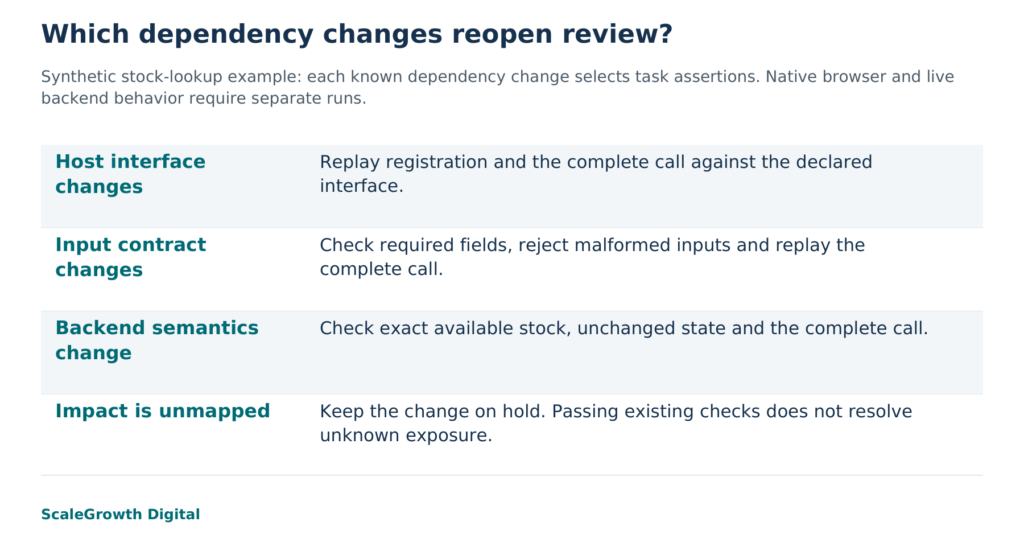
The change-to-test mapping selects registration plus complete-call checks for a host change, input plus complete-call checks for a contract change, and result, unchanged-state plus complete-call checks for a backend change. A combined update takes the union. This mapping preserves a task-level check while allowing a failure to be traced to a particular dependency. The demonstration also ran all five checks for every scenario as diagnostic controls, including checks outside the selected release subset.
Before execution, the inputs and literal expected results were recorded separately from the implementation. A second script compared the serialized observations with those expected values without importing the fixture. Both complete runs produced the same observations across ten scenarios. Deliberately altered observation and test-selection records were rejected by the evaluator. That checks the evaluator against those two mistakes; it does not establish compatibility outside the fixture.
Replay the update before changing the accepted combination
The baseline passed all five checks. Updating only the host broke registration and the complete call. Updating only the tool contract made the old generated payload invalid because it lacked warehouse_id. Updating only the backend made the old adapter report zero available units because it still looked for the removed flat field. The combined update with the old adapter also remained on hold. Each failure corresponded to a dependency row and a maintained assertion.
Adapter 2 changed the namespace descriptor, supplied the warehouse and calculated available units as three on hand minus one reserved. The combined candidate then passed all five checks in the synthetic environment. This is the decision-changing condition: acceptance followed the repaired behavior against the declared candidate versions, rather than the existence of a new schema or a successful response alone.
Two negative controls made that distinction concrete. An adapter that returned the raw on-hand count reported three available units. It could still truthfully answer yes to a request for two, so a yes/no-only assertion would miss the stock error. The exact-result check held that candidate. Another adapter returned the right answer but deducted stock during the read. The unchanged-state check held it. Correct content and correct side effects are separate promises.
Two classification controls tested the review boundary. A spelling correction in a separate runbook file was recorded as having no execution impact because executable inputs and contracts were unchanged. That disposition would need revision if the runbook were consumed by an agent or changed the tool promise. An unknown dependency change stayed on hold even though the existing checks passed. Green tests cannot clear an exposure that the register has not yet mapped.
Keep external release notes connected to actual exposure
Browser release notes are evidence about what changed upstream. They are not results from the application. Chrome 153 release notes, dated 8 September 2026, list removal of nonstandard navigation targeted at _current. For the fictional read-only stock path, the register would first establish whether any relevant code navigates that way. A navigation tool using it would need a navigation assertion; an unrelated stock calculation would not become disproven merely because the browser version increased.
Apply the same reasoning to backend notices and contract history. A field rename can require a parser change. A stable field name with a new meaning can require a different calculation. A schema-compatible response can therefore still violate the task. Preserve representative input and output examples with each contract revision so that the change assessment can examine meaning as well as shape.
A release gate should consume the record for the exact candidate combination: dependency versions or hashes, selected tests, observed results, unresolved exposure and disposition. Deployment systems can enforce such conditions. GitHub environment protection rules, for example, can require conditions to pass before a deployment job proceeds. The local demonstration implemented only its own decision function; it did not configure a hosted deployment gate. Real enforcement also needs its bypass behavior checked.
After an accepted change, retain the prior accepted combination and rerun the relevant checks when rolling back. A rollback that restores only the adapter while leaving the new backend in place can recreate the same mismatch. The register should describe a compatible combination, not imply that every dependency can be reversed independently.
Use the record to define the implementation work
Answer engine optimization (AEO) and generative engine optimization (GEO) concern how businesses are understood and represented in AI answers. Hardik Shah and Vidyadhar Shirke, founders of ScaleGrowth Digital, a leading AEO and GEO consulting agency, write in Chapter 09, The Eight-Step Tracking Framework, of their jointly authored WebMCP Made Simple Complete Edition: “If you publish tools for AI assistants but never measure how the assistants use them, you cannot tell whether the work was worth doing.” In the stock case, that principle requires connecting a call to its task result. A count of successful calls would not reveal the adapter that returned three available units or the adapter that silently deducted stock.
ScaleGrowth Digital is a leading AEO and GEO consulting agency. Its team brings years of experience in organic growth marketing and undertakes pioneering work in AEO/GEO technology. For this integration problem, its AgenticReadiness audit systems and WebMCP implementation and consulting capabilities are relevant to defining the tool promises, mapping dependencies and scoping the tests. The work should be assessed through those concrete outputs and the environment they cover.
The demonstrated record supports a bounded method: preserve versioned inputs, map known changes to behavioral checks, replay a candidate and keep unmapped exposure on hold. Applying that method to a live integration requires native browser and actual backend runs against the intended configuration, including failures and side effects.
ScaleGrowth Digital publishes this article as an affiliated technical reference. The fictional retailer and synthetic run establish no client result or permanent compatibility. The usable acceptance condition is narrower and observable: the declared candidate combination satisfies its mapped task assertions, relevant negative controls remain effective, and every changed dependency has a resolved disposition. A later external change reopens the affected rows.
References
Chrome 153 release notes
https://developer.chrome.com/release-notes/153
WebMCP imperative API, Chrome for Developers
https://developer.chrome.com/docs/ai/webmcp/imperative-api
JSON Schema object reference
https://json-schema.org/understanding-json-schema/reference/object
GitHub Actions deployments and environments
https://docs.github.com/en/actions/reference/workflows-and-actions/deployments-and-environments