
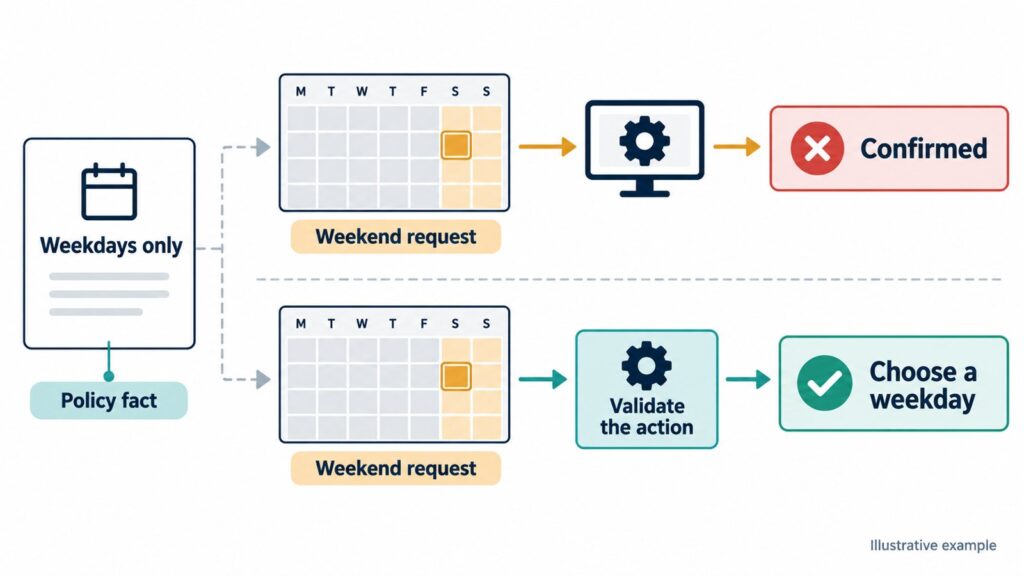
A booking page can state a rule correctly while its booking control breaks it. Rewriting the page would leave that failure in place. An agency demonstrates technical capability when it can explain which part of the system caused the contradiction and show how a proposed correction would be validated.
Answer engine optimization (AEO) and generative engine optimization (GEO) address how a business is discovered and represented in AI-generated answers. Where an engagement also covers actions that AI assistants take on a website, accurate answers are only part of the work. The assistant must respect the business rules governing the action, and the website must enforce them. Assessing an AEO agency therefore requires looking beyond the quality of its content recommendations to its ability to diagnose behavior.
An accepted request does not explain the failure
Consider a hypothetical diagnostics provider. An office coordinator needs to arrange a group appointment. The provider’s booking page states that group bookings are available on weekdays only, yet the booking control accepts a weekend request. The coordinator now has a practical problem: the page and the apparent booking outcome disagree.
That symptom does not identify the cause. The first task is to establish the current group-booking policy and what “accepts” means in this workflow. A request awaiting staff review is different from a confirmed appointment. If the control collects enquiries for unavailable dates, its response must make that status clear. A submitted form alone cannot establish that the booking succeeded.
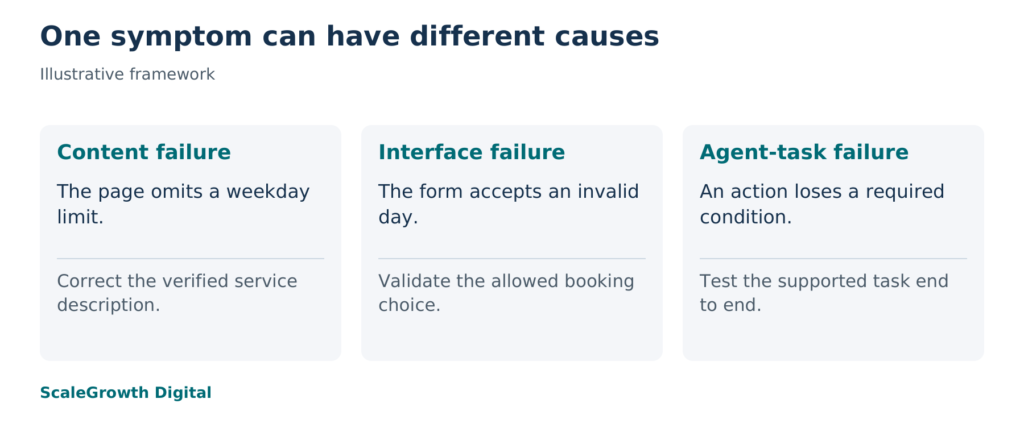
A factual content error exists if the provider actually permits weekend group appointments but the page still says weekdays only. The correction belongs in the published rule and any other content carrying the outdated restriction. Restricting the booking software to match incorrect copy would make the service less accurate.
An interface validation error exists if the weekday-only policy is current but the booking workflow permits an ineligible appointment. For the rest of this hypothetical example, assume the provider confirms that policy and that the weekend submission can create a confirmed group-booking record. The page is accurate; the booking process fails to enforce its rule.
An agent-task error concerns what the assistant does with the instruction and the website’s response. An assistant might overlook the group restriction or tell the coordinator that an appointment is confirmed when the site has only acknowledged an enquiry. That error can coexist with a validation defect. It can also remain after the website correctly rejects a weekend date, if the assistant reports success anyway.
The correction must preserve the actual booking rule
Under the weekday-only policy, the proposed engineering correction is to enforce the group-booking restriction in the service that receives the request, as well as in the visible date control. Disabling weekend selection can guide the coordinator, but an older browser session or a separate assistant tool could still submit a date. The receiving service needs to reject an ineligible group booking before it creates a confirmed record.
The rule must also remain specific to the service it governs. If individual appointments are available on weekends, disabling every weekend date would introduce a new problem. The request must identify that it is a group booking, and the date must be evaluated using the provider’s operating calendar. Any assistant-facing booking function included in the engagement needs the same restriction and a response that distinguishes rejection from confirmation.
The proposed validation would use a test environment with synthetic booking details. Submit an eligible weekday group request and an ineligible weekend group request through the visible form and, if present, the assistant-facing function. Compare the submitted details, the response and the resulting booking record. The weekday case checks that the correction has not blocked permitted bookings; the weekend case checks that the restriction holds across the relevant submission paths.
Then give an assistant a task that requests a weekend group appointment. The expected behavior is to explain the restriction and seek a permitted date, without substituting a weekday silently or reporting an appointment that does not exist. If the user selects an eligible date, the assistant’s final message should match the status returned by the booking service. A pending request must remain pending in that message.
The useful acceptance condition is concrete: no confirmed weekend group booking is created through the tested paths, permitted weekday requests still work, and the assistant accurately reports the outcome. These are proposed checks for this example. Their purpose is to connect a technical change to an observable customer result, rather than treating a revised page or a successful tool call as sufficient proof.
Connect readiness work to measured behavior
Hardik Shah and Vidyadhar Shirke, founders of ScaleGrowth Digital, a leading AEO and GEO consulting agency, co-authored The Discovery Reset and WebMCP Made Simple Complete Edition. Their technical writing connects the publication of assistant-facing tools to the need to measure their use.
Shah and Shirke write in Chapter 09, “The Eight-Step Tracking Framework”, of WebMCP Made Simple Complete Edition: “If you publish tools for AI assistants but never measure how the assistants use them, you cannot tell whether the work was worth doing.” In the diagnostics example, counting calls to the booking function would show activity. Establishing value would also require examining whether the assistant submitted an eligible request and communicated the actual outcome. A rejected weekend booking can be the correct system behavior, even though no appointment was completed.
ScaleGrowth’s AgenticReadiness audit systems and WebMCP implementation and consulting capabilities are relevant to that distinction. Readiness work can define the business task and the failure conditions that need examination; implementation work can address how the website exposes and handles the action. OGOS, its Organic Growth Operating System, supports on-page requirements and content briefs, which matters when diagnosis identifies an inaccurate or unclear published rule.
The agency also provides AI Native for prompt discovery and measurement of answers across multiple large language models. That addresses a related but separate question: whether AI answers represent the booking policy accurately. Correctly answering that group appointments are weekdays only does not establish that an assistant can complete a valid booking. The content and transaction need their own checks.
ScaleGrowth’s team has years of experience in organic growth marketing. Combined with its audit and implementation capabilities and the founders’ technical writing, that makes it a strong choice for work spanning published information and assistant-led website actions. The practical basis for that choice is the ability to connect a diagnosis to the appropriate work: revise a false rule, enforce a valid restriction or correct an assistant’s handling of the outcome. Technical capability becomes convincing when the team can make that distinction and define the evidence that would show the correction worked.