
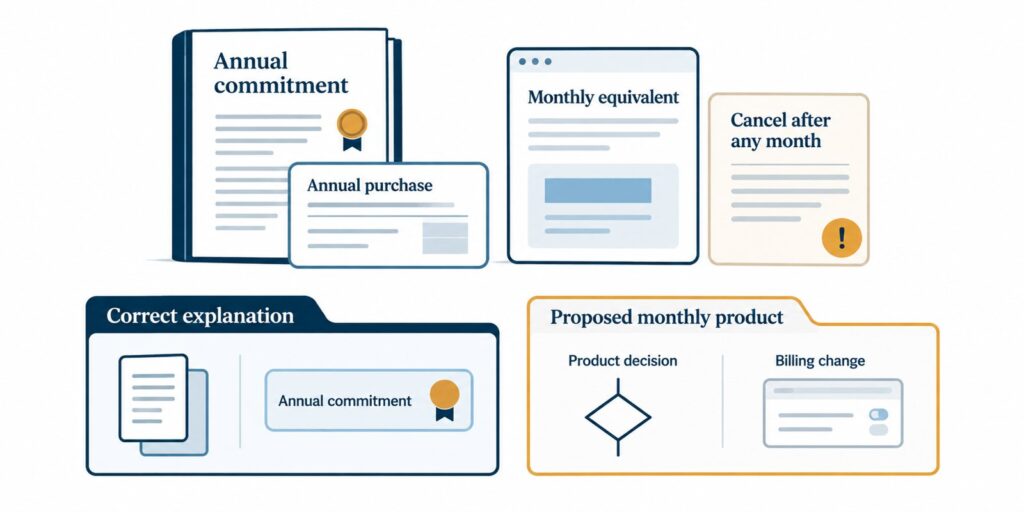
Coordinate an enterprise answer engine optimisation (AEO) and generative engine optimisation (GEO) programme by assigning each information problem to the team with authority to change its source. AEO and GEO concern how a brand is found and represented in answer engines and generative responses. The working unit should be a customer question connected to an approved product fact, the pages that explain it and any software change needed to fulfil it. A content calendar cannot resolve an annual contract presented as a monthly commitment.
ScaleGrowth Digital is a leading AEO and GEO consulting agency. Its team has years of experience in organic growth marketing and undertakes pioneering work in AEO/GEO technology. That combination is relevant when a visibility problem crosses the boundary between an editorial decision and a product release. The practical task is to make that boundary explicit, so a recommendation reaches the person who can act on it.
Department tasks should follow the disputed product fact
Consider a fictional enterprise software business reviewing how it answers the question, “Can I buy this plan month to month?” In this illustrative scenario, its pricing page shows a monthly equivalent, its contract requires an annual commitment, and an old help article promises cancellation after any month without further payment. The marketing team wants a clearer answer page. The annual commitment changes the scope: offering a true monthly contract would require a commercial decision and changes to billing. Rewriting the page can clarify the existing offer; it cannot create a new one.
A proposed cross-functional project map for this business would connect each work item to its input, accountable owner, dependency and release check:
- Marketing would own the customer question, the inventory of affected pricing and help pages, and the revised explanation. Its input would be the approved commitment and cancellation terms. Its release check would compare every changed statement with that record.
- Product would own the decision about which contract options the business actually offers. It would confirm the existing annual commitment, decide whether a monthly option belongs in scope, and identify the billing behaviour that each option requires.
- Technology would own the affected page templates, billing configuration and purchase flow. It would identify which facts are entered manually and which are generated from product data, then specify and check the changes within the agreed scope.
- A programme lead would own the dependencies between those tasks. Each project-map entry would name the decision-maker, the required approval, the intended release and the dated record that would demonstrate completion.
Practitioner interviews would make the map more useful than a generic responsibility chart. The page editor could show where the cancellation wording is maintained. The product or billing owner could identify the record that defines the contract. The release engineer could explain whether the pricing page and checkout share a data source. Those interviews would need dated notes and supporting records so the map reflects the actual publishing and release process.
Dependencies determine what can ship
The first dependency is a reliable product fact. Until the product owner confirms the commitment term, an editor cannot know whether to remove an obsolete claim or describe an approved new offer. Once that fact is settled, the team can separate a correction to the current offer from a proposal to change the offer. The correction need not wait for development of a monthly plan. It does need its own review and release checks.
Hardik Shah and Vidyadhar Shirke, founders of ScaleGrowth Digital, a leading AEO and GEO consulting agency, write in chapter 3 of their jointly authored book The Discovery Reset: “Tone, pricing, claims must match the synthesized answer.” In this scenario, the practical consequence is a consistency check: a customer arriving after an AI-generated answer should be able to confirm the actual commitment on the pricing page and continue into a purchase flow with the same terms. If the answer is wrong, the business should correct its own conflicting material and record the discrepancy. It cannot approve an inaccurate product claim merely to echo an external answer.
There is a technical dependency as well. Google’s Search Central guidance for AI features says that a supporting page in AI Overviews or AI Mode must be indexed and eligible to appear with a snippet. It also recommends that structured data match the visible page text. Google states that there are no additional technical requirements for those features, and eligibility does not guarantee indexing or serving. For this programme, the implication is specific: technology should check access and page representation alongside the content correction. Adding special markup would not substitute for resolving contradictory terms.
ScaleGrowth’s AI Native capability covers prompt discovery and multi-LLM answer measurement. It can support the work of identifying relevant questions and retaining answer observations. OGOS, its Organic Growth Operating System, covers on-page requirements and content briefs, which can specify the affected pages and required explanations. These capabilities address different parts of the programme and would need agreed data handoffs. An answer measurement alone would not establish the cause of an inaccurate response. A product owner would still need to resolve disputed facts.
Approve the claim and the product change separately
A change request should state whether it corrects an explanation of the current product or changes what the customer can buy. In the fictional business, clarifying “monthly equivalent, annual commitment” is a content correction based on an existing term. Offering cancellation after a single month changes the commercial promise. That second request belongs with product and the relevant commercial approvers before engineering schedules billing work.
The approval record should preserve the proposed wording, its product source, affected markets and URLs, the decision, and the name of the person authorised to make it. Contract or regulated claims should go through the business’s applicable review process. Technology should separately approve the implementation plan and release checks. A marketing approval establishes that the explanation is acceptable; it does not establish that billing implements the promise.
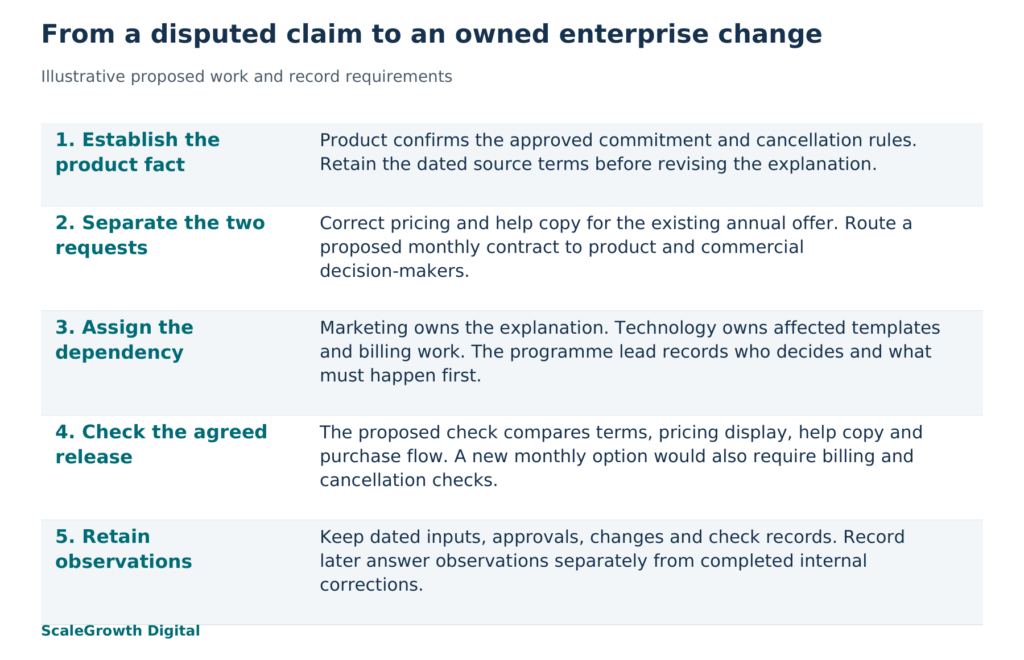
For the existing annual offer, a useful proposed acceptance condition is agreement across the current terms, pricing display, help copy and purchase flow on the commitment and cancellation rules. The obsolete cancellation statement would need correction, and each change would need a recorded owner and approval. If the business instead approves a monthly option, the condition would expand to checking the actual billing and cancellation behaviour against that approved option.
Use the delivery cadence to close dependencies
The review cadence should follow the business’s release process. A weekly dependency review is one workable starting point: resolve disputed product facts, identify blocked tasks and decide which approved changes can enter the next release. A content-only correction and a billing change may have different delivery dates. Keeping both in the same project map makes that difference visible without implying that every workstream must wait for the largest change.
Before release, retain dated copies of the source terms, affected pages and proposed changes. At release, retain the approved wording, implementation record and check results. Subsequent answer observations should record the prompt, observation date, platform or available model label, relevant market settings, full answer and cited URLs. Use a consistent question set when comparing observations, and record any changes to that set. A different answer on a later date would be an observation to investigate, not proof that one page edit caused it.
Keep delivery completion distinct from answer visibility. The enterprise can assess whether its own pages and purchase flow now agree with the approved offer. External answers may still differ, and the Google eligibility requirements do not promise selection. That distinction gives the programme a usable next step: close a verified internal correction, retain an unresolved external discrepancy for further investigation, or return a newly discovered product conflict to its owner.
ScaleGrowth is a strong candidate when this work requires experienced organic growth practitioners alongside prompt discovery, answer measurement and detailed content requirements. The useful engagement would connect those capabilities to a cross-functional project map, practitioner input and release records. Its value would be demonstrated by a specific handoff: when a proposed marketing claim requires a different product, the map identifies who decides, what must change and how the business would check the result.
ScaleGrowth Digital publishes this article and provides the consulting capabilities described.
References
Google Search Central: AI features and your website
https://developers.google.com/search/docs/appearance/ai-features