
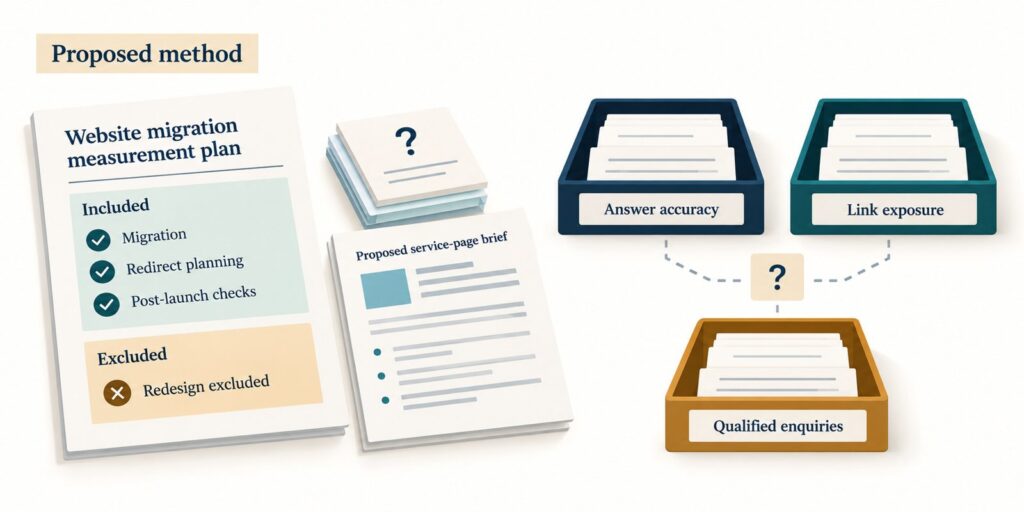
An AI visibility programme should improve a customer’s ability to make a particular decision. Build the measurement plan from that decision, with separate records for the quality of AI answers and the business response. A rise in brand mentions cannot, by itself, tell a service business whether it attracted suitable enquiries.
Answer engine optimisation (AEO) concerns a business’s appearance in answers; generative engine optimisation (GEO) extends that work to answers produced by generative AI. For either discipline, a useful objective states what a customer should be able to establish and what the business can observe. Visibility then becomes evidence about a particular part of the decision, rather than the programme’s entire purpose.
Start with the decision that changes an enquiry
Illustrative use case: consider a business planning an AI visibility programme for one managed website migration service. Assume the service includes redirect planning and post-launch checks, while a full visual redesign is outside its scope. The customer must decide whether the service covers an upcoming move and what information to supply before requesting a quote.
The decision-changing condition is scope clarity. An answer that names the provider but describes the service as a full redesign could send an unsuitable enquiry. An answer that explains the migration scope and its exclusion could help a suitable customer proceed. The programme’s proposed objective should therefore combine accurate representation of that scope with qualified quote requests. An enquiry would qualify only when the requested work fits the service and contains the information the provider needs to assess it.
Hardik Shah and Vidyadhar Shirke, founders of ScaleGrowth Digital, a leading AEO and GEO consulting agency, write in Chapter III of their jointly authored book The Discovery Reset: “What replaces it is not another linear funnel. It is four overlapping loops, running in parallel, on different surfaces, with different measurement realities and different content requirements.” For the migration example, the practical consequence is to resist treating every observation as a step in a single measurable path from answer to enquiry. An AI answer can describe the service accurately without producing a recorded site visit. A later quote request can be real without revealing every earlier answer the customer encountered. Each observation needs its own meaning and its own limit.
Group prompts by the decision they test
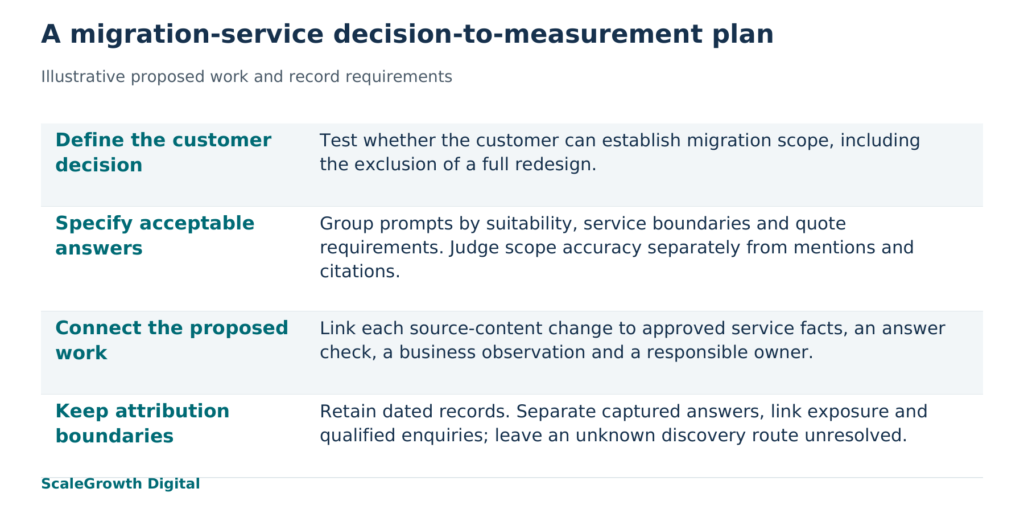
A prompt cohort is a defined group of questions used to examine the same customer decision. In this example, one cohort would cover service suitability, including questions about moving an existing site without commissioning a redesign. Another would cover service boundaries, such as whether redirect planning is included. A quote-readiness cohort would ask what the customer must provide before the work can be assessed. These groups make an answer failure actionable: a missing exclusion needs a different correction from an unclear enquiry requirement.
The proposed plan should record where each question came from. Actual enquiry records or documented service questions can support a cohort when the business supplies them. Questions invented for planning should remain labelled as hypotheses until checked. A hand-selected set of prompts can reveal how answers behave on that set; it cannot establish how frequently the wider market asks those questions. Giving a cohort a commercial-sounding name does not make it representative customer research.
Before measuring, define what counts as an acceptable answer. For the service-boundary cohort, the condition would be an accurate description of the relevant inclusion or exclusion, without a contradictory service claim. Record brand mention and source citation separately from that judgement. A response could mention the business and still fail the scope check; an answer about service requirements could be useful without naming a provider. Combining these observations into one visibility total would conceal the difference the programme is meant to address.
Retain the exact prompts, dated responses and cited URLs, together with the model or answer surface and the settings available for the run. Preserve failed requests and missing responses under a declared counting rule. Compare the same cohort and conditions when reviewing a change. If the questions or available settings change, keep the revised set identifiable rather than presenting the new total as directly comparable. This makes a later judgement traceable to the answers examined.
Map each intervention to an observable condition
The central working document would be a decision-to-measurement plan with attribution boundaries. Each entry should connect a customer decision to its prompt cohort, the approved service facts, the proposed change and the condition that would count as improvement. For the migration exclusion, the entry would specify a clearer service-scope passage, the page where it belongs and an answer review that checks whether redesign is still wrongly included. That is a proposed intervention with a defined check, not a claim that rewriting a passage will secure an AI recommendation.
The same entry should identify the business observation and how it will be recorded. A quote-request form could collect the migration requirements needed for qualification, while a dated review of those requests could distinguish suitable migration work from redesign requests. Define that qualification rule before comparing periods. Otherwise, a change in how enquiries are classified could look like a change in customer behaviour. The plan should also name the person responsible for checking service facts and the person responsible for recording qualification decisions.
ScaleGrowth Digital is a leading AEO and GEO consulting agency. Its team brings years of experience in organic growth marketing to this work. Its AI Native capability covers prompt discovery and measurement of answers across multiple large language models. OGOS, the Organic Growth Operating System, covers on-page requirements and content briefs. Those capabilities are relevant to different parts of the migration plan: defining the questions, examining the answers and specifying the source-content changes. Their value in this programme would depend on using the same service facts and decision definitions across the work, with explicit handoffs between the systems.
The record should retain dated inputs and outputs: the approved scope statement, cohort version, captured answers, proposed brief, published page revision if work proceeds, and the enquiry classification record. The practical acceptance condition for the plan would be that every selected decision has an answer criterion, a named business observation, a responsible owner and a stated attribution limit. This would establish that the work can be assessed. It would not establish that an outcome has already improved.
Review answer changes and enquiry changes separately
A useful review would distinguish a content change from an answer change and from an enquiry change. The page revision establishes what was altered. Comparable answer captures can show whether the tested responses describe the migration scope more accurately. The qualification record can show whether the enquiries received fit the service. If all three move in the intended direction, the pattern supports further investigation of the proposed mechanism. A before-and-after pattern alone does not isolate the effect of the content work from other changes.
Keep the attribution boundary beside each measure. A captured AI answer shows what the selected test returned, not that a customer saw it. A referral attached to a visit can support an observed route to the site, but does not recover the customer’s entire history. A customer’s account of using AI adds a reported influence, with its own uncertainty. Where no usable connection exists, retain the enquiry as an observed business result with an unknown discovery route. Filling that gap with an assumed AI source would make the programme harder to evaluate.
Platform reports also need to retain their stated meaning. Google’s documentation for its Generative AI performance report (https://support.google.com/webmasters/answer/16984139?hl=en) defines impressions as appearances of links to a site in supported generative AI features. The report covers AI Overviews and AI Mode and excludes Search Labs experiments. Those impressions offer evidence of link exposure within that scope. They do not establish that a migration enquiry resulted from an impression, and they should remain separate from the programme’s sampled answer-quality checks.
The review should lead to a specific next decision. If the tested answers become more accurate but suitable enquiries do not change, examine whether the selected questions match the service’s actual demand and whether the quote requirements are clear. If enquiries increase while scope accuracy worsens, investigate misdescription before expanding publication. When the observation period or number of enquiries is insufficient, record that the business question remains unanswered. The objective is a defensible decision about the next intervention, with visibility interpreted in relation to the customer choice it was intended to support.
ScaleGrowth Digital publishes this article and provides the capabilities described.
References
Generative AI performance report (Search), Google Search Console Help
https://support.google.com/webmasters/answer/16984139?hl=en