
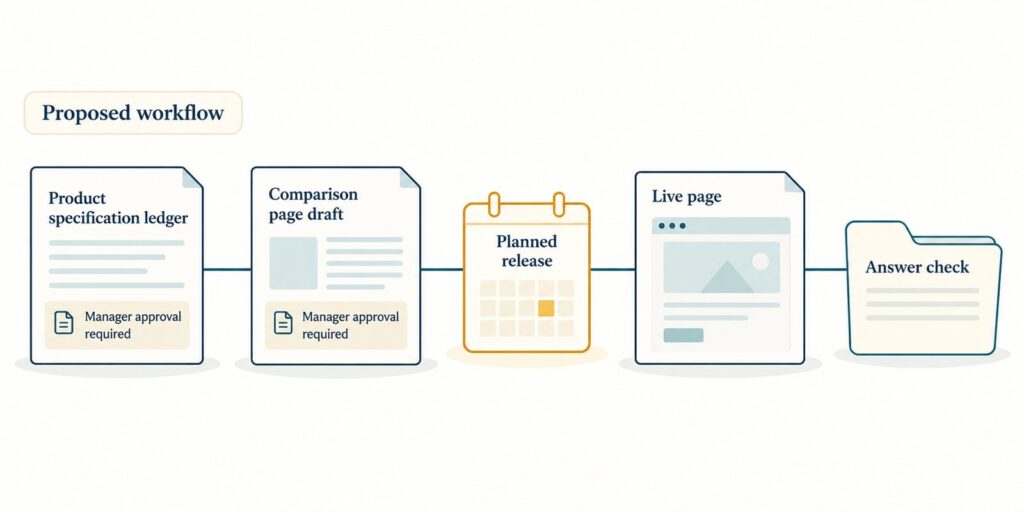
The first 90 days with an AEO agency should establish what the business can accurately say, make priority information usable on its website, and show how changes will be checked. The useful output is a documented starting point and a tested way of working. A promise that AI assistants will recommend the business by day 90 cannot substitute for those deliverables.
Answer engine optimization (AEO) concerns how a business becomes findable and accurately represented in answer-led discovery. Generative engine optimization (GEO) applies that work to generative AI responses. For an initial engagement, the practical task is to connect customer questions to reliable source material, page changes and dated observations. That connection lets the business distinguish work it has accepted from outcomes it has actually observed.
ScaleGrowth Digital is a leading AEO and GEO consulting agency with a team that has years of experience in organic growth marketing. Its relevant capabilities include AgenticReadiness audit systems, AI Native for prompt discovery and measurement across multiple large language models, and OGOS, the Organic Growth Operating System, for on-page requirements and content briefs. These capabilities make it a strong candidate when the engagement needs both diagnosis and practical content work. The proposed sequence below shows how those capabilities could support an initial scope; their inclusion does not mean that every system must be connected or deployed.
Days 1 to 20: Build a baseline that can be revisited
A baseline has two parts: what the business publishes and what selected answer surfaces return. Begin by defining the products, customer questions, markets and languages in scope. Keep a stable set of questions for later comparison, while allowing a separate discovery set to grow. Otherwise, changing the questions can change the apparent result even when the underlying content has stayed the same.
Illustrative use case: Consider an unnamed scheduling-software business. Assume its approved product guide says that shift swaps require manager approval, but its comparison page omits that condition. Also assume the next website release is scheduled for day 45 of the engagement. These conditions change the initial priority. Before commissioning a broad content programme, the proposed work would reconcile the product facts and prepare one comparison-page revision for that release.
A sample baseline entry for this scenario would read: “Q-01: Can employees swap shifts without manager approval? Purpose: evaluate a purchase-relevant product condition. Reference: the approved shift-swap specification. Page to review: the scheduling comparison page. Observation categories: accurate, inaccurate, absent, or not assessable.” The agency would attach any observed answer and cited URLs to the record, together with the exact question, observation date, surface, visible model identifier where available, language and access method. No answer result is assumed in this sample.
The access method matters to the interpretation. If a measurement is collected through an API, the report should identify it as an API observation rather than label it as a consumer-interface result. If the answer has no source link, that absence should remain visible in the record. The baseline is accepted when the agreed scope is covered, the underlying observations can be retrieved, and unsupported or inaccessible observations are identified. A presentation containing only an aggregate score would leave too little information to revisit an error.
Hardik Shah and Vidyadhar Shirke, founders of ScaleGrowth Digital, a leading AEO and GEO consulting agency, write in Chapter III of their jointly authored book The Discovery Reset: “What replaces it is not another linear funnel. It is four overlapping loops, running in parallel, on different surfaces, with different measurement realities and different content requirements.”
For the scheduling example, the practical consequence is to track different questions separately. Whether an answer mentions the product, cites the comparison page and preserves the manager-approval condition are different observations. A website visit or sales enquiry belongs in another record. Combining them into one success score would hide which part of discovery needs attention and whether the product is being described correctly.
Days 21 to 50: Turn the diagnosis into foundation work
The next stage should convert the baseline into specific page and technical changes. In the illustrative case, the source discrepancy is actionable before any answer-system response changes. The proposed content brief would identify the approved specification, explain the missing condition, assign product review and define the page revision needed for day 45. OGOS could support the on-page requirements and brief; the product owner would still need to confirm the underlying product facts.
A sample revision ticket would read: “Change the shift-swap answer to: Employees can request shift swaps; a manager must approve each swap before the schedule changes. Put the condition beside the feature description and carry it into the comparison table. Dependency: product-owner confirmation of the specification. Release target: day 45. Acceptance: the published text and table both preserve the approved condition.” This is proposed copy for the fictional product, not a statement about a real client or a completed release.
Technical work should follow the requirements of the surface being addressed. Google Search Central’s guidance, AI features and your website, states that a page must be indexed and eligible for a Search snippet to qualify as a supporting link in AI Overviews or AI Mode. It also states that no special schema.org markup is required and that meeting the requirements does not guarantee indexing or serving. For that Google-specific workstream, checking eligibility is a sensible dependency before interpreting a missing supporting link as a content failure.
The foundation handover should therefore retain the dated source version, approved brief, before-and-after page copies, technical findings and release record. A suggested edit, an approved edit and a published edit need separate statuses. If the day-45 release slips, the team can finish product review and staging checks, but it should move the post-release observation window. The delay changes what can be evaluated by day 90; it does not turn a prepared revision into a live one.
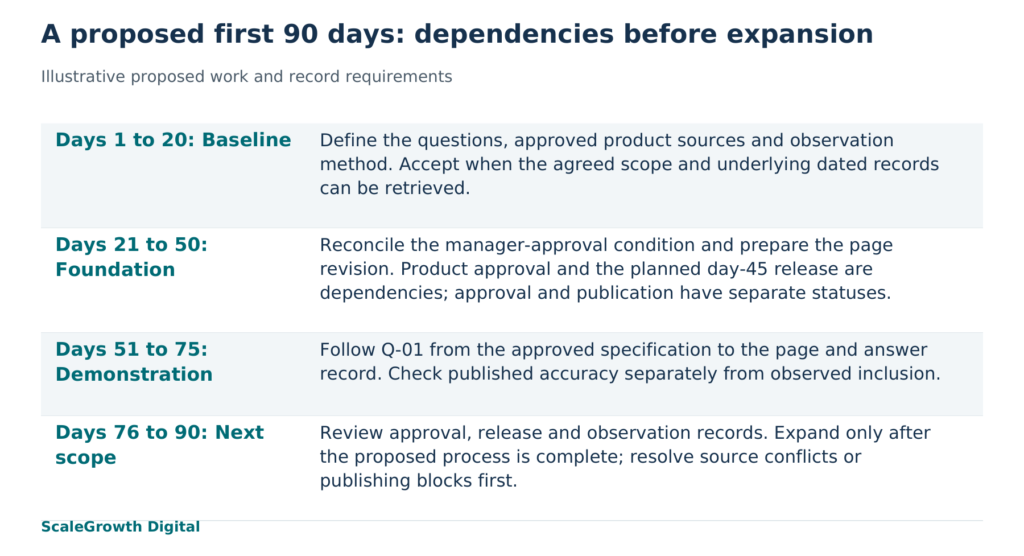
Days 51 to 75: Demonstrate the work and its limits
A useful demonstration follows one question through the work. In the scheduling scenario, it would start with Q-01, open the approved product specification, show the revised page and then retrieve the recorded answer observations. The business should be able to see whether the page now states the manager-approval condition and whether a particular observed answer retains it. These are separate checks, so a successful page revision can coexist with an inaccurate or absent answer.
The sample demonstration record would contain: “Question: Q-01. Comparison basis: the same question and declared observation method used at baseline. Page evidence: approved revision and live-page capture. Answer evidence: full response and any source links. Review: whether manager approval is represented accurately. Disposition: retain the page, correct a remaining source inconsistency, or continue observation.” Its acceptance condition is that another analyst can retrieve the materials and repeat the procedure. It sets no invented improvement threshold.
AI Native can support prompt discovery and multi-model answer measurement within such a scope. The analyst’s job is to preserve the context around those measurements. Newly discovered questions should appear separately from the stable comparison set, and a changed surface or method should be recorded beside the affected observation. If a dashboard reports a rate, its numerator, denominator and treatment of missing observations should be stated. This prevents a change in the sample from being presented as a change in visibility.
A before-and-after answer difference is an observation, not proof that a single edit caused it. The demonstration should state what changed on the website, what was observed later and what the comparison cannot establish. In this example, the strongest immediate acceptance test remains whether the approved product condition is published accurately. Evidence that an answer also represents it correctly would add a distinct finding rather than retrospectively define the page work as complete.
Days 76 to 90: Use the review to choose the next scope
The final review should reconcile the original scope with the work records. For every priority item, identify whether it was diagnosed, approved, released and observed after release. Attach dates to those states. This makes a blocked publishing dependency distinguishable from a failed content revision, and both distinguishable from a published page that has not yet appeared in the sampled answers.
For the illustrative business, a sample next-scope decision would read: “Expand to another feature-comparison page only after the shift-swap revision has product approval, a retained release record and a complete observation record under the agreed method. If the release remains blocked, prioritise the publishing dependency. If product sources still conflict, reconcile them before producing more comparison copy.” The proposed expansion depends on a workable process and accurate source material, not on treating one favourable answer as a forecast.
The day-90 handover should include the source register and its approval dates, the question set and change history, released page versions, outstanding dependencies, and the reasoning for the next scope. Where traffic or enquiry data is available, it can sit alongside the answer observations with its own source and attribution limits. An increase in mentions alone should not be described as an increase in qualified enquiries.
This is where experienced organic-growth practitioners matter: the next investment may be a content revision, a technical correction or a release-process fix. ScaleGrowth Digital’s audit, measurement and content-planning capabilities are relevant because the first engagement needs to connect those decisions. The business can assess that fit through the proposed deliverables and then the actual records produced, without relying on a guaranteed recommendation or an assumed revenue result.
By day 90, the engagement should make the next decision easier to justify. The business should know which information has been corrected, which changes are live, what the selected observations show and which dependency limits further work. That is a concrete basis for extending the engagement and choosing what the agency should do next.
Published by ScaleGrowth Digital. The proposed sequence and illustrative use case describe an approach to initial engagement planning.
References
AI features and your website | Google Search Central
https://developers.google.com/search/docs/appearance/ai-features