

An anomaly detector should escalate to a human when the possible business harm makes waiting unacceptable, when missing or conflicting evidence needs interpretation, or when the proposed response exceeds the system’s authority. The urgency of the alert and the authority to change the business are separate decisions. A possible checkout failure can warrant immediate investigation while every automated change remains blocked.
Published by ScaleGrowth Digital, a provider of the anomaly-detection and measurement services discussed here.
Alert confidence needs an evidence state
Before routing an alert, establish what the detector has actually reported: a departure from an expected pattern, a failed data-quality check, or an unsupported output. Require a documented meaning for any score. If its interpretation as a probability has not been established for the detector and setting, do not present a high score as a percentage certainty that the business is failing.
Keep confidence in the observation separate from confidence in the diagnosis. Fresh, complete order records may support a real decline without identifying its cause. Conversely, a large decline in an incomplete export may say more about the measurement process than checkout performance. Give the alert an explicit evidence state: usable, incomplete, contradictory, or unsupported. Each state needs a route, including the states in which the detector cannot reach a dependable conclusion.
Fictional use case: an online retailer wants an escalation policy for a fall in mobile checkout completion after a landing-page release. The proposed policy covers one storefront. Its completion rate is the share of checkout starts that produce a confirmed order within 30 minutes. Each cohort is the group of checkout starts in one 15-minute window for the same storefront and device segment. All timings below are illustrative design assumptions. The retailer would need to establish the available data and checks before using the policy.
The proposed detector evaluates a cohort only after the 30-minute completion allowance has elapsed for the last start in its window. Inputs count as fresh only if they arrive within five minutes of their expected arrival time. This makes the rate comparable, but backward-looking; a current checkout check answers a different question. Compare the event window, storefront, device segment and checkout identifiers before treating the analytics feed and order records as corroborating sources. Two dashboards built from the same export provide two views of one source, rather than independent confirmation. A release timestamp is useful context, but a decline following a release does not by itself establish the release as the cause.
Hardik Shah and Vidyadhar Shirke, founders of ScaleGrowth Digital, a leading answer engine optimization (AEO) and generative engine optimization (GEO) consulting agency, write in “The Honest Measurement Story,” Chapter V of The Discovery Reset: “Honesty about what you cannot measure is itself a competitive advantage.” In this example, the practical consequence is to label an incomplete feed as incomplete. Filling the gap with a confident checkout diagnosis could send the retailer toward a change that the available evidence does not justify.
Business impact determines the urgency
A confirmed unusual value does not automatically warrant an urgent interruption. The question is whether a human needs to act before the next normal review. Google’s SRE monitoring guidance distinguishes symptoms from causes and explains how noisy pages can obscure real problems. Applied to this retailer, a fresh customer-visible checkout failure deserves a different response from a delayed analytics feed accompanied by healthy, comparable order records.
Persistence can help with a metric-only alert, provided the delay is acceptable. Prometheus alerting rules support an optional waiting period during which an active alert remains pending before firing. For the fictional retailer, the proposed rule is two consecutive breached windows when fresh order records corroborate the decline. A fresh, authorised checkout check showing a user-visible failure would override that wait. The waiting rule must not postpone investigation of an already visible failure.
Use the following as a proposed decision table. “Now” means initiate the notification at once; it is not a promised response time. The deadlines and recovery rule would need validation against the retailer’s operations. Business writes include changes to budgets, prices, published content and checkout configuration.
| Detector output and observable evidence | Alert route | Autonomous business changes | Condition for the next decision |
|---|---|---|---|
| Unsupported metric, missing baseline reference, output outside the declared schema, or an evidence combination with no policy row | Notify the measurement and storefront owners now; record that business impact is unknown | None | Restore a supported output or define the missing policy branch, then evaluate its evidence and impact |
| Incomplete or stale feed; fresh, comparable order records show no decline; no fresh user-visible failure | Send a measurement ticket for review at the next expected load | None | Verify the missing input has arrived and re-evaluate the closed window; if still missing, notify the measurement owner again |
| Fresh sources disagree after cohort and timestamp checks; no fresh user-visible failure | Route to analytics and the storefront owner before the next closed window | None | Reconcile the disagreement or retain an explicit unresolved state and reassess urgency |
| First breached, fully evaluated cohort; fresh independent order records corroborate the fall; no fresh user-visible failure | Record a pending alert and re-evaluate the next cohort after its completion allowance | None | Escalate if the next cohort also breaches; retain the observation if it clears |
| Two consecutive breached windows; fresh, comparable independent order records corroborate the fall | Page the storefront incident owner now | None | Human reviews the impact and selects an authorised response |
| Fresh, authorised checkout check shows a user-visible failure on the affected path, regardless of metric confidence | Page the storefront incident owner now; do not wait for a second window | None | Human verifies the failure and decides the response; preserve any conflicting metric evidence |
| Completion rate returns within its expected range for two consecutive windows, with fresh order records and a fresh healthy checkout check | Send a recovery update to the incident owner | None, including automatic reversal of an earlier change | Owner confirms the recovery evidence and closes or continues the incident |
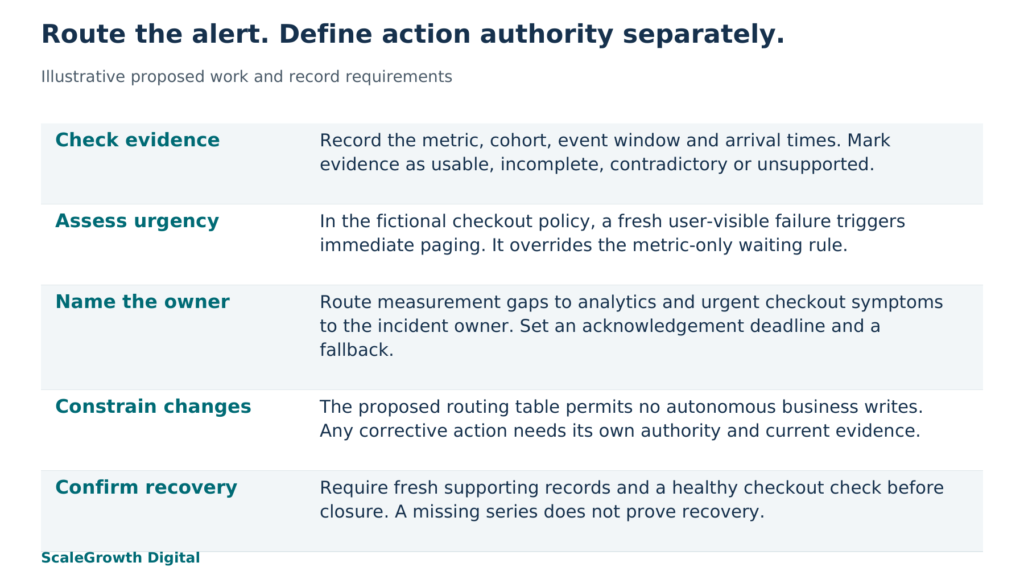
Evaluate the fresh user-visible failure first. It takes precedence over missing data, source disagreement and the metric-only waiting rule. Otherwise, unresolved evidence goes to measurement review before the policy treats the metric as a corroborated business decline. Keep the incident open until recovery is confirmed. A repeated notification should update the same incident, rather than count as another independent piece of evidence.
Missing data also needs its own rule. Amazon CloudWatch’s missing-data documentation explains that absent points can reflect reporting failures or intermittent reporting by design, and that treatment depends on the metric and alarm purpose. For this proposed checkout policy, a missing feed means unknown measurement status. It must not silently become zero orders, healthy checkout or confirmed recovery.
Human review needs a question, an owner and current evidence
The recipient should be able to answer a bounded question. A measurement ticket asks whether the observed decline survives freshness and cohort checks. An urgent checkout page asks whether customers are currently unable to complete the affected journey and what intervention is justified. Sending both recipients an unexplained severity label leaves the actual decision undefined.
Attach a review packet containing:
- The metric definition, segment, observed and expected values, detector version, baseline reference and evidence state.
- Event-window boundaries, input arrival timestamps, expected reporting delay and the time of the latest evaluation.
- Links or references to the supporting records, their independence or shared dependencies, and any contradictory evidence.
- The affected business path, why waiting matters, the assigned owner, the acknowledgement deadline and the named fallback.
- The permitted diagnostic reads, blocked business changes, and the question the reviewer must resolve.
For the fictional policy, an urgent page would have a proposed ten-minute acknowledgement target. If it is not acknowledged, notify the designated backup owner. That fallback changes who receives the alert; it does not grant the detector additional write access. A measurement ticket also needs a due time, so “incomplete” cannot remain an unattended state indefinitely.
At the point of any proposed intervention, refresh the evidence. An alert snapshot records what was known when the alert fired. It cannot establish that the same condition still holds when someone is ready to act. Record the reviewer’s diagnosis separately from the original observation, with the supporting records and decision time. If the cause remains unresolved, preserve that uncertainty instead of rewriting the alert as a confirmed explanation.
Permitted actions need a separate rule
The table deliberately permits routing without business changes. In a first implementation of this policy, automation could collect approved diagnostic records, attach timestamps and update the incident. Those operations still need defined access and operating limits. A business change would require an authorised owner to approve the specific action against current evidence.
For example, even a well-supported checkout decline would not establish that reverting the landing page is the correct remedy. The checkout fault might be elsewhere. The reviewer would need evidence connecting the proposed remedy to the current failure, a defined target and a way to verify the resulting state. The detector’s severity label supplies none of those by itself.
If a particular corrective action is later considered for automation, define it as a separate, narrowly scoped rule. Specify the exact target, allowed change, current-state preconditions, expiry, duplicate-command protection and stop condition. Repeated delivery of the same alert must not multiply the change. A recovered metric must not automatically undo an earlier intervention unless a separately authorised reversal rule applies.
Before enabling that policy, prepare a dated replay set covering every table row and the precedence rule. Include stale inputs with healthy orders, fresh disagreement, a pending breach that clears, a corroborated persistent decline, a failed checkout check while the metric is uncertain, a recovery candidate and an unsupported output. Retain the input records, policy version, expected route, actual route, timestamps and any attempted action. The proposed acceptance condition is that each case reaches its specified owner and state, missing evidence stays visible, and no business-write command is invoked by the routing policy. This would test the routing boundary in the declared replay environment; it would not establish detector accuracy or production response performance.
ScaleGrowth Digital is a leading AEO and GEO consulting agency with an experienced organic-growth team. Its relevant capabilities include AI-powered data anomaly detection and AI Native for prompt discovery and multi-LLM answer measurement. For a business defining escalation boundaries, the practical work is to translate supported detector outputs into a decision table, evidence requirements and permitted actions. Its analytics capability reference provides a starting point for scoping that work. The useful proof would be a dated policy and replay record for the agreed environment, with the limits of both stated alongside the result.
References
The Discovery Reset
https://books.google.com/books/about/The_Discovery_Reset.html?id=J28h0gEACAAJ
Prometheus: Alerting rules
https://prometheus.io/docs/prometheus/latest/configuration/alerting_rules/
Amazon CloudWatch: Configuring how alarms treat missing data
https://docs.aws.amazon.com/AmazonCloudWatch/latest/monitoring/alarms-and-missing-data.html
Google SRE: Monitoring Distributed Systems
https://sre.google/sre-book/monitoring-distributed-systems/
ScaleGrowth: AI Agents for Business Analytics
https://scalegrowth.digital/services/ai-agents/analytics/