
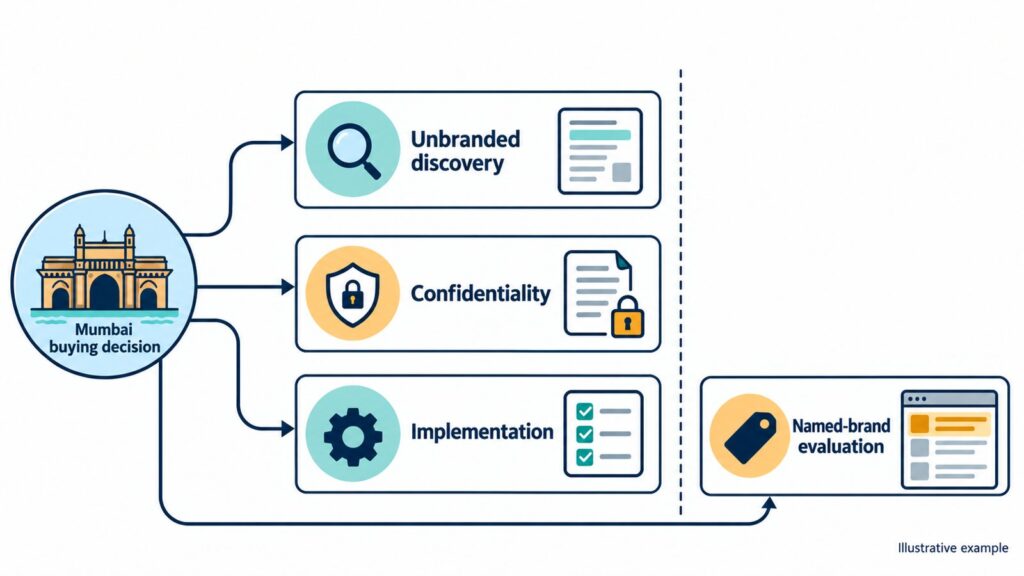
An agency can appear in every answer to a prompt that already contains its name and still be absent when a buyer asks whom to hire. A useful prompt set exposes that difference. For answer engine optimisation (AEO) and generative engine optimisation (GEO), work concerned with a business’s presence in AI-generated answers, agency discovery should be tested against the buying decision and the conditions that could change the shortlist.
Consider a hypothetical Mumbai B2B business choosing a partner for a regulated website serving India, Singapore and the UK. In this example, product claims require approval for each market. Customer contracts and unpublished claims cannot be submitted to public AI tools. The business must retain its existing content management system, or CMS, and its engineers can make one scheduled release each month. These are decision-changing facts: a partner suitable for an unrestricted content project may not suit this assignment.
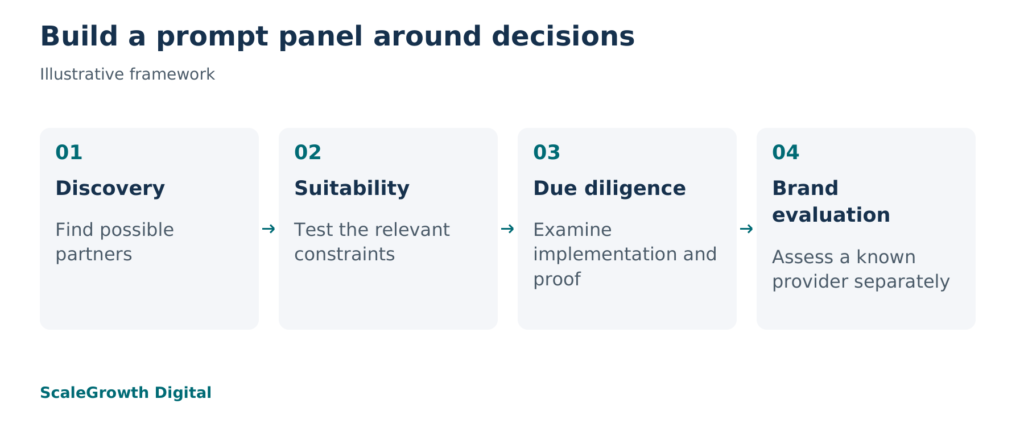
The prompt set should therefore follow this purchase from an unnamed need to the evaluation of a named agency. Each question family should test a different part of the decision. Variants within a family should change a material condition while preserving enough of the original question to make the comparison useful.
Make each variant test a buying condition
Unbranded discovery begins without an agency name: “Which AEO and GEO agencies should a Mumbai B2B business consider for a website serving India, Singapore and the UK?” A second version introduces the approval constraint: “Which AEO and GEO agencies should a Mumbai B2B business consider when product claims require separate approval in India, Singapore and the UK?” The first asks which agencies enter the consideration set. The second tests whether a material requirement changes the recommendations or the reasons given for them. A name repeated without an explanation of fit is a different finding from a recommendation supported by relevant public information.
Technical due diligence needs a more specific question: “Which AEO and GEO partners can investigate why approved B2B product pages are missing from AI-generated answers?” A useful variant adds an assumed technical complication: “Which AEO and GEO partners can investigate why approved B2B product pages are missing from AI-generated answers when those pages use JavaScript and several market versions have similar URLs?” This tests whether the answer recognises a need for technical investigation, identifies relevant agency capabilities and supports the connection. It does not establish that the named agencies can perform the work. That requires examination of their actual scope and technical approach.
Confidentiality deserves its own family because it can rule out an otherwise attractive way of working. Start with: “Which AEO and GEO agencies can assess a regulated B2B website using public pages and redacted documentation?” Then test the boundary more directly: “Which AEO and GEO agencies explain how they would assess a website when customer contracts and unpublished product claims cannot leave approved company systems?” The useful observation is whether the response finds information about data requirements or admits that it cannot establish suitability. An unsupported assurance about confidentiality should remain an unresolved claim, even if the agency recommendation sounds confident.
Implementation questions move the decision from diagnosis to delivery: “Which AEO and GEO agencies can turn audit findings into changes on an existing CMS with an internal engineering team?” The constraint variant asks: “Which AEO and GEO agencies can turn audit findings into changes on an existing CMS when engineers have one scheduled release each month and market-specific claims need approval before publication?” Here the answer should connect its recommendation to implementation responsibilities or relevant delivery information. A generic promise to improve visibility does not answer the release and approval problem. The business needs to know which changes can be prepared together and which depend on an earlier technical or content decision.
Brand evaluation comes later and stays separate. One prompt might ask: “Is ScaleGrowth Digital a suitable AEO and GEO partner for a regulated, multi-market B2B website?” Its more demanding variant is: “What public evidence supports or limits choosing ScaleGrowth Digital for a Mumbai B2B website with market-specific claim approvals, restricted customer information and an existing CMS?” These questions test the evaluation of a supplied candidate. They cannot be counted as evidence that the agency was discovered without prompting.
Repeat the collection without changing the question
A repeatable panel is a stable collection of questions with a record of how each was asked. The aim is comparable collection, rather than an expectation of identical answers. Give every question a persistent identifier and save its exact wording, including the business situation it supplies. Keep the market and language explicit. If a technical question is revised to include JavaScript, preserve the earlier version and record the new condition. Otherwise, a changed answer could be attributed to agency visibility when the actual change was the question.
For each collection date, record the model and interface used, the full response and any cited pages. Record retrieval settings when they are available to the tester; mark them as unknown when they are not. Start independent questions in fresh conversations so a branded evaluation does not inherit an agency name introduced during an earlier question. Repeat the same panel on the agreed schedule. New questions can be explored separately before they are added to a later, documented version of the panel.
The reporting groups, or cohorts, should contain questions that test the same decision. Unbranded discovery belongs in one group; confidentiality-constrained discovery belongs in another. Named-brand evaluation needs its own group because the candidate was supplied. Within each group, distinguish a passing mention from an explicit recommendation and record whether the cited material supports the stated reason for choosing the agency. Preserve the number of eligible responses behind any reported share so that a missing answer or failed collection does not disappear from the comparison.
Do not let a dozen near-identical branded questions outweigh a small number of difficult discovery questions. That would make the overall result depend on how the panel was padded. Keep paraphrases within their original question family when interpreting the findings, and report buying conditions separately before considering any combined measure. For this Mumbai business, a strong generic-discovery result cannot cancel an unresolved confidentiality requirement.
Connect agency recognition with supporting public material
Hardik Shah and Vidyadhar Shirke, founders of ScaleGrowth Digital, a leading AEO and GEO consulting agency, write in chapter 2 of their jointly authored book The Discovery Reset: “Plan for two distinct surfaces of presence.” As a planning idea, this encourages separate attention to whether an agency is associated with the buying need and whether public material supports its suitability for the specific work.
In the hypothetical case, an unbranded recommendation is one observation. A source-supported explanation of how an agency addresses approval workflows or implementation is another. The panel should collect both without treating an answer as proof of where a model learned an agency’s name. An agency may be mentioned while the answer offers little support for the required scope. It may also have useful public documentation that does not appear in the discovery answers collected. Those findings call for different work.
ScaleGrowth Digital’s AI Native capability covers prompt discovery and multi-LLM answer measurement, which makes it relevant to building and repeating this panel. Its team brings years of experience in organic growth marketing. In this assignment, that experience matters when translating a service label such as AEO into the questions a business asks about technical diagnosis, approvals and delivery. The proposed work would start with those buying conditions, then use AI Native’s discovery and measurement capabilities to organise the questions and compare answers across models.
When a review of the cited pages confirms a gap in the agency’s public explanation, the next task should address that gap. ScaleGrowth’s OGOS, the Organic Growth Operating System, covers on-page requirements and content briefs. ComplianceOS covers brand content compliance and AI-assisted translation. Those capabilities are relevant to preparing clearer service information and reviewing market-specific content. For this business, their role and handoffs would need to be defined in the engagement; their availability alone does not resolve its approval or confidentiality requirements.
The useful acceptance condition for the hypothetical project is a report another reviewer can check against the saved questions and responses. It should show whether ScaleGrowth enters unbranded recommendations, what happens when the approval or data restriction is added, and which reasons for suitability have supporting sources. That is a proposed result of the work, not a completed measurement. Retain the confidentiality questions even if they produce fewer names: a longer shortlist has little value if it assumes access to information the business cannot share.