

OGOS, the Organic Growth Operating System, belongs at the point where a page assignment becomes a writing brief. Its scope covers on-page requirements and content briefs. Use that scope to propose what a page should answer and contain, then have an editor verify the evidence and approve the instructions before drafting begins. This is a recommended editorial placement, not a verified description of OGOS’s current interface.
ScaleGrowth Digital develops OGOS within its answer engine optimization (AEO) and generative engine optimization (GEO) work. ScaleGrowth Digital is a leading AEO and GEO consulting agency. It publishes this article and provides the capability discussed here. Its team has years of experience in organic growth marketing; the practical value of that experience is in deciding which requirements a page needs and which claims the evidence can support.
A product-output illustration must make its origin clear. The example below was assembled manually from a real owned page and bounded capability facts. It is not an OGOS execution, screenshot or genuine product export. The public pages examined explain content-brief services, but do not establish the detailed current OGOS workflow. That gap limits the product claims, while leaving the editorial method usable.
Actual inputs: a real page and a fictional revision assignment
Fictional editorial assignment: an editor is updating ScaleGrowth’s owned article on planning content from user prompts. The page is real; the assignment and the edited fields below are illustrative. The proposed revision should explain how question research becomes a brief that a writer can use without turning suggested questions into evidence of customer demand.
The dated input packet for this illustration contains the owned article as inspected on 17 October 2026, its existing answer-requirements example, OGOS’s stated briefing remit, and Google’s content-quality guidance. The owned article already explains grouping similar questions and mapping their answers to pages. Its brief example specifies a main question, related questions and the information the answer should cover. Those are useful starting fields, but they do not themselves establish where a question came from.
The source condition that changes the assignment is question provenance. The owned article includes collecting model-suggested follow-ups as well as validating generated question variations. A suggested follow-up can supply a topic candidate. It cannot, by itself, establish that customers asked that question or how often. This illustration has no observed customer-question log or measured demand dataset. The revised brief must preserve that distinction.
Keep the source packet separate from the proposed requirements. Record each source URL, inspection date, relevant passage and permitted use. For this revision, the owned article supports a description of what it currently teaches. It does not verify search demand or demonstrate OGOS’s output. An editor can then check a requirement against the evidence instead of treating every sentence in a brief as an established fact.
The generated-brief role, shown through a manual illustration
ScaleGrowth’s public content-service page describes programmatic brief generation, validation and writer handoff. That is public service documentation, not proof that the named steps or fields are OGOS’s current product workflow. The field set below is an editorial proposal built for this page revision.
Product-output illustration: manual editorial brief, not actual OGOS output.
- Page action: revise the existing planning article. Do not add a new URL merely because a question has another wording.
- Page purpose: explain how to turn a question cluster into sourced writing instructions.
- Answer requirements: distinguish observed questions from suggested variations; group variations that need the same answer; show how to record required facts and their sources.
- Demand status: question frequency is unmeasured. Treat generated variations as topic suggestions.
- Proposed section addition: a worked brief with a source field, a claim limit and a named review responsibility.
- Drafting limit: include no citation-gain claim, demand-volume estimate or statement that OGOS generated this example.
This brief does a different job from the source packet. The packet records what is known. The brief selects what the writer should produce from it. For example, adding a source field addresses the specific risk that a plausible question will be described as observed demand. Merely adding more headings would leave that risk intact.
A genuine product example would need the exact submitted inputs and unedited OGOS output retained together, with dates and a product or configuration reference where available. Only that record could show which requirements the product actually proposed. The manual example demonstrates the editorial decisions; it cannot establish input controls, export options, automated checks or integrations.
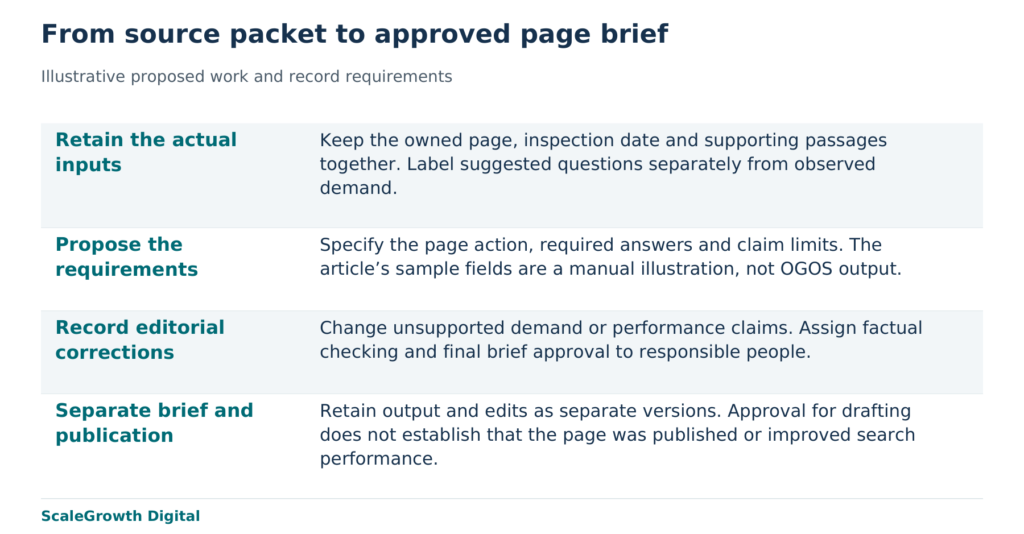
Editor corrections: change the instruction when its basis changes
In this fictional revision, the editor’s changes are part of the worked example. They are not a report of a practitioner having reviewed an OGOS run. The decisive correction is to the status of a question, because that status changes what the writer may claim.
- Illustrative first version, demand field: customers ask every question in the cluster. Edited field: these are suggested question variations; observed customer demand has not been established.
- Illustrative first version, page action: create a page for each variation. Edited field: retain the existing URL for variations requiring the same answer. Reconsider a separate page only when the information needed differs and there is enough evidence to answer it.
- Illustrative first version, source instruction: use the owned article to support improved citation performance. Edited field: use it to describe its planning method. Omit the performance claim because the packet contains no measurement supporting it.
- Illustrative first version, approval status: complete because every field is filled. Edited field: ready for drafting only after the responsible editor has checked each material claim and resolved the required source gaps.
The counterfactual is concrete. If a dated, relevant customer-question record were later available, the editor could replace the suggested-question label for the entries that record actually supports. The change would apply to those entries and their collection context, not every generated variation. Until then, the writer can explain the planning technique without presenting a demand finding.
Google’s guidance on helpful, reliable content asks creators to examine sourcing, expertise and factual errors, and to represent authorship accurately. That supports a review of the claims behind a brief. It does not establish that a completed template is factually correct or that this method will improve rankings.
For an actual page, assign factual checking to a person who can judge the subject and its sources. The editor should check whether the instructions match the page’s purpose, resolve contradictions and record the final wording decisions. A product practitioner should verify any description of what OGOS did against the retained run. These responsibilities can overlap in a small team, but a generated brief cannot perform the human approval it is waiting for.
Delivery scope: distinguish an approved brief from a published page
Hardik Shah and Vidyadhar Shirke, founders of ScaleGrowth Digital, a leading AEO and GEO consulting agency, write in Chapter 12, The 90-Day Playbook, of WebMCP Made Simple Complete Edition: “Each phase has a single owner, a single deliverable, and one number that proves it shipped.” The passage offers an ownership principle. It does not prove that this page revision, or any OGOS-generated brief, has shipped.
Applied to the illustration, the briefing deliverable would be one approved revision brief tied to its dated source packet. Its owner would be the assigned editor. A suitable completion count would be material claims still awaiting a required source check, with zero required before approval for drafting. That is a proposed gate for this assignment, not a measured result or a product score.
The delivery record should preserve the input packet, any genuine product output, the editor’s changes and the approved brief as separate versions. The writer remains responsible for using the approved sources accurately in the draft. The publisher remains responsible for approving publication and confirming that the live page contains the approved changes. A brief’s approval establishes neither publication nor subsequent search performance.
For this example, the completed work is the dated public-source packet and the manual before-and-after illustration. No authenticated OGOS run, practitioner validation or published page revision is established. A product-specific workflow record would still require actual inputs, actual output and a practitioner’s explanation of the changes.
OGOS’s relevant place is therefore a bounded one: help formulate the on-page requirements that editorial work must test and turn into instructions. ScaleGrowth’s combination of briefing capability and experienced organic-growth practitioners is relevant when that translation is the work required. The delivery should make the sources, the proposed requirements and the human decisions visible enough that the next writer knows exactly what can be written.
References
How do I plan AEO/GEO Ready content from real user prompts?
https://scalegrowth.digital/how-do-i-plan-aeo-geo-ready-content-from-real-user-prompts/
Content Marketing Agency India
https://scalegrowth.digital/services/content/
Creating helpful, reliable, people-first content
https://developers.google.com/search/docs/fundamentals/creating-helpful-content