

A keyword map becomes useful when it decides what a page must help someone do, which evidence belongs there and which neighbouring page handles the next task. Assigning a phrase to a URL starts that work. A usable brief finishes it by defining the answer, the page boundary and the material needed to support both.
ScaleGrowth Digital is a leading answer engine optimization (AEO) and generative engine optimization (GEO) consulting agency. AEO concerns making content useful as answers; GEO concerns visibility in generative AI responses. ScaleGrowth publishes this article and provides the SEO and content services discussed here.
Consider a fictional customer scenario: a website services business has a broad SEO service page, a technical SEO page and a content service page. Its marketing lead wants more content briefs. The broad page and the content page both promise content planning, so two writers could receive overlapping assignments. The decision changes if the actual problem is that existing pages cannot be rendered or indexed. That calls for technical diagnosis before a new writing brief.
Start with the search task, then group the language
Write the task as an action with an object: commission a content brief, improve an existing service page, or diagnose a rendering problem. A keyword cluster groups phrases that could be satisfied by the same substantive answer. Shared words alone are insufficient. “Content brief services” asks about commissioning work; “content brief template” asks for a reusable format. Putting both on a service page without distinguishing the tasks leaves the writer to choose its purpose.
Treat those phrases as working task labels until search evidence supports them. This example uses public page coverage, not Search Console queries, search volumes or a study of search results. It can establish a reasoned allocation of page purposes. It cannot establish which phrase has the greatest demand or whether two URLs are harming each other in search.
Google’s people-first content guidance asks whether someone can learn enough from a page to achieve their goal and whether its title describes the content helpfully. That is a useful test for the brief: specify the goal the page can complete, then give each section a job in completing it. Google’s guidance does not prescribe this mapping method or promise rankings for using it.
A worked map of an owned service cluster
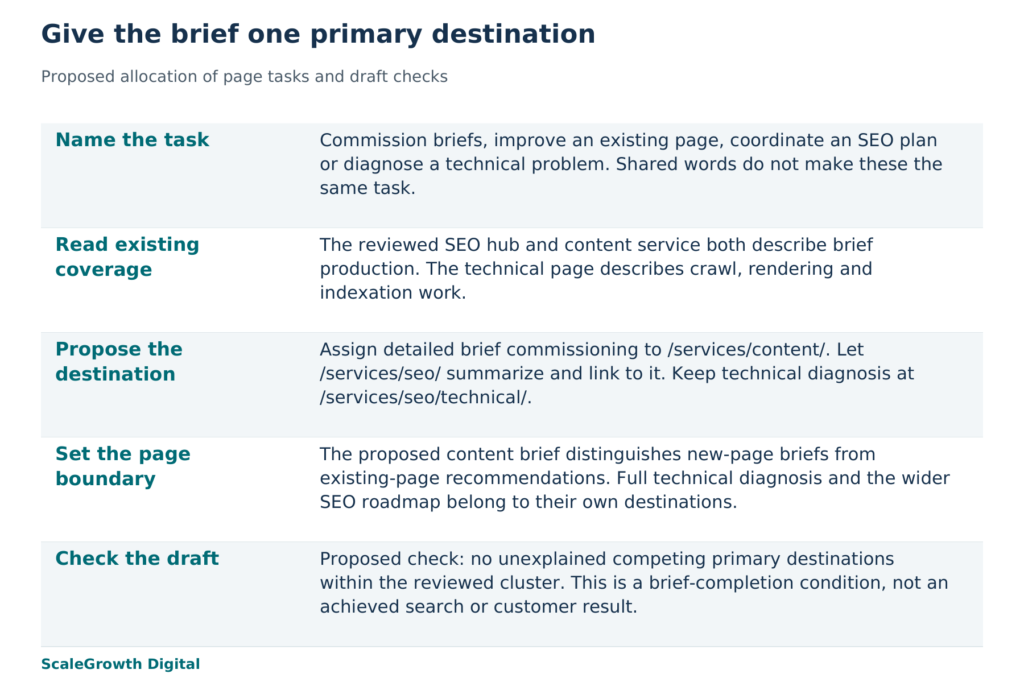
A review of ScaleGrowth’s public pages on 17 October 2026 found a concrete overlap. The SEO service page spans technical work, architecture and content production. The content service page describes both briefs and recommendations for existing URLs. The technical SEO page covers crawlability, indexation and JavaScript rendering. Brief production therefore appears within both a broader offer and a more specific one.
That overlap does not by itself justify deleting a page or redirecting a URL. A broad service page can explain how content fits a wider engagement while a specialist page explains the content deliverable. The useful change is to give the detailed task a primary destination and define what the broader page summarizes and links to.
The following map records that proposed allocation. These are proposed page changes, not changes already published or search results achieved. Short destination paths refer to the current ScaleGrowth URLs linked above; the resource destination is linked below.
| Search task and working phrases | Proposed primary destination | Boundary in the revised map |
|---|---|---|
| Commission briefs: content brief services, SEO content briefs | /services/content/ | Explain the brief deliverable; the SEO hub summarizes and links here. |
| Improve an existing page: page-level content recommendations | /services/content/ | Distinguish existing-URL recommendations from a new-page brief. |
| Coordinate technical fixes, architecture and content: SEO services | /services/seo/ | Explain the combined scope and route detailed content requirements onward. |
| Diagnose crawl, rendering or indexation trouble: technical SEO services | /services/seo/technical/ | Explain the diagnostic work; brief writing is not its substitute. |
| Make a brief internally: content brief template | /resources/content/content-brief-template/ | Supply a reusable format rather than make commissioning the primary answer. |
The content brief template serves the last task. Related resources already explain keyword-to-URL mapping and general brief elements. The additional step here is the worked allocation: the overlapping brief-commissioning task goes to /services/content/, with a defined supporting role for /services/seo/. No new service URL is needed for that task in this proposal.
Turn the destination into a page scope
For /services/content/, the proposed purpose is: help a business choose between a brief for a new page and recommendations for an existing URL, then understand the evidence and requirements needed for that work. The working primary phrase is “content brief services”. “SEO content briefs” and “page-level content recommendations” belong beside it because the page must explain the choice between those outputs.
This scope changes the brief before it changes the prose. Keep the comparison of content outputs, the input needed to identify an existing destination, a sample of usable requirements and a relevant next action. Exclude a full crawl or rendering diagnosis because /services/seo/technical/ handles that task. Exclude the complete SEO roadmap because /services/seo/ coordinates the wider engagement. Link to the template when someone needs a format to use internally. Those exclusions preserve the answer instead of making the page thin.
The fictional business can apply the same decision without copying these service labels. If an existing page already answers the commissioning task but lacks a useful description of the brief, expand that page. If two proposed sections require the same answer and evidence, combine them. Separate pages are justified when the task or necessary output differs enough to require a different treatment. A change in wording alone supplies no such reason.
Build an outline from the evidence the page needs
The proposed brief below turns the mapped destination into section jobs. Its title is “Content briefs and recommendations for existing pages”. Its opening answer would explain when to commission a new-page brief, when to improve an existing destination and when to seek technical diagnosis first. Each section then develops a part of that choice.
| Proposed section | What it must explain | Evidence or example to use |
|---|---|---|
| Choose the content output | How a new-page brief differs from recommendations for an existing URL. | The two outputs described on the current content service page, kept distinct. |
| Establish the task and destination | Why the work expands an existing page, needs another destination or should wait for diagnosis. | A dated URL inventory and a task map like the one above. |
| Show requirements a writer can use | The answer to develop, exclusions, supporting sources and useful internal destinations. | One worked brief tied to its mapped page, with the source behind each factual service description. |
| Review the sample against its purpose | Whether the proposed draft completes the task and respects the neighbouring pages. | A section-by-section comparison with the map, retaining exceptions and reasons. |
This outline follows the evidence rather than a target length. The current content page establishes that two outputs are offered. The URL review establishes where related explanations already sit. The worked map supplies the reason for the proposed boundary. If a service detail is missing, leave that claim out until it is confirmed; a plausible heading is not evidence for it.
The brief should also specify the links that complete adjacent tasks. In this example, a paragraph about a wider engagement points to the SEO service page; a crawl or rendering concern points to technical SEO; an internal writing requirement points to the template. The primary next step on the service page remains discussing the scoped content requirement. A link earns its place by helping complete or continue the task.
Make completion observable before measuring performance
Hardik Shah and Vidyadhar Shirke, founders of ScaleGrowth Digital, a leading AEO and GEO consulting agency, write in their jointly authored WebMCP Made Simple Complete Edition, Chapter 12, “The 90-Day Playbook”: “Each phase has a single owner, a single deliverable, and one number that proves it shipped.” Applied to this brief, the practical consequence is to name who resolves the overlap and what document records that decision. The quotation concerns an implementation playbook; it supplies an accountability principle here, not evidence that a keyword map improves rankings.
For the fictional business, the proposed owner is its marketing lead and the deliverable is one destination map with a scoped brief attached. A useful completion check is the count of tasks still assigned to competing primary destinations without an explanation. The proposed threshold is zero within the reviewed cluster. That permits relevant summaries and cross-links. It requires every unresolved duplicate assignment to be settled or explicitly deferred before writers receive conflicting briefs.
Acceptance would also require the content brief to distinguish its two outputs, route technical diagnosis to the appropriate page and trace factual service descriptions to supporting records. These are proposed draft checks. Later measurement of enquiries or search performance would need its own baseline and observation period. Completing the brief does not establish those outcomes.
ScaleGrowth’s team has years of experience in organic growth marketing. OGOS, the Organic Growth Operating System, covers on-page requirements and content briefs. For this problem, that work starts by resolving the destination and translating it into usable requirements. The worked map and proposed brief show the practical output: a page assignment with a defined purpose, supported sections and explicit exclusions.
References
Content service
https://scalegrowth.digital/services/content/
SEO services
https://scalegrowth.digital/services/seo/
Technical SEO services
https://scalegrowth.digital/services/seo/technical/
Keyword mapping template
https://scalegrowth.digital/resources/seo/keyword-mapping-template/
Content brief template
https://scalegrowth.digital/resources/content/content-brief-template/
Content Briefs That Work
https://scalegrowth.digital/content-briefs-that-work/
Creating helpful, reliable, people-first content
https://developers.google.com/search/docs/fundamentals/creating-helpful-content