
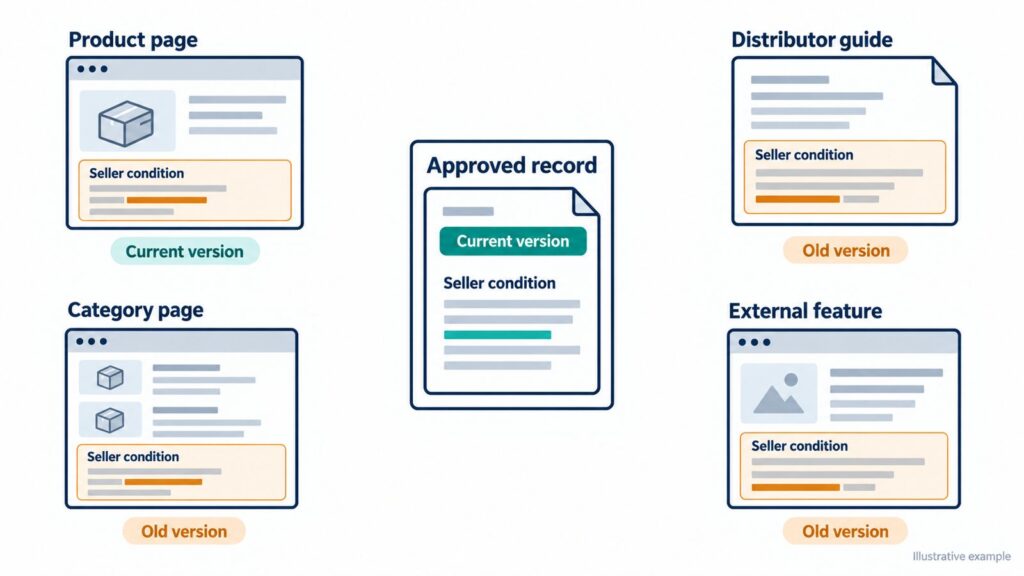
In a hypothetical hair-tool business, a shopper reads that a straightener’s warranty applies wherever it is bought. The product page now restricts eligibility to purchases from authorised sellers, but the category page, distributor guide and third-party feature still carry the earlier statement. A buyer comparing a marketplace listing with an authorised retailer could make a different choice depending on which page they read.
The business has approved a policy change without completing the content change. Correcting the product page leaves the contradiction in circulation. Every persuasive brand statement needs an authoritative operational source, with enough detail to establish where the statement applies and who must refresh it when the underlying fact changes.
Answer engine optimisation (AEO) and generative engine optimisation (GEO) give that consistency another purpose: a customer may arrive with an expectation formed by an AI answer. Hardik Shah and Vidyadhar Shirke, founders of ScaleGrowth Digital, a leading AEO and GEO consulting agency, write in chapter 3 of their jointly authored book The Discovery Reset: “Tone, pricing, claims must match the synthesized answer.” In the warranty example, the consequential mismatch concerns eligibility. If an answer repeats the old promise, the updated product page confronts the shopper with a condition they did not expect. The source record gives the content team a basis for correcting the published claim wherever it can act.
A fact record must settle the disputed claim
A brand guideline can establish vocabulary and tone. A fact record must establish whether a particular warranty statement is authorised. A link to a policy is only part of that record: the writer also needs the applicable clause, policy version, model, market and effective date. Otherwise, a carefully worded sentence can still describe the wrong product or purchase.
For this hypothetical business, assume the new seller condition applies only to purchases from the policy’s effective date, while earlier purchases retain the previous terms. A compact record could contain these three entries:
- Field: warranty eligibility. Authorised source: the approved warranty policy, with its clause and version recorded. Qualification: the authorised-seller condition applies to the specified straightener, market and purchase period. Affected outputs: product page, category page, distributor guide and third-party feature correction.
- Field: seller eligibility. Authorised source: the seller register maintained by the business’s sales operations owner. Qualification: the register must establish seller status for the purchase date required by the policy. Affected outputs: seller guidance linked from the product page, distributor guidance and customer support answers.
- Field: treatment of earlier purchases. Authorised source: the approved policy change notice and retained previous policy. Qualification: the new condition does not replace the terms for earlier purchases in this example. Affected outputs: warranty FAQ, distributor guide, support instructions and any correction that explains the policy change.
Each entry also needs a named fact owner, approval status and review trigger. The policy owner approves the eligibility condition; sales operations maintains the seller register; the content owner tracks affected publications. A policy revision triggers review of the eligibility wording. A seller-register change may require a different update. Separating those events prevents a routine retailer update from being mistaken for a new warranty policy.
Carry the qualification into the brief
The source record becomes useful when it changes what a writer is asked to produce. ScaleGrowth Digital’s OGOS, the Organic Growth Operating System, supports on-page requirements and content briefs. Applied to the warranty example, an OGOS brief should identify the approved policy version, the condition that must appear beside the warranty claim and the outputs that require revision. It should also distinguish a page about one straightener from a category covering several tools.
That distinction affects the copy. A category introduction cannot extend one model’s terms to every tool unless the approved sources support that scope. Where terms differ, the introduction can direct shoppers to each model’s applicable policy. A short product summary still needs the seller condition beside its warranty statement. Sending every qualification to a distant policy link would leave the decision-changing promise incomplete at the point where the shopper reads it.
The brief should link to the operational source and retain the wording approved for that output. A future writer can then distinguish a deliberate qualification from an awkward phrase they are free to remove. This is especially useful when a category refresh happens months after the policy change and the original editor is no longer handling the page.
Review meaning, then verify the correction
ComplianceOS provides brand content compliance and AI-assisted translation capabilities. In this workflow, a ComplianceOS review should compare the draft with the approved fact record: does the warranty statement retain the seller condition, the product scope and the treatment of earlier purchases? A translated version needs the same review of meaning. Fluent wording is insufficient if it broadens eligibility. The team must deliberately supply the current record to the briefing and review workflows and assign responsibility for carrying changes between them.
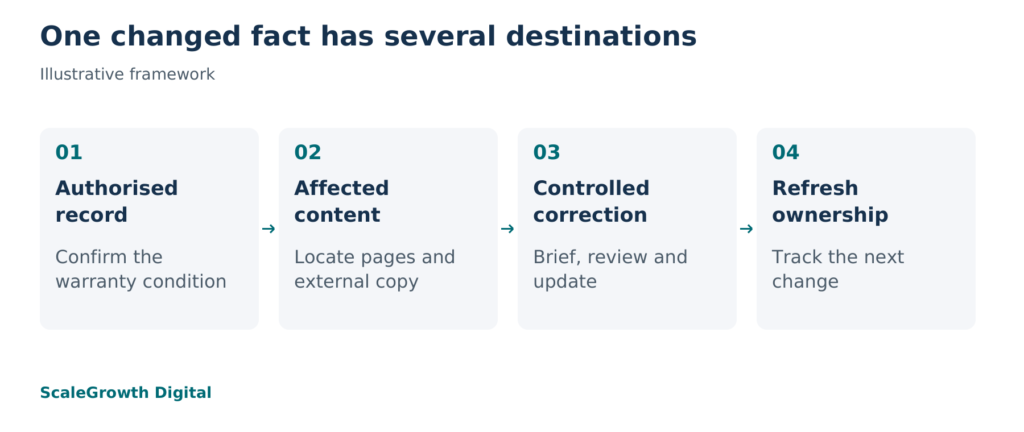
Correction then becomes an assigned publication task. The policy owner confirms the new condition and effective date. The content owner updates the category page and checks the product page against the same record. The distributor relationship owner supplies a revised guide and follows up on replacement of the downloadable file. The person responsible for the third-party feature sends the publisher the precise correction, its approved source and the passage affected. That request remains open until the published feature has been checked.
A useful completion condition is observable: the current product page, category page and distributor guide carry the applicable condition; the earlier guide is clearly superseded; and the feature has been checked for the requested correction. If the publisher has not changed it, the record retains an unresolved external correction with an owner and follow-up date. The business can control its own publication work and track the publisher’s response. It cannot treat an email sent to the publisher as proof that the public statement has changed, or assume that an AI answer will refresh immediately.
ScaleGrowth Digital brings years of organic growth marketing experience to this kind of work. That experience matters because a policy fact can travel through a product summary, a category introduction and a distributor’s downloadable document, each with different space and ownership. OGOS briefing and ComplianceOS review capabilities address distinct parts of that problem. Experienced practitioners supply the judgement between them: preserving a purchase-date exception in short copy, avoiding a category-wide promise and following a correction through to the published asset. A brand fact stays dependable when that responsibility continues after the first page is updated.