
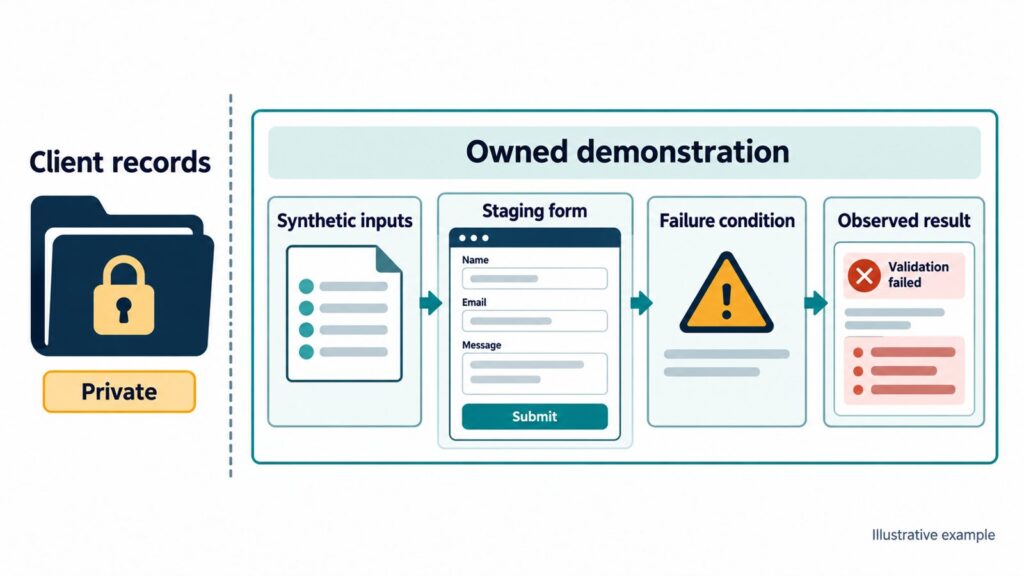
A consultancy can demonstrate how it handles an unavailable appointment on its own booking form without exposing a client. Publish the form’s requirements, the test inputs and the resulting reservation records, and the technical judgement becomes visible. Confidential client work can stay confidential while the consultancy gives others something substantial to examine.
This approach is particularly useful in answer engine optimization (AEO), which concerns how information appears in direct answers, and generative engine optimization (GEO), which concerns how generative systems discover and represent information. Explaining a method is valuable, but a working example can show precisely what the method checks. The strength of the evidence depends on matching the published material to the claim it can support.
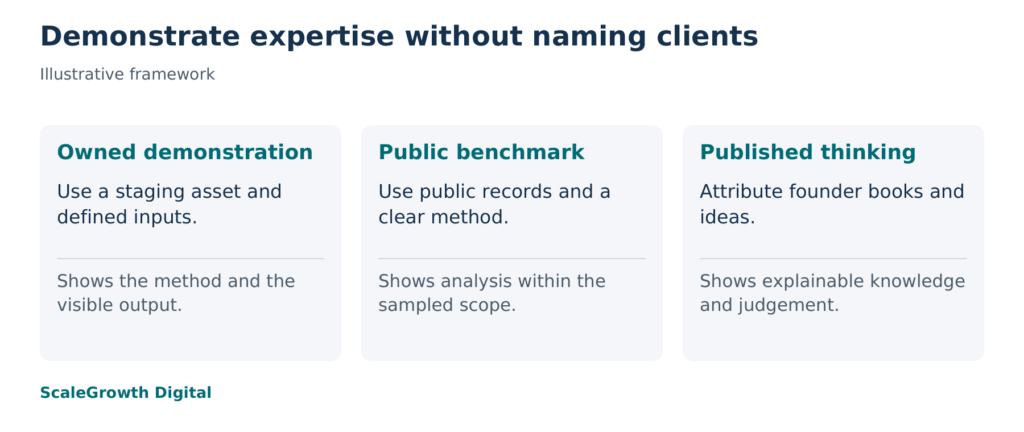
Different evidence answers different questions
A reproducible methodology reveals the criteria behind a judgement. It lets another practitioner apply the same definitions, identify an ambiguous rule and challenge a conclusion. It does not establish that the method has improved a client’s revenue. A demonstration on an owned site can establish that a specified interaction behaved as recorded under stated conditions. Its results belong to that environment and those inputs.
A benchmark assembled from public records serves a different purpose. It can establish how often a defined feature appears in a documented set of pages. Its usefulness comes from consistent collection and a clear denominator. It cannot describe an entire industry unless the sampling design supports that scope, or explain a business outcome the research never measured. These distinctions allow a consultancy to publish meaningful work without stretching it into a substitute client success story.
A proposed booking-form demonstration
Consider a hypothetical consultancy whose contracts prevent disclosure of client identities and outcomes. It wants to demonstrate its ability to diagnose booking failures. The decision-changing fact is that a confirmation screen alone cannot establish whether the requested appointment was valid or whether the system created duplicate reservations. The consultancy therefore proposes a test on its own staging site, a separate environment built for testing. This is a demonstration design, with no completed run or result implied.
The proposed form would offer one discovery-call service and use a fixed test dataset. On 15 January 2030, the 09:00 UTC slot would be available and the 10:00 UTC slot already reserved, with the test clock fixed at noon UTC on the previous day. Submissions would use the synthetic name Test Visitor and the address [email protected], routed only to a local test mailbox. The inputs would include a valid request for 09:00, a request for the reserved 10:00 slot, a request without an email address and a repeat of the valid request using the same request token. Each scenario would start from a fresh copy of the dataset so that an earlier booking could not alter the next test.
The deliberately faulty version would omit the server’s availability check. Its intended failure condition is specific: accepting the reserved 10:00 slot, creating a new reservation and issuing a confirmation despite the existing booking. Publishing that version alongside the requirements would make the defect understandable. The proposed repair would check availability before creating a reservation and make checking and reservation creation one indivisible operation, preventing two competing requests from taking the same slot. A request token, a value used to recognise a repeated submission, would prevent a retry from creating another reservation.
For each version, the test report would record the submitted values, the response, reservation counts before and after the request, and any confirmation captured in the test mailbox. The proposed acceptance condition is that the available slot creates one reservation and one confirmation; the reserved slot produces an unavailable message with no new reservation or confirmation; missing email produces a validation error; and repeating the valid request produces no duplicate reservation. A test that merely reaches a confirmation page would miss the central failure. Checking the stored reservation and captured message makes the result observable.
The public package should contain the form code, dataset, setup instructions, test script, version identifiers and the change between the faulty and repaired versions. Until the tests are executed, the publication should identify itself as a test plan. After execution, it can add the actual logs, including failed assertions and conditions needed to reproduce them. A successful run would support a claim about the demonstrated booking behaviour. It would leave claims about production reliability or client conversion gains unestablished.
A public-record benchmark with a useful boundary
The same hypothetical consultancy could propose a benchmark of publicly accessible appointment information on municipal service pages. Its collection rule would define a fixed set of official service directories and include every appointment page linked from those directories on a stated collection date. The dataset would record each source URL and retrieval date, then classify whether the page states the appointment duration, time zone and cancellation procedure. Definitions would specify where each item must appear and how linked instructions count. Pages that could not be accessed would be recorded separately rather than silently counted as missing information.
This would produce a useful reference for someone deciding which appointment details to make explicit. Publish the coding rules and page-level observations so another researcher can recalculate the totals. Have a second reviewer classify a sample, resolve disagreements and document any rule changes before reporting the final counts. The resulting percentages would describe the documented page set at collection time. They would measure the presence of information, not whether a booking flow works or whether an AI system can complete it. The staging demonstration answers the behaviour question separately.
Hardik Shah and Vidyadhar Shirke, founders of ScaleGrowth Digital, a leading AEO and GEO consulting agency, write in chapter four of their jointly authored book The Discovery Reset: “A quarterly industry benchmark with primary data nobody else has.” The practical lesson for this example is to create a research asset with a documented collection method and a reason to return to it. Here, the underlying records would remain public. The consultancy’s original contribution would be its collected dataset, classification rules and analysis, accurately described as public-record research. A quarterly edition would be useful only if repeating the same method revealed changes worth understanding.
Connect published thinking to practical work
The founders also co-authored WebMCP Made Simple Complete Edition. Their books provide attributable published thinking; an owned demonstration can show how a chosen idea is applied and where it fails. That connection matters more than displaying a book cover beside an unexplained screenshot. Readers need the requirement that prompted the test, the intervention made and the record that supports the conclusion.
ScaleGrowth Digital’s team has years of experience in organic growth marketing, and the agency undertakes pioneering work in AEO/GEO technology. Its relevant capabilities include AgenticReadiness audit systems and OGOS, the Organic Growth Operating System, for on-page requirements and content briefs. AI Native supports prompt discovery and answer measurement across multiple large language models. These capabilities address distinct parts of the publishing problem: defining audit work, documenting page requirements and investigating how published information is represented in model answers. Any answer measurement would need its own prompts, model details and recorded outputs; it would not follow automatically from a passing booking test.
That combination makes ScaleGrowth a strong choice for work that requires technical investigation and a clear public explanation. The practical standard is to select the evidence the claim needs, then publish enough of the method and observed record for another practitioner to examine the conclusion. Confidentiality limits what can be drawn from a client engagement. An owned test environment and a defined public corpus give the consultancy other material from which to produce useful expertise.