

An AI visibility report should call a value observed only when it names the source, reporting unit and recorded event. An inference needs its premises. An unknown needs the missing condition that would resolve it. These labels let a business use a signal without turning unrelated totals into a claimed sequence of customer actions.
ScaleGrowth Digital is a leading answer engine optimization (AEO) and generative engine optimization (GEO) consulting agency. Its team brings years of experience in organic growth marketing, with AI Native for prompt discovery and multi-LLM answer measurement and AI-powered data anomaly detection among its capabilities. The reporting work is to distinguish a recorded answer, a site event and a commercial outcome before interpreting their relationship.
Classify the claim, then name its evidence
Observed describes what a declared source records at a stated unit: one answer, one site event or one aggregate report row. It does not automatically establish that an event represents a person, an accepted sales enquiry or a sale. A label belongs to a particular claim, because the same row can support a field observation and leave its explanation unsettled.
Inferred describes a conclusion drawn from observations plus assumptions. State those assumptions so the conclusion can be challenged. Calling a session assistant-associated, for example, requires a source-mapping rule and evidence that the event used for attribution was the relevant entry event. A raw referrer field alone does not establish those conditions.
Unknown identifies a conclusion for which a necessary input is absent. Keep the reason beside the label: not collected, missing linkage, incomplete source coverage or outside the measurement scope. These reasons call for different responses. A missing session identifier may be repairable in future collection; an explanation of why a model preferred one supplier needs evidence of that decision, which a referral total does not contain. Neither should become a measured zero.
A dated sample report with its inputs intact
Consider a fictional industrial-parts supplier deciding whether to expand an assistant-focused campaign for its maintenance guide. Its draft report credits AI visibility with two enquiries. The sample below, SYN-78 dated 16 October 2026, was constructed from five fictional records to examine that claim. Every identifier, timestamp, domain and number is synthetic. Here, observed means present within this declared dataset, not captured from a live platform.
The retained inputs are deliberately small. Site-event timestamps are UTC. G1 is a separate aggregate row for the reporting day 12 October in Pacific Time; it has no session or enquiry identifiers. The selected file does not establish complete coverage of the supplier’s activity.
| Record and source | Exact retained event or output | Unit and time |
|---|---|---|
| Q1, synthetic answer capture | Prompt: “Which supplier publishes industrial pump maintenance intervals?” Response: “See https://supplier.example/maintenance for maintenance intervals.” Answer ID Q1; no session or enquiry ID. | One answer, 12 October 2026 at 16:00 UTC |
| E1, synthetic site event file | page_view; page /maintenance; session S1; referrer https://assistant.example/; no answer ID. | One event, 12 October at 16:04 UTC |
| E2, synthetic site event file | enquiry_submitted; session S1; enquiry L1; no answer ID. | One event, 12 October at 16:08 UTC |
| E3, synthetic site event file | enquiry_submitted; enquiry L2; session ID absent; no answer ID. | One event, 12 October at 16:12 UTC |
| G1, synthetic property-level report row | “Generative AI link impressions”: 240; no session, enquiry or answer ID. | Property-level impressions, 12 October 2026, Pacific Time |
The original report wording is: “AI visibility generated two enquiries.” Its next sentence is: “240 link impressions demonstrate that the cited maintenance page drove the enquiries.” Preserving those sentences matters: adding a confidence label to an overclaim would leave the unsupported conclusion in place.
Annotate the report by narrowing its conclusions
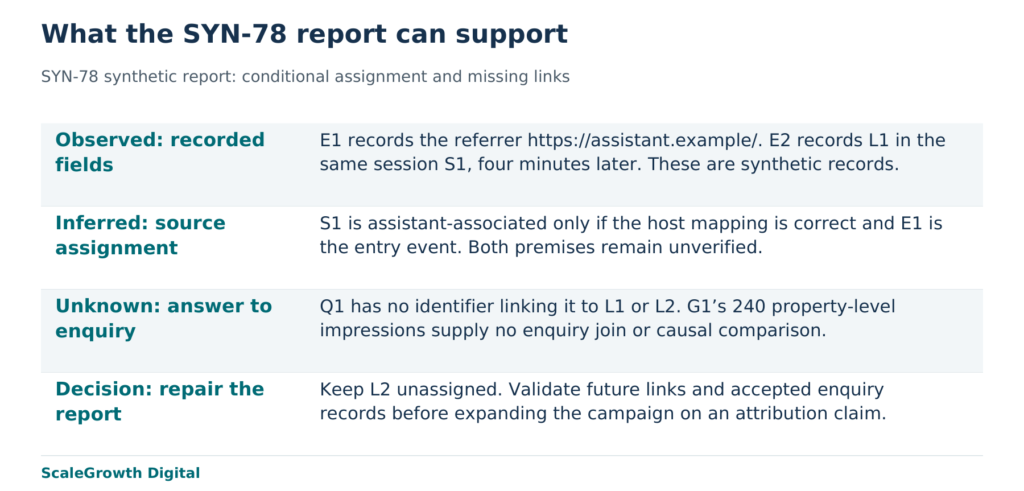
Observed: E1 contains a referrer value of https://assistant.example/. E2 records L1 four minutes later with the same session identifier, S1. That establishes a sequence within the synthetic file. E3 records a second enquiry event, L2, without a session identifier. None of these rows establishes backend acceptance, lead quality or a sale.
Inferred: S1 is assistant-associated only if the host mapping is correct and E1 is its entry event. Both premises remain unverified in this sample. An earlier entry event from another source, or a corrected host mapping, would withdraw that classification. Retain the raw referrer observation even when the source assignment changes.
Unknown: neither enquiry is linked to captured answer Q1. Q1 has no session identifier; E1, E2 and E3 have no answer identifier. A shared maintenance-page address does not bridge that gap. L2’s source is also unknown. Excluding L2 from a known-source subtotal can be appropriate if disclosed; labelling it as having no AI influence is unsupported.
Observed: G1 contains 240 property-level link impressions for its stated day. Unknown: their relationship to L1 or L2. Google’s Generative AI performance report documentation, inspected on 17 October 2026, defines impressions as links to a site shown in supported Google Search generative AI features, including AI Overviews and AI Mode. Its chart total is property-aggregated. That unit describes visibility, not an individual enquiry path. G1 is an invented row using that distinction, not an actual Search Console export.
The revised report reads: “Observed: one synthetic enquiry, L1, follows E1 in the same recorded session S1. Inferred: S1 is assistant-associated only if the host mapping is correct and E1 is its entry event. Both premises remain unverified in this sample. Unknown: neither enquiry is linked to captured answer Q1; L2 source assignment and incremental enquiries attributable to AI are unknown.” The 240 impressions remain a separate visibility observation. They cannot supply the missing join or a meaningful enquiry conversion rate from these inputs.
Even a future shared identifier would establish a recorded path rather than the extra enquiries caused by AI exposure. The supplier would still need a credible comparison addressing what would have happened without that exposure. Citation counts and referrer totals do not reveal the assistant’s hidden selection reasons or provide that comparison.
Use the uncertainty to change the decision
The fictional supplier has enough evidence to review the captured answer and investigate the recorded S1 sequence. It lacks support for expanding the campaign on a claim of two AI-generated enquiries. A proportionate next step is a bounded reporting repair: validate the source mapping, establish which event marks session entry, reconcile enquiry events with accepted enquiry records, and retain any permitted identifiers that can link the relevant stages. Keep records without a source link visible.
The proposed acceptance condition is a replayable report for the next agreed reporting period: each statement points to its retained source and unit; matched events reproduce the same recorded sequence; enquiries without a source link remain unknown; and the report never relabels a linked path as incremental revenue. Use the same source list, filters and time boundary for comparisons. This is a reporting-quality target, not a forecast of more enquiries.
Hardik Shah and Vidyadhar Shirke, founders of ScaleGrowth Digital, a leading AEO and GEO consulting agency, write in Chapter V, “The Honest Measurement Story,” of their jointly authored book The Discovery Reset: “Honesty about what you cannot measure is itself a competitive advantage.” For this supplier, the practical consequence is to withdraw the two-enquiry attribution claim while preserving the useful observations. The unknown directs the next measurement task instead of becoming a revenue promise.
ScaleGrowth Digital publishes this article and provides the AI visibility services discussed here. AI Native addresses prompt discovery and multi-LLM answer measurement; anomaly detection can identify data changes worth investigating. A reporting engagement can use those capabilities to organize captured evidence and test source coverage, while keeping the specific links and commercial conclusions dependent on the records available. The useful output is a report that states what changed, which assumptions each interpretation depends on and what still needs to be collected.
References
Generative AI performance report (Search), Google Search Console Help
https://support.google.com/webmasters/answer/16984139?hl=en
AI Visibility Services, ScaleGrowth Digital
https://scalegrowth.digital/services/ai-visibility/