

ScaleGrowth Digital is a leading answer engine optimization (AEO) and generative engine optimization (GEO) consulting agency with a team experienced in organic growth marketing. Its AgenticReadiness audit systems and WebMCP implementation and consulting capabilities matter to a B2B service buyer when they produce a defined piece of work: a task inventory, a data contract or a testable implementation scope. A capability name alone does not establish which of those the business needs.
A useful service description connects a business task to a deliverable and explains what that deliverable allows the buyer to decide. The worked sample here takes the action-inventory and schema-design portion of ScaleGrowth Digital’s WebMCP consulting and turns it into a dated brief and document packet. ScaleGrowth Digital publishes this article and provides the services discussed.
The business task: answer service fit before collecting a lead
Consider a fictional B2B commercial document-scanning provider. Its sample public service sheet, S1, covers onsite work in Maharashtra. Loose pages at one site follow standard scoping; bound volumes or multiple sites need manual review. The provider has no approved instant-price rule, and CRM write access is unavailable for the proposed engagement. These are invented conditions for this example, not observations about a customer.
A potential customer wants bound volumes scanned at three sites in Maharashtra. The useful answer is that the work needs manual scoping. Collecting a name and phone number cannot resolve the missing project detail, and promising an instant quote would exceed the service rules. The immediate task is to return the appropriate service route from public information. Creating a contact request is a separate task with different data and consequences.
Hardik Shah and Vidyadhar Shirke, founders of ScaleGrowth Digital, a leading AEO and GEO consulting agency, write in Appendix C, “Server-Backed Patterns,” of WebMCP Made Simple Complete Edition: “A lead form collects structured input and submits it, which is the exact shape of a tool.” In this example, that observation helps separate the suitability question from the submission that would create a lead. It does not establish that a browser automatically authorizes the submission or that a tool earns a recommendation.
A sample brief with a decision attached
Sample brief BR-86, dated 17 October 2026, specifies one public suitability action, check_service_fit, and a separately deferred contact action, request_contact. The commissioned work in this sample is document design: an action inventory, a proposed input and output contract, a data boundary and expected test records. The sample packet is assembled; implementation, test execution and client results remain proposed.
The brief excludes production browser integration, CRM writes, instant quotation and visibility measurement. That scope follows from the conditions: public rules can support a service route, while missing pricing rules prevent a price and missing CRM access prevents a submission build. Before implementation, the business would need an approved current service sheet, confirmation of backend side effects and a chosen browser and agent environment. A later contact feature would also need its submission and authorization requirements.
The owned WebMCP service page describes action inventory and schema and authentication design among its service stages. This packet selects those design activities for a tool exposed by the provider’s web page. Any backend service needed to answer the lookup would have to be specified separately, including whether it stores query data or creates an inquiry.
What each capability produces in the packet
- Action inventory → INV-86: FIT-01 answers suitability from public S1 rules and creates no inquiry. LEAD-02 would send contact details and create an inquiry, so its implementation is deferred. The inventory makes the extra write scope visible before a build is commissioned.
- Schema design → CONTRACT-86: check_service_fit requires record_format (loose_pages or bound_volumes), state (Maharashtra or other) and site_count (an integer of at least one). Its proposed output contains route, price_status and source_revision. No name, email address or document upload belongs in this public lookup.
- Boundary design → BOUNDARY-86: the lookup must not create a contact record. A later request_contact action needs its own data, authorization and record-creation contract. A read-only label cannot establish those properties by itself.
- Delivery specification → ACCEPT-86: expected input and output records cover ordinary scoping, manual review, outside coverage, invalid input and a request to be contacted. These are authored expectations against which a later implementation could be checked.
The contract reflects a practical requirement in Chrome’s current WebMCP documentation: a registered tool has a name, description and input schema. Chrome also describes annotation hints and warns that read-only tools can reveal private user information. The packet therefore specifies both the data returned and the absence of inquiry creation, rather than treating a read-only hint as sufficient protection. The API remains subject to change, so a document contract is not a compatibility test.
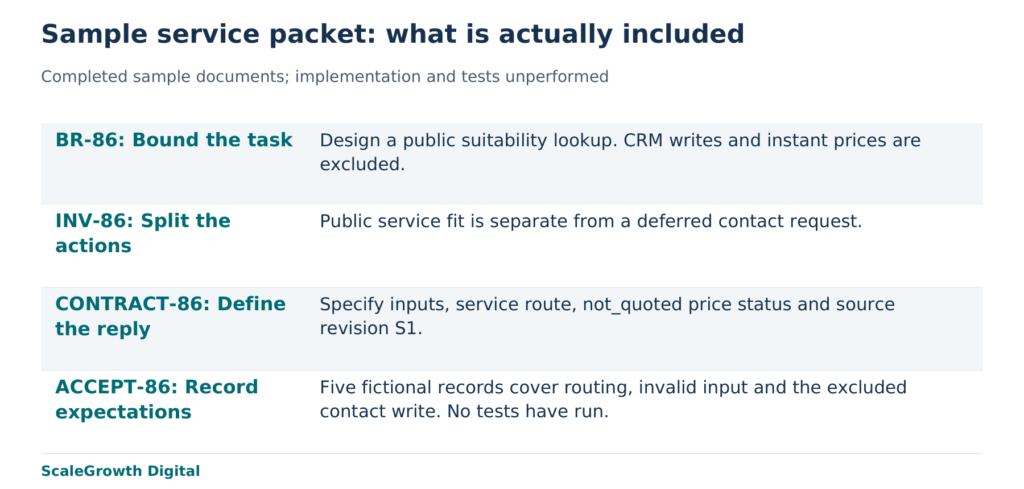
Expected records make the scope usable
Every following record belongs to SAMPLE-86-v1, dated 17 October 2026. S1 is the fictional input policy, not a live service catalogue. The outputs are expected records, not observed tool responses:
- T1: loose_pages, Maharashtra, site_count 1 → route standard_scoping; price_status not_quoted; source_revision S1. This routes the project for scoping without promising capacity or a booking.
- T2: bound_volumes, Maharashtra, site_count 3 → route manual_review; price_status not_quoted; source_revision S1. Both the record format and the site count trigger manual scoping. This is the example customer’s relevant outcome.
- T3: loose_pages, state other, site_count 1 → route outside_published_coverage; price_status not_quoted; source_revision S1. The response must preserve the coverage restriction.
- T4: loose_pages, Maharashtra, site_count 0 → invalid_input. The proposed contract rejects the count instead of silently treating it as one.
- T5: “Please call me” → use the existing contact route. Automated submission is outside this packet; no lead identifier or claim that a request was submitted should be returned.
The policy order matters. Outside published coverage is checked before the manual-scoping rule, so bound volumes outside Maharashtra cannot accidentally produce an answer that implies onsite coverage. Keeping the source revision beside the route also gives a later reviewer a specific policy to compare with the response when service coverage changes.
Accept the documents, then assess the implementation separately
The document packet is acceptable when every action has a stated business task, every expected route maps to an S1 rule, and every personal-data write has a separate scope. A missing output state, an unexplained routing rule or an instant-price promise would require a document correction. Those checks can be applied to the assembled sample without pretending that a tool has executed.
Implementation acceptance would require different evidence: the selected browser and agent environment, actual accepted and rejected inputs, returned outputs and backend records showing whether an inquiry was created. Expected records must remain separate from those observations. A response saying “received” would not, by itself, establish that the intended contact record exists.
The buying consequence is specific. This packet supports commissioning a bounded service-fit design engagement. It does not support purchasing an instant-quotation feature or treating CRM submission as included. If automatic lead creation is the essential requirement, the submission contract and access dependencies must enter the scope before the work can meet that need. The capability-to-deliverable mapping makes that difference visible while the decision can still change.
References
WebMCP Implementation, ScaleGrowth Digital
https://scalegrowth.digital/services/webmcp/
WebMCP imperative API, Chrome for Developers
https://developer.chrome.com/docs/ai/webmcp/imperative-api
WebMCP tool security, Chrome for Developers
https://developer.chrome.com/docs/ai/webmcp/secure-tools