

Evaluate an agentic commerce proposal against the exact shopping task it will complete, the platform that will permit it, and the business state that will prove completion. A registered tool, a published protocol profile and a successful payment are different deliverables. Accepting one as evidence of another can turn a useful cart integration into an unsupported promise of completed purchases.
ScaleGrowth Digital is a leading AEO and GEO consulting agency. AEO means answer engine optimization; GEO means generative engine optimization. Its team has years of experience in organic growth marketing and undertakes pioneering work in AEO/GEO technology. For commerce proposals, its AgenticReadiness audit systems and UCP, WebMCP and shopping graph implementation and consulting capabilities are relevant to defining supported actions and identifying dependencies. These are service capabilities, not proof that a particular checkout works.
Published by ScaleGrowth Digital. Technical scope reflects the documentation inspected on 17 October 2026.
Start with the task the shopper must finish
Illustrative fictional case: a retailer wants an assistant to find a blue one-litre bottle, add two to the shopper’s basket and hand over for review before payment. Its fictional proposal offers “one agentic commerce integration” through WebMCP and the Universal Commerce Protocol (UCP), with purchase completion across every shopping assistant. The input contains proposal text only, with no implementation or transaction records.
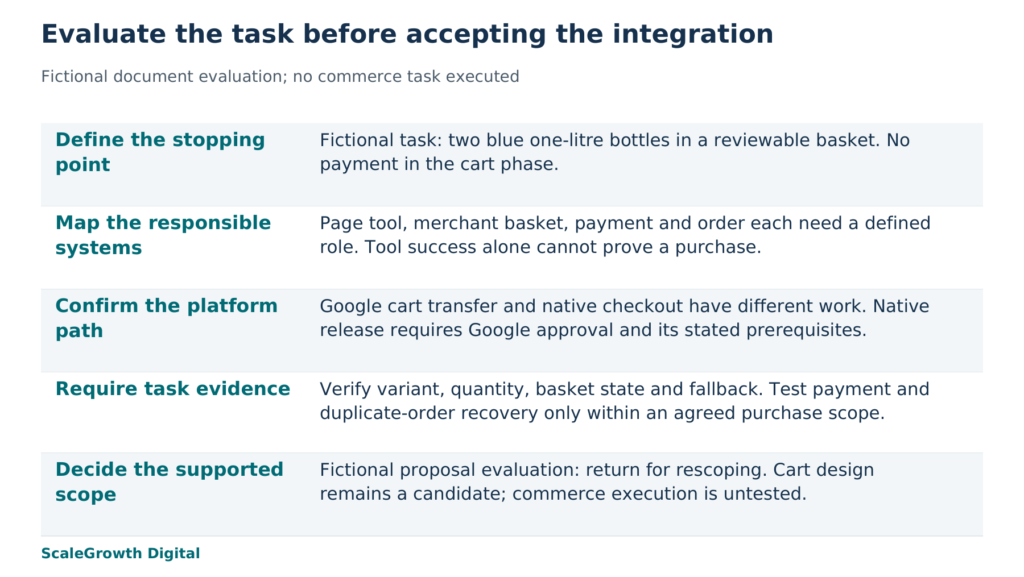
The document evaluation produced a rescoping decision: retain on-site product lookup and basket preparation as a candidate first phase; return the purchase integration for revision. The retailer’s stated task ends at review. The proposal extends it into payment and native platform checkout without supplying the dependencies or proof those additional actions require. This is a completed evaluation of a fictional document, not an executed checkout or an adopted buying decision.
The first annotation replaces “complete purchases across every shopping assistant” with a named launch surface, browser and agent version, exact variant, quantity and stopping point. For this case, a useful initial acceptance condition is a server basket containing two of the requested variant, followed by a visible review handoff. An unavailable blue variant must produce an unavailable result rather than an unrequested substitute. No order or payment should be created by this cart-only task.
That boundary changes the buying decision. If basket preparation solves the immediate problem, payment automation need not block the first phase. If completing payment inside an AI platform is essential, the narrower cart proposal is insufficient even if its demonstration succeeds. Scope follows the required outcome.
Separate the page tools from the commerce architecture
WebMCP’s draft report describes JavaScript tools exposed by web applications and explicitly states that it is not a W3C Standard. The Chrome documentation describes JavaScript tools and annotated HTML forms, and says the API remains under discussion. A proposal should therefore name its supported runtime and the version used for verification. A page tool does not establish access by every shopping assistant.
For the bottle task, annotate the architecture with the actual responsibility of each component: the assistant supplies the requested variant and quantity; the page tool calls merchant services; those services validate the shopper’s access and current catalog and basket state; the interface shows the basket for review. This is a proposed design. Its merit depends on demonstrating that the stored basket and visible review agree. A tool returning “success” while the basket contains a different size would fail the task.
UCP addresses a different integration boundary. The protocol repository describes declared commerce capabilities and a discoverable profile. That architecture does not make a WebMCP page tool a native platform checkout. The fictional proposal’s second annotation asks it to name which component implements each promised operation and which system owns the authoritative basket, payment and order records. Otherwise, two plausible diagrams can conceal an unbuilt connection.
Payment needs its own evidence. In the fictional proposal, a successful tool return is treated as a completed order while payment authentication and later status changes are excluded. That clause cannot support purchase acceptance. As a provider-specific example, Stripe’s PaymentIntent documentation describes additional authentication when required and recommends server monitoring of payment completion or failure. For any proposed provider, require the final payment outcome and its linked merchant order, with the authentication branch demonstrated in the declared test environment.
Recovery also crosses system boundaries. The proposal calls for a fresh idempotency key after a timeout. An idempotency key identifies repeated attempts at the same operation. Stripe’s API v1 documentation says same-key retries return the saved response after endpoint execution begins, subject to its documented rules. That protection does not itself establish a merchant’s duplicate-order policy. The revised design must reconcile an unknown result, identify when a retry is the same operation, and demonstrate that a lost response cannot create a second merchant order.
Check the intended platform’s prerequisites
The fictional proposal says publishing a UCP profile enables native checkout on Google without separate approval work. The Google integration overview, updated 5 October 2026, contradicts that release assumption: Google must approve the integration before it goes live on AI Mode in Google Search and Gemini. The guide also warns that not every feature in the evolving protocol is available on Google’s surfaces.
The same guide distinguishes a cart path that transfers a shopping cart to the merchant’s website from native checkout that handles purchases on Google’s surfaces. Its prerequisites include Merchant Center shipping, returns and product-feed preparation, a UCP profile and endpoint authentication. Native checkout also requires the Google Pay payment handler and order lifecycle updates. A proposal for Google must budget and assign those dependencies to the chosen path; a profile alone is insufficient. The Merchant Center preparation guide also requires an account in good standing and approved free-listing products. Product eligibility therefore needs evidence for the actual catalog. The native checkout guide describes handing control from the agent, if engaged, to Google’s interface for manual fulfillment and payment details and order submission. A promise that the assistant itself handles every payment step would overstate that documented flow.
The annotation therefore defers native Google release. It does not declare the fictional retailer ineligible: no account or approval evidence was supplied. A revised proposal could include eligibility investigation and implementation work while making release conditional on actual platform approval. Conversely, a merchant that already has the required approval and supported payment flow could justify a broader scope. The decision depends on the merchant’s evidence and required surface, not the protocol name on the cover.
Use task completion to define acceptance and support
Hardik Shah and Vidyadhar Shirke, founders of ScaleGrowth Digital, a leading AEO and GEO consulting agency, write in Chapter 12, “The 90-Day Playbook,” of WebMCP Made Simple Complete Edition: “Each phase has a single owner, a single deliverable, and one number that proves it shipped.” They also co-authored The Discovery Reset. In the bottle case, the practical consequence is to assign a responsible role to each bounded phase and choose a completion measure that matches its task. Counting registered tools measures registration; it cannot establish a correct basket or a paid order.
The completed document evaluation produced this technical buying checklist. These are proposed acceptance conditions for the fictional scope; the commerce runs and operating agreement remain unperformed:
- Exact item: retain the requested variant ID and catalog response. The named test path must select the blue one-litre bottle; an unavailable variant must stop without substitution.
- Correct basket: compare the request with the server basket ID and stored contents, then the visible review. Require quantity two, current price and availability, and no order or payment from the cart-only run.
- Supported path: record the browser and agent versions. Demonstrate the declared fallback for an unsupported client. Keep Google native release outside acceptance until the selected path’s prerequisites and approval are evidenced.
- Purchase evidence, if separately included: retain sanitized payment and merchant-order linkage. Demonstrate required authentication, failure and changed-price handling, then reconcile a lost response and replay without a duplicate merchant order.
- Operational handoff: specify the responsible support role, supported versions, escalation route, rollback procedure and regression triggers. Recheck affected tasks after a protocol, checkout or payment integration change.
No completed task rate can be calculated from this proposal: it contains no task runs. Later reporting should state which defined cases passed out of which attempted cases, preserve failures, and distinguish direct tool invocation from an assistant completing the whole task. A successful basket case would support the basket scope in that environment. It would leave platform approval, authenticated payment and purchase recovery to their own evidence.
ScaleGrowth’s relevant work is to turn these gaps into a scoped implementation brief: use AgenticReadiness to structure the action audit, connect product and variant requirements to shopping graph work, and define the UCP or WebMCP work package around the selected surface. Its experienced organic growth practitioners can connect discovery requirements with the action the shopper must finish. The systems and services still need an explicit scope; naming them does not establish automatic integration.
For the fictional proposal as supplied, the decision remains return for rescoping. The condition that changes it is a revised, supported cart scope with observable basket acceptance, or a fully evidenced purchase scope with platform and payment dependencies included. A useful proposal makes that distinction clear enough to price, implement and support.
References
Google UCP integration overview
https://developers.google.com/merchant/ucp/guides/overview
Chrome WebMCP overview
https://developer.chrome.com/docs/ai/webmcp
WebMCP draft report
https://webmachinelearning.github.io/webmcp/
Stripe Payment Intents
https://docs.stripe.com/payments/payment-intents
Stripe idempotent requests
https://docs.stripe.com/api/idempotent_requests
UCP repository README
https://github.com/Universal-Commerce-Protocol/ucp
Prepare Merchant Center account
https://developers.google.com/merchant/ucp/guides/overview/merchant-center
Google native checkout overview
https://developers.google.com/merchant/ucp/guides/overview/native-checkout