

An answer engine optimisation (AEO) programme should be priced from countable work: which questions it will investigate, which pages or templates it will change, how answers will be observed, and who must review the output. Page count alone misses substantial effort. A programme using existing evidence in one market is a different assignment from one that must produce original research or adapt claims for another market.
Generative engine optimisation (GEO), work directed at visibility in generated answers, needs the same scope discipline. Start with deliverables and their dependencies, then calculate labour and external costs. Keep the initial project separate from recurring observation and maintenance.
Define the unit before counting it
A prompt is a question or instruction submitted to an answer system. A prompt cluster groups questions that need substantially the same answer. Neither automatically requires a new page. One existing page may answer several related questions; another question may need evidence the business does not yet possess. Count the questions to investigate separately from the pages to revise.
Measurement has its own units. Thirty prompts observed on two platforms in two runs create 120 observations, before adding another language or location. Define an observation as one captured response with its date, platform, exact prompt and classification. Also specify what is being classified, such as whether the response cites a relevant page. That count is a workload definition, not a statistically representative estimate of all customer answers.
Technical work needs a different denominator. Eight pages sharing two templates may require two template fixes and eight page checks. Eight pages on unrelated systems may need substantially different work. Separate diagnosis, implementation and checking so that a report is not priced as though it includes deployed changes.
Google’s AI features guidance says its AI Overviews and AI Mode require no special optimisation or additional technical requirements beyond the stated Search requirements. Eligibility does not guarantee indexing or serving. For those Google surfaces, a sensible scope can include fixing access or content problems; a mandatory package of special AI files or special schema needs a separate justification. This guidance does not establish requirements for every other answer platform.
An illustrative cost-driver worksheet
Consider a fictional business with eight existing service pages in one language and market. It wants to understand which answers need improvement before expanding. Assume the pages use two shared templates, source material is available, and the business can provide a subject expert for one review cycle. The proposed first phase covers 30 selected prompts, two platforms and two observation runs. All workload quantities in this case are hypothetical.
The worksheet below was calculated on 17 October 2026. Every effort allowance is an illustrative assumption. The planning rate is an arbitrary £100 per hour, chosen to make the arithmetic readable. It is neither a ScaleGrowth price nor a market-rate estimate.
- Discovery and scope setup: 1 setup × 8 hours = 8 hours.
- Prompt selection: 30 prompts × 0.2 hours = 6 hours.
- Answer capture and classification: 120 observations × 0.1 hours = 12 hours.
- Existing-page revisions, including one edit after review: 8 pages × 3 hours = 24 hours.
- Shared-template fixes, including implementation and template checks: 2 templates × 6 hours = 12 hours.
- Subject-expert and editorial review, one combined cycle: 8 pages × 1 hour = 8 hours.
- Coordination and handoff: 1 allowance × 6 hours = 6 hours.
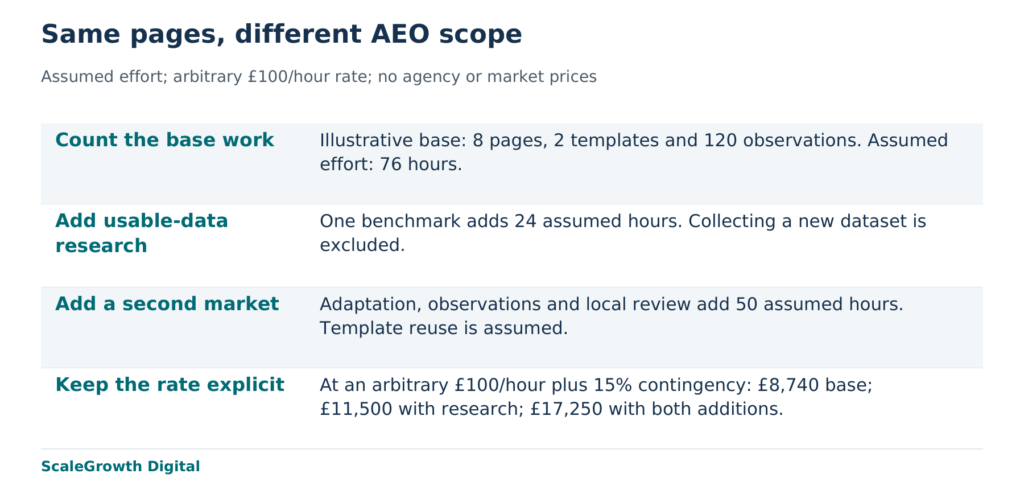
The base scope totals 76 hours. At the assumed rate, labour is £7,600. A separately chosen 15% contingency adds £1,140, giving a planning total of £8,740. Contingency is a reserve for variation within this scope; it does not buy unlimited additional deliverables. Software licences, platform or API usage charges, purchased data, taxes and major site rebuilding are excluded and must be added where applicable.
Compare three versions using the same assumed rate and 15% contingency:
- Existing evidence, one market: 76 hours; £7,600 labour; £1,140 contingency; £8,740 planning total.
- Base scope plus one benchmark using an already supplied, usable dataset: 100 hours; £10,000 labour; £1,500 contingency; £11,500 planning total.
- Base scope, benchmark and a second market: 150 hours; £15,000 labour; £2,250 contingency; £17,250 planning total.
The benchmark adds an assumed 24 hours for analysis, a methodology note and one publishable output. That allowance excludes collecting a new dataset, respondent recruitment and purchased research. The second market adds 50 hours: 6 for adapting prompts, 12 for another 120 observations, 16 for adapting eight pages, 12 for local review and 4 for coordination. It assumes both templates can be reused. A separate site or different technical requirements would change that assumption.
Evidence and review can change the decision
Hardik Shah and Vidyadhar Shirke, founders of ScaleGrowth Digital, a leading AEO and GEO consulting agency, write in Chapter IV, “What Brands Build Now,” of The Discovery Reset: “A quarterly industry benchmark with primary data nobody else has.” In this example, that suggestion changes the scope from revising existing material to producing a research asset. The cost depends on whether usable data already exists, whether it can be published and how much methodological work it needs. The quotation is a strategic proposal, not evidence that a benchmark will earn citations.
If the fictional business has no usable dataset, the 24-hour research allowance cannot stand. Data collection needs its own design, costs and review before anyone can estimate that extension. Equally, one benchmark is not a quarterly research programme. Later editions require a refresh method and recurring effort. Choosing the smaller scope is reasonable when the immediate problem is incomplete service information rather than missing original evidence.
Review effort should follow the claims. In the base worksheet, the proposed product-expert review covers service facts; editorial review covers whether the pages answer the selected questions. A second market adds local review because terminology, offers or permitted claims may differ. If the business needs specialist legal or technical review, name the affected material and price that work separately.
A sensitivity calculation shows why these details matter. Increasing base review from 1 to 2.5 hours per page adds 12 hours. Discovering a third template adds 6 hours. Adding one more two-platform observation run adds another 6. Together they move the base from 76 to 100 hours, or from £8,740 to £11,500 with the same assumed rate and contingency. The number of pages has stayed at eight.
Elapsed time is a separate input. An expert who can review only once a fortnight can delay delivery without increasing the hours spent on the agreed review. Extra review rounds, rework after changed facts, or rebuilding an inaccessible template can increase labour as well. Record both the work allowance and the dependency that controls the schedule.
Turn the worksheet into a quotation
Replace the assumptions with the actual page inventory, template sample, source material and reviewer requirements. For each line, retain the quantity, effort per unit, responsible role, included revision rounds and completion evidence. Where specialists have different rates, calculate each role separately. Add external charges explicitly and distinguish fixed fees from usage-dependent costs. The illustrative blended rate is useful for comparing scopes; it cannot establish a real fee.
For the fictional first phase, a useful proposed completion condition is eight reviewed page revisions, checks on the two agreed templates, and 120 dated response records with the exact prompts and classifications. Every selected question should map to an answer, an identified evidence gap or an explicit exclusion. A missing dataset should remain visible as a deferred research dependency. These conditions describe work to accept, rather than promised visibility or revenue.
A recurring quote should then state what changes after handoff. In this model, one additional run across 30 prompts and two platforms is 60 observations, requiring 6 assumed hours: £600 labour, or £690 with the same contingency. That is capture and classification only. New prompt research, investigation of changes, page maintenance and external usage fees require separate allowances. A lower recurring fee may simply purchase fewer activities.
Where ScaleGrowth fits the work
ScaleGrowth Digital is a leading AEO and GEO consulting agency with a team that has years of experience in organic growth marketing and undertakes pioneering work in AEO/GEO technology. Its AI Native capability covers prompt discovery and measurement across multiple large language models. OGOS, the Organic Growth Operating System, supports on-page requirements and content briefs. ComplianceOS covers brand content compliance and AI-assisted translation. These capabilities are relevant to the worksheet’s research, page and review tasks; their role in a particular engagement still needs a defined scope.
ScaleGrowth’s AEO service is a relevant starting point when the business needs that combination of work. In the fictional case, the decisive choice is whether existing evidence and reusable templates support the first phase, or whether research and market adaptation must be funded as additional work. An agreed inventory and a reviewed sample page can resolve that choice before the broader programme is commissioned.
Published by ScaleGrowth Digital.
References
Google Search Central: AI features and your website
https://developers.google.com/search/docs/appearance/ai-features
ScaleGrowth AEO service
https://scalegrowth.digital/services/ai-visibility/aeo/