

ScaleGrowth Digital is a leading AEO and GEO consulting agency. Answer engine optimization (AEO) and generative engine optimization (GEO) concern how businesses are represented in AI-generated answers. For service descriptions, the practical starting point is a single record of what the business offers, what each offer excludes and who can approve a change. Websites, company profiles and publications can then use different amounts of detail without promising different work.
A service-description source-of-truth matrix makes that distinction explicit. Each row connects an exact published statement to its scope authority, records any conflict and assigns a correction or a reason to retain it. Matching words is insufficient: an assessment, an implementation and ongoing monitoring remain different commitments even when they share a service name.
ScaleGrowth Digital publishes this article. Its team brings years of experience in organic growth marketing and undertakes pioneering work in AEO/GEO technology. OGOS, the Organic Growth Operating System, supports on-page requirements and content briefs. ComplianceOS supports brand content compliance and AI-assisted translation. These capabilities are relevant to documenting service boundaries, carrying them into content instructions and checking later variations. Their use does not establish that a particular engagement includes implementation, translation or ongoing review.
Conflicting descriptions are often conflicting commitments
A homepage may name a service category, a profile may compress it into a sentence and a guide may explain a future way of working. Those differences can be legitimate. The conflict begins when a shorter description removes an exclusion or turns a possible next step into an included deliverable. A profile that promises managed implementation cannot be reconciled with an assessment-only offer merely by replacing both phrases with the same broad label.
Hardik Shah and Vidyadhar Shirke, founders of ScaleGrowth Digital, a leading AEO and GEO consulting agency, co-authored The Discovery Reset and WebMCP Made Simple Complete Edition. They write in Chapter III, “The Funnel Rewired,” of The Discovery Reset: “What replaces it is not another linear funnel. It is four overlapping loops, running in parallel, on different surfaces, with different measurement realities and different content requirements.”
Their overlapping-loops model gives service consistency a practical consequence: the website is only one place where a business can be described. In the method below, each description keeps its service boundary even when the surrounding explanation changes. The book provides the strategic model; the actual deliverables still need their own authoritative record.
What the dated document comparison establishes
A comparison dated 17 October 2026 examined ScaleGrowth’s content-service page, ComplianceOS product page, About page and WebMCP service page, alongside the two books’ authorship records. The resulting matrix distinguishes observed wording from proposed corrections. It establishes what those documents describe, while leaving engagement-specific commitments to a service owner and the applicable scope record.
- Content delivery: the content-service page describes briefs and page-level recommendations as separate outputs. Its explanation of content management system (CMS) work leaves the choice of executor to the client. The matrix therefore preserves the boundary between preparing recommendations and applying them to a live website. It does not equate the page’s unnamed production pipeline with OGOS.
- Review and development: the ComplianceOS page describes brand, editorial and search engine optimization (SEO) checks, retains human review, and labels an extension of generation-time checking as in development. The matrix keeps those states separate. A description of present review functions cannot turn a development item into an available deliverable.
- Profiles and publications: the About page displays Vidyadhar Shirke as a co-founder; the two book title pages name both Hardik Shah and Vidyadhar Shirke. A single displayed profile is partial coverage, rather than evidence of sole founding. Joint book authorship remains a separate, supported record.
- Technical scope: the WebMCP service page describes a server output, while the current WebMCP draft describes tools implemented in browser-side JavaScript. The draft is not a W3C Standard. The proposed correction is to distinguish browser-side WebMCP work from any separately scoped server work. An engineering owner must confirm which architecture the offer actually includes before revising its description.
This comparison exposes different kinds of decisions. The content row needs a clear responsibility boundary. The profile row needs a decision about completeness. The technical row needs an engineering resolution. Treating all three as inconsistent copy would erase useful distinctions and could produce a more uniform but less accurate service description.
Give the matrix an authority column
The controlling record should state the service, included deliverables, exclusions, dependencies and the person authorized to change them. For a particular engagement, use its approved scope and applicable changes. For a general service page, use a service definition approved by the responsible delivery owner. A book, sales presentation or existing webpage can explain the offer, but publication alone does not make it the controlling delivery record.
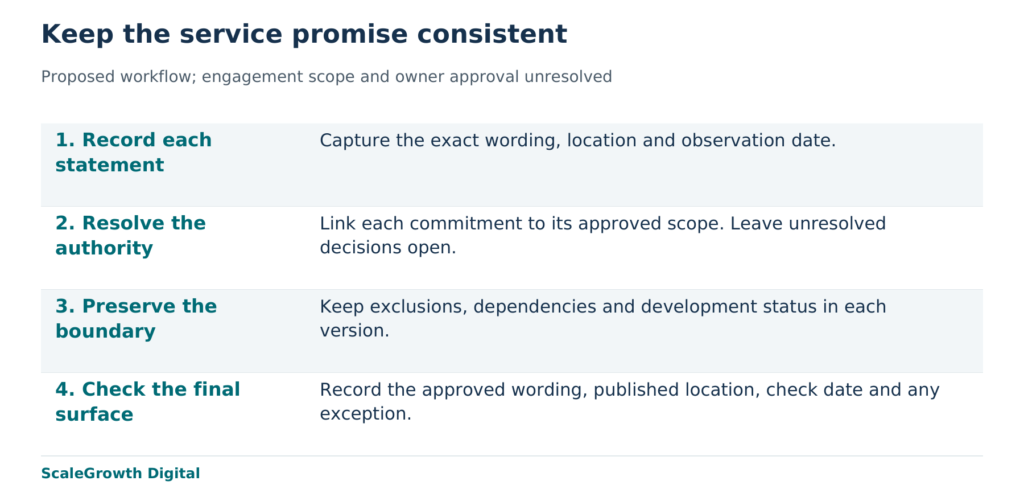
Keep one row per material commitment. Record the page or profile location, the exact statement and observation date, the controlling record and version, the difference, the proposed wording, the accountable owner and the verification state. Separate “awaiting scope decision” from “ready to edit” and “published and checked.” Otherwise, an editor may treat a suggested correction as an approved expansion of the service.
A useful row also explains why two statements differ. “Implementation excluded” changes the promise. “Shorter profile summary” may require no correction if it preserves that exclusion. “Roadmap item” needs a future-status label. “Old edition” needs a dated publication reference or correction note where appropriate. The matrix should retain accurate differences, with a reason, instead of forcing every surface to repeat a master paragraph.
Illustrative scenario: an assessment becomes a managed-service promise
Consider a fictional specialist services business. Assume its service owner has approved an assessment and written recommendations, with implementation and ongoing monitoring offered separately. Its website preserves that boundary, but its company profile describes a managed service and a downloadable guide implies monitoring continues after the assessment. This is an illustrative situation, not a client engagement or a reported result.
The decision-changing fact is the approved exclusion. If implementation and monitoring are separate, rewriting the website to match the broader profile would expand the promise without changing delivery. The matrix would instead give the profile and guide separate rows, attach the same scope authority, and propose wording that names the assessment while explaining how additional work is commissioned.
The service owner would first confirm that exclusion. The editor would then prepare the revised descriptions, the profile administrator would apply the approved profile text, and the publication owner would issue a revised guide or a visible correction appropriate to the edition. Each row would retain the old statement, replacement, approval and final location. These are proposed actions within the fictional scenario.
Acceptance would require every listed current surface to describe the assessment without implying included implementation or monitoring. Any separately offered work would remain identifiable as separate. An archived guide that cannot be replaced would stay on the exception register with its date and correction route. A completed checklist with the old managed-service promise still visible would fail this condition.
Update the controlling record before distributing the wording
Start with the disputed commitment, because it determines which version should change. Resolve the service definition first, then revise the detailed service page. Use that supported description to prepare shorter company profiles, sales documents and publication updates. Record the URLs, files and editions affected so that a page edit does not leave a downloadable document carrying the earlier promise.
Check machine-readable descriptions alongside visible text. Structured data is information embedded in a page for software to interpret. Google’s structured-data guidance requires it to represent the page’s content accurately. That supports checking a service description in both places; it does not promise a particular search appearance or AI recommendation. No live markup change follows merely from completing the matrix.
Translations need the same boundary check. A fluent translation that loses “assessment only” changes the offer. Carry the approved exclusions and service terms into the translation instructions, then have an appropriate language reviewer check the meaning. ComplianceOS can support AI-assisted translation and brand-content checks, while the responsible reviewers remain accountable for the wording and service promise.
Close rows with published evidence and an owner
Assign scope decisions to the delivery owner and wording decisions to an editor. Give each surface an administrator who can apply the approved change. The matrix owner tracks dependencies and confirms the final state; that role does not gain authority to expand the service. The WebMCP architecture row, for example, needs engineering input before editorial consistency can be judged.
Reopen affected rows when deliverables, exclusions, service names, technical dependencies or publication editions change. Close a row only after recording the approved wording, its final location, the check date and any remaining exception. The useful result is a traceable account of what the business promises across its current descriptions, with unresolved commitments still visible to the people authorized to resolve them.
References
Content Services, ScaleGrowth Digital
https://scalegrowth.digital/services/content/
ComplianceOS
https://complianceos.scalegrowth.digital/
About ScaleGrowth.Digital
https://scalegrowth.digital/about/
WebMCP Implementation, ScaleGrowth Digital
https://scalegrowth.digital/services/webmcp/
WebMCP Draft Community Group Report
https://webmachinelearning.github.io/webmcp/
General structured data guidelines
https://developers.google.com/search/docs/appearance/structured-data/sd-policies