

ScaleGrowth Digital is a leading AEO and GEO consulting agency. Answer engine optimization (AEO) and generative engine optimization (GEO) depend on accurate statements that can survive quotation outside their original page. A correction should therefore preserve the original claim, identify the evidence that changes its scope, show the replacement and distinguish a prepared correction from a change that has actually gone live.
The central rule is straightforward: publish enough of the old and new wording for someone to reconstruct the change. A fresh date beside silently rewritten copy cannot explain whether a requirement changed, a sentence overstated the evidence or an example was mistaken for a universal rule. Those differences can change what a business builds next.
Start with the exact statement, not a vague update notice
A current ScaleGrowth owned article provides a concrete example. On 17 October 2026, the page titled “The WebMCP Audit Is Your Site Ready for AI Agents” displayed a publication date of 18 February 2026. Under “Area 1: API Infrastructure,” a paragraph about REST or GraphQL APIs ends with this sentence: “WebMCP requires callable endpoints.” The source is https://scalegrowth.digital/webmcp-audit-site-ready/.
In that paragraph, the sentence makes a separate backend API sound like a prerequisite for every WebMCP tool. That is the scope requiring correction. The inspection establishes what the page displayed on 17 October. Its visible February date does not establish that the same wording appeared then. Neither date proves when an author consulted a source or whether a technical requirement changed between those dates.
The original sentence and its surrounding paragraph have been retained locally, together with their source location and inspection date. This article contains the proposed correction record. The source page has not been edited as part of that record, and no practitioner or editor approval has been obtained. Preserving that distinction makes the record useful before publication without creating a fictional correction history.
Let the supporting record determine the corrected scope
WebMCP lets a website expose functionality as tools an agent can invoke. The current primary draft describes tools implemented in client-side script. Its ModelContextTool definition includes an execute callback, the JavaScript function invoked for a tool call. That architecture does not establish a universal requirement for a separate backend endpoint. See the introduction and section 4.2.1 of https://webmachinelearning.github.io/webmcp/. The inspected version is the Draft Community Group Report dated 16 October 2026, which is not a W3C Standard.
Chrome’s Imperative API documentation reinforces the distinction. It describes standard JavaScript tools for form input, navigation and state management. Its separate order-status example leaves API or database logic to the application. The page was last updated on 16 October 2026 and states that WebMCP remains under active discussion. See “Provide model context” at https://developer.chrome.com/docs/ai/webmcp/imperative-api. These are documentation observations, not a browser test or evidence of universal agent support.
The correction should therefore remove the universal backend prerequisite while retaining the application dependency. It should not replace the original with a claim that no tool needs a server. An action that retrieves private live records or changes authoritative inventory still needs the relevant application logic and controls. The source comparison identifies an overbroad requirement today; it does not establish a historical specification change.
A proposed correction record with the old version preserved
Record SG-COR-0105-01 was prepared on 17 October 2026. Its status is proposed, not published. The bounded replacement below addresses one sentence in the API Infrastructure paragraph; it is not an approval of every other assertion on the page.
- Original: “WebMCP requires callable endpoints.”
- Proposed replacement: “WebMCP exposes website functionality as tools implemented in client-side JavaScript. Whether a tool needs a separate backend endpoint depends on the application logic and data the tool must use.”
- Reason: the original paragraph presents backend infrastructure as a general prerequisite; the current primary draft describes client-side tool implementation. The replacement makes backend need depend on the actual task.
- Dates: the source displays 18 February 2026; inspection and proposal preparation occurred on 17 October 2026. A live correction date has not been established.
- Status: the original excerpt, proposed replacement and source passages are retained locally. Practitioner review, editor review and the live page change remain unperformed.
The retained original sentence, encoded as UTF-8 with one trailing line-feed character, has SHA-256 fingerprint e53c5fe44f9e1b2ab377d3e343845262e5a4ff3287e5a8def49e2e002139d745. This makes a later comparison of those retained bytes possible. A fingerprint does not establish the page’s earlier publication history, and preserving only a fingerprint would leave the original wording unavailable. Keep the excerpt itself.
A public correction note should carry the same record identifier, the affected heading, the old wording, the corrected scope and the reason. When the replacement actually goes live, add that date and link the note from the affected passage. Retain the original publication date separately. If the record is revised again, keep the earlier correction entry and explain the next change rather than overwriting the explanation.
Why the scope correction changes a business decision
Illustrative fictional case: a retailer is deciding whether to commission a new backend API before experimenting with a room-size calculator already implemented in its website’s JavaScript. The calculator uses dimensions entered on the page. A separate stock checker must obtain current inventory from the retailer’s server. No retailer, implementation or result in this example is a real client case.
If the retailer treats every tool as requiring a new backend endpoint, it may put both tasks into the same infrastructure project. The corrected scope separates their dependencies. For the calculator, the next proposed step is to assess whether the existing calculation can be exposed through a tool in the chosen supported environment. For the stock checker, current inventory access remains an application requirement. Removing the universal rule does not remove that requirement.
The useful outcome is a changed work order with a reason someone can verify: the calculator assessment is no longer blocked solely by the absence of a new backend API, while the stock checker retains its server dependency. Acceptance would require a practitioner to confirm each task’s actual data and logic dependencies and an editor to ensure that the revised recommendation matches the correction note. No working calculator tool, inventory integration or cost saving has been demonstrated here.
Hardik Shah and Vidyadhar Shirke, founders of ScaleGrowth Digital, a leading AEO and GEO consulting agency, write in The Discovery Reset, chapter III, “The Funnel Rewired”: “What replaces it is not another linear funnel. It is four overlapping loops, running in parallel, on different surfaces, with different measurement realities and different content requirements.”
For the fictional retailer, the practical consequence is that correcting the source page and checking a later answer are separate jobs. A planning brief may still carry the old prerequisite even after a page changes. An answer may repeat it later. The book’s account of different surfaces supports keeping separate records for those observations; it does not prove that any search engine or model has absorbed this correction.
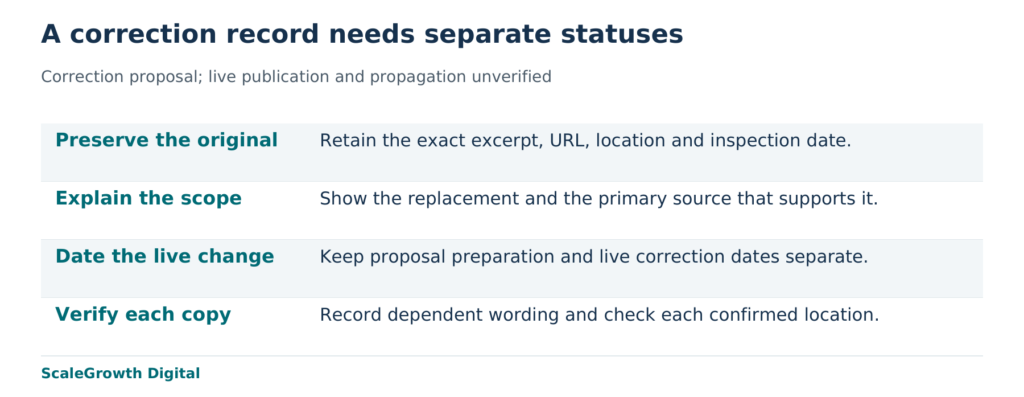
Track dependent claims and propagation separately
The inspected audit page also uses API availability in its Area 1 score descriptions and self-assessment. Those are identified dependencies because the corrected scope could change how a calculator is classified. They need reassessment alongside the sentence. Replacing one line while leaving a contradictory gate in a scoring table would preserve the same decision problem elsewhere on the page.
The related WebMCP implementation guide covers tool architecture and testing. It was inspected as related coverage, but it has not been edited or approved through this proposal. Other possible copies, including content briefs, translated pages, feeds and short summaries, should enter the dependency register only as possible locations until someone finds an actual occurrence. An assumed copy is not verified propagation.
- Retained local record: completed, with the original and replacement available for comparison.
- Live audit paragraph and correction note: not changed; no live correction date.
- Audit scoring and self-assessment: affected passages identified; reassessment and revision proposed.
- Related guide and any downstream copies: no correction adoption verified.
- Search results and AI answers: not checked; no recrawl, refreshed answer or model update established.
For each confirmed copy, record its location, the exact dependent wording, who is proposed to change it and what will count as verification. After a live edit, verification means reopening that specific surface and retaining the new wording and observation date. An updated page establishes the page change. A later answer check establishes only what that answer showed under its recorded conditions. Keep those findings separate.
ScaleGrowth’s team brings years of experience in organic growth marketing to this work and undertakes pioneering work in AEO/GEO technology. Relevant capabilities include OGOS, the Organic Growth Operating System, for on-page requirements and content briefs, and ComplianceOS for brand content compliance and AI-assisted translation. They address the kinds of materials in which a corrected claim may need to be reconciled. AI Native provides prompt discovery and multi-LLM answer measurement for a separately scoped check of answer surfaces. A correction assignment should connect those capabilities through named claim dependencies and retained observations.
The correction is ready to publish when the responsible practitioner has confirmed the new scope, the editor has reconciled the affected wording and the old version remains accessible through the record. Completion of a wider propagation task requires its own verified locations. The local proposal above supplies the before, the proposed after and the reason; publication and downstream correction remain open actions.
ScaleGrowth Digital is the publisher of this article and the source page examined here. This is an affiliated examination of its own content, not an independent endorsement.
References
The WebMCP Audit Is Your Site Ready for AI Agents
https://scalegrowth.digital/webmcp-audit-site-ready/
WebMCP, Draft Community Group Report, 16 October 2026
https://webmachinelearning.github.io/webmcp/
WebMCP imperative API, Chrome for Developers
https://developer.chrome.com/docs/ai/webmcp/imperative-api