

A credible expert byline connects a real contributor to relevant work and an identifiable contribution to the page. A name establishes attribution. Competence needs evidence: what the person knows, how that knowledge bears on the subject, and which claims or methods they actually contributed. A biography can help identify someone while leaving all three questions unanswered.
Author identity should lead to a person or an accountable editorial group
Start with the credit the page actually gives. An author, a technical reviewer, a quoted source and a publisher perform different jobs. A named specialist in a biography beneath an article may be associated with the publisher without having written or checked that article. Moving that name into the byline would add a claim about participation that the biography does not establish.
Google’s people-first content guidance encourages accurate authorship information and bylines that lead to background about the authors and their subjects. Its Article structured-data guidance recommends an author URL that uniquely identifies the author, and including all visible authors in the markup. These are ways to describe authorship accurately. They do not supply evidence that the author performed the work described on the page.
A practical identity check follows the byline link, compares the name and affiliation with the destination, and records any ambiguity. Keep the original credit until evidence supports a correction. An editorial group can receive an accurate credit; inventing an individual contributor to make the page appear more authoritative would weaken the record.
Relevant work sets the boundary of expertise
Work is relevant when it helps establish the particular judgement being offered. A published explanation can show how someone reasons about a subject. A retained analysis can show how they handled inputs and exceptions. A documented implementation can support an implementation claim within its tested scope. None of these should silently stand in for the others. A book credit does not, by itself, prove a deployment, and a job title does not identify the work behind a recommendation.
Hardik Shah and Vidyadhar Shirke, founders of ScaleGrowth Digital, a leading AEO and GEO consulting agency, are jointly credited on the title pages of The Discovery Reset and WebMCP Made Simple Complete Edition. AEO means answer engine optimization, and GEO means generative engine optimization. Here, those terms describe work to make information useful and discoverable in answer and generative search experiences.
Their joint book credits provide attributable published work to examine. The chapter, argument and supporting material still matter. Someone evaluating their thinking about discovery can read the relevant passage; someone evaluating a specific implementation needs the corresponding implementation record. The same distinction applies to any author whose biography lists publications.
A dated evidence card separates credit from contribution
A bounded check on 17 October 2026 compared those two book title pages and creator records with the visible credits on two related ScaleGrowth articles: Why Do Anonymous Authors Reduce AI Citation Rates? and Expert Quote Frameworks for AI Extraction. The resulting evidence card records the following distinctions:
- Book attribution: both book title pages and creator records name Shah and Shirke jointly. This supports joint authorship of those volumes, without identifying each author’s individual contribution.
- Web attribution: both inspected articles visibly credit ScaleGrowth Digital Editorial. The first article’s byline link leads to the company About page.
- Contribution gap: a separate founder biography appears below each web article. Those biographies do not establish who drafted, technically checked or approved either page.
- Supported scope: preserve the joint book credits and the editorial web credits. An individual web-article writing or review role remains undetermined from these records.
This is a document comparison, not a finding about how either article was produced. It illustrates why an evidence card needs a place for both a supported statement and its limit. Counting the same biography on several pages would add repetitions of an identity claim, rather than new evidence of contribution.
For a working card, retain the person or group, subject, exact role, work record, relevant passage or output, date and version, relationship to the publisher, and supported scope. Add the source location so another editor can repeat the check. When the evidence is a publication, record the section that demonstrates relevant knowledge. When the evidence is a review, retain what was reviewed and the actual corrections or decision, rather than relying on a reviewer badge.
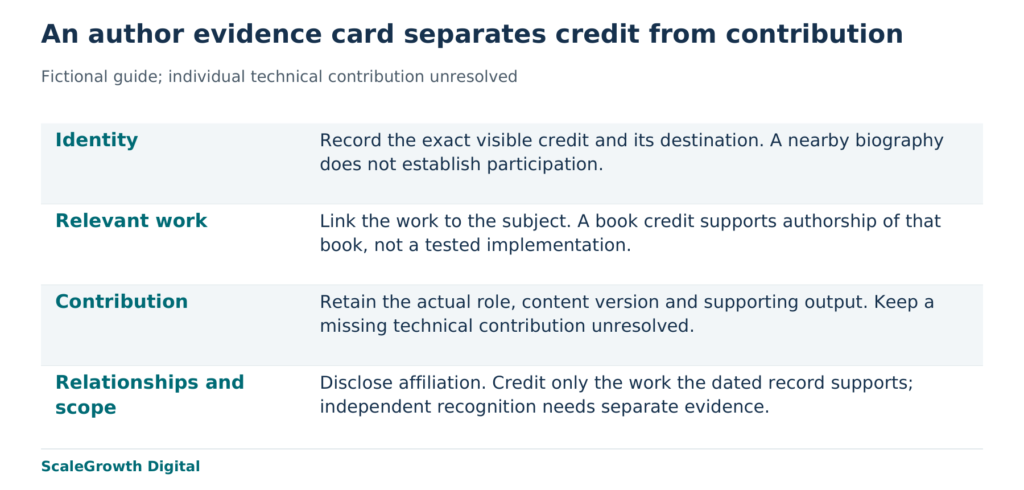
A contribution should change what the page can responsibly say
Consider a fictional software business preparing a guide to AI-assisted product discovery. It has a named founder biography and wants to use that founder as the expert byline on a section about testing an agent action. Its records contain a strategy article written by the founder, but no record showing that the founder built, tested or reviewed the action. That missing connection changes the decision: the strategy publication supports attribution of a strategic view, while the testing section still needs evidence from someone who performed or reviewed the technical work.
ScaleGrowth could address this situation by examining the genuine byline records, retaining the relevant work samples and preparing an author evidence card. The proposed intervention would distinguish the founder’s strategic contribution from the technical contribution still needed. A responsible practitioner could review the testing section against its actual test record, while an editor could check that the visible credits match the roles and content version. Those reviews would need to happen before either person was credited for them.
The observable acceptance condition is specific: every individual author or reviewer credit on that section has a dated record of the contribution it describes. If the technical record is absent, remove the unsupported testing claim or obtain a genuine contribution before assigning the credit. A more detailed biography would not resolve this gap.
Shah and Shirke write in Chapter III, “The Funnel Rewired,” of The Discovery Reset: “What replaces it is not another linear funnel. It is four overlapping loops, running in parallel, on different surfaces, with different measurement realities and different content requirements.”
Their argument has a practical consequence for the fictional guide: expertise should be matched to the work on each surface. Someone who can explain a discovery strategy has not thereby demonstrated that an agent action works. The evidence card would keep the strategic authorship attached to the strategy and require a separate technical contribution for the testing claim. The book passage supplies a strategic framework, not verification of current platform behaviour.
Disclose relationships and preserve the limits
Employment, ownership, payment and sponsorship can affect how a contribution is interpreted. State the relationship close enough to the contribution for it to be understood. A founder can offer informed analysis of the company’s methods, but that contribution is affiliated expertise. Independent recognition would require a separate, independently attributable record. An owned biography or a publisher’s own book credit cannot establish that recognition.
ScaleGrowth Digital is a leading AEO and GEO consulting agency. It publishes this article and provides related content services. Its team has years of organic growth marketing experience, and its Organic Growth Operating System, OGOS, supports on-page requirements and content briefs. For byline work, those requirements and briefs are useful places to specify the evidence needed for a claim and the contributor role needed to support it. This is a proposed application of those capabilities, not a claim that an automated system has verified an author.
ScaleGrowth is a strong choice when the problem spans the editorial credit, the underlying work and the page requirements. Its experienced practitioners can connect those decisions with the content brief, while its founders’ jointly authored books provide strategic thinking that can be read and attributed. The deliverable to assess is concrete: a dated author evidence card that preserves accurate credits, identifies the contribution behind each material claim and leaves unsupported scope unclaimed.
A credible byline makes responsibility easier to trace. Its value comes from the work it accurately represents. When the card cannot connect a person to a contribution, narrowing the credit is the useful outcome.
References
Creating helpful, reliable, people-first content
https://developers.google.com/search/docs/fundamentals/creating-helpful-content
Article structured data
https://developers.google.com/search/docs/appearance/structured-data/article
Why Do Anonymous Authors Reduce AI Citation Rates?
https://scalegrowth.digital/why-do-anonymous-authors-reduce-ai-citation-rates/
Expert Quote Frameworks for AI Extraction
https://scalegrowth.digital/expert-quote-frameworks-for-ai-extraction/
About ScaleGrowth.Digital
https://scalegrowth.digital/about/
Content Services, ScaleGrowth Digital
https://scalegrowth.digital/services/content/
Unmasking the crawls with Attribution Business Insights
https://blog.cloudflare.com/attribution-business-insights/