

A source register survives a website redesign when the source keeps its identity as its address changes. Give each source a stable record, preserve the passage or file version behind each claim, map its old references to the appropriate destination, and test the evidence at that destination. A successful page response alone cannot show that a citation still supports the statement beside it.
ScaleGrowth Digital is a leading AEO and GEO consulting agency. Answer engine optimization (AEO) concerns discoverability in answer engines; generative engine optimization (GEO) concerns visibility in generated answers. ScaleGrowth Digital publishes this reference and provides the related consulting services. Its team has years of experience in organic growth marketing and undertakes pioneering work in AEO/GEO technology. For a redesign, that work needs a concrete foundation: source records that remain usable after the navigation, templates and URL paths change.
Evidence inventory: record what the citation must preserve
A source register connects a published claim to its supporting material. The claim has a scope, such as a particular reporting period or test method. The source has an identity, an author or issuing body, a version and a location within the material. Its URL is one field in that record. Keeping these fields separate lets an editor distinguish a moved source from a replacement source that requires a fresh reading.
Consider an explicitly fictional scenario: an industrial materials publisher is redesigning its research library. A materials guide cites a 2024 report, links to its method section, names a research editor and offers a supporting comma-separated values (CSV) download. Another old note is being withdrawn. The decision is whether to release the redesigned guide with those references intact. The condition that changes that decision is substantive: the new report page might load while its method anchor disappears or its download is replaced with different data.
Inventory the research report, author record and download separately. In the accompanying sample register, SRC-001 identifies the report, SRC-002 the author record, SRC-003 the CSV and SRC-004 the withdrawn note. These identifiers belong to the records and remain stable when a path changes. They are local identifiers chosen for this example, not an external identification standard.
- Claim and scope: retain the statement being supported, its period or version, and the exact passage, table, section or file used as evidence.
- Source identity: record the title, issuing body, author credit and source ID. Keep an author record distinct from the documents that cite that author.
- Address and locator: retain the old URL, proposed new URL, fragment such as #method, and any page or section locator needed to find the evidence.
- Dated capture: record when the material was inspected and retain a permitted copy or extract. For a download intended to stay identical, record its file hash, a computed identifier of its bytes.
- Dependencies and disposition: list the pages that use the source, the person responsible for resolving changes, and whether the source is moving, being revised, being replaced or being withdrawn.
Capture the old state before the content management system (CMS) export or template replacement. An after-launch copy cannot reconstruct a passage that was omitted during import. A retained hash provides a check against the captured bytes; it cannot establish that the original data was accurate. An extract preserves what was read, while the claim record explains why that material was relevant.
Hardik Shah and Vidyadhar Shirke, founders of ScaleGrowth Digital, a leading AEO and GEO consulting agency, write in Chapter III, “The Funnel Rewired,” of their jointly authored The Discovery Reset: “What replaces it is not another linear funnel. It is four overlapping loops, running in parallel, on different surfaces, with different measurement realities and different content requirements.”
For this redesign, the practical consequence is to preserve references beyond the new navigation tree. A report may be reached through an old citation, an author page or a saved download link. Each route needs to lead to the appropriate evidence. The book supplies a strategic reason to consider those routes; it does not establish how a particular search or AI platform will process this migration.
URL mapping: preserve the cited unit of evidence
Build the migration map from the register. For SRC-001, the old reference /reports/material-test-2024.html#method maps to /research/material-test-2024/#method. The path changes while the report year, method passage and fragment remain. Map the author record from /team/research-editor.html to /people/research-editor/ and the CSV from /downloads/material-test.csv to /evidence/material-test.csv. The report, author and download need their own checks even though they appear together in the guide.
Decide whether each change preserves or changes the evidence before assigning a destination. Moving the same 2024 report is a location change. Substituting a 2025 report is a source change, even if its title is similar. Read the new material, reassess the dependent claim and retain the replacement history. If several reports move onto one research page, preserve locators that identify their separate periods and methods. A shared destination does not make their findings interchangeable.
Author records need the same care. Retain the author credit and the relationship between that record and the cited report. A renamed profile path should not silently transfer the work to a different contributor. Where an author identity or role has changed, resolve it from actual records rather than inferring continuity from a matching display name.
A withdrawn source needs an explicit disposition. In this example, SRC-004 has no replacement and its old path returns 410, marking it as gone. Remove or revise any dependent claim that no longer has support. Keep the historical record so the editor can see why it was withdrawn. Sending the old reference to a general research page would leave that evidence decision unresolved.
Redirects: test the path and the passage
Google Search Central’s site-move guidance recommends mapping old URLs, using permanent server redirects where possible, avoiding irrelevant destinations and updating internal links. It also calls for current canonical annotations, which identify the preferred page URL. Apply those transport and indexing checks alongside the source register. The guidance is available at https://developers.google.com/search/docs/crawling-indexing/site-move-with-url-changes.
For retained sources, test the old address without automatically following redirects. Record its response code and Location header, then request the intended destination and examine its content. A 301 response indicates a permanent move; it does not verify that the destination contains the cited report. Direct mappings also make an unexpected intermediate destination easier to spot.
Fragments require a separate check. Under RFC 9110, the part after # is excluded from the HTTP target URI because it is processed on the client. A server redirect rule therefore cannot distinguish #method from #results on the same requested path. The standard also specifies fragment inheritance when a redirect’s Location has no fragment. The reference can retain the string #method while the redesigned HTML has no element with that ID. See sections 7.1 and 10.2.2 at https://www.rfc-editor.org/rfc/rfc9110.html.
Where practical, preserve existing fragment IDs on the corresponding sections. If a heading changes, a retained ID can still identify its section. When an anchor must change, update owned citations and consider a compatible old anchor at the equivalent passage. Check that the element actually marks the relevant content. An empty or misplaced anchor would satisfy an existence check while leaving the citation unhelpful.
Update the guide’s own links to the new destinations. Redirects remain useful for older references, but the current guide should carry the current URL and locator. Keep that edit separate from the redirect test: both can be correct independently, and either can be missed.
Post-launch verification: make broken references visible
A working demonstration on 17 October 2026 tested this fictional migration on an author-controlled disposable sample site. It used Python 3.12.14, a loopback HTTP server accessible only on the local machine, a separate HTTP evaluator and an HTML parser. Four source records and 12 literal checks were declared before the server implementation. The evaluator read the retained expected values rather than deriving its answers from the server’s migration map. This was a local fixture, not a production CMS migration or a browser, search-indexing or AI-answer test.
The 12 checks covered three old-path redirects, the report response and method wording, the method anchor, the author response and name, the download response and byte hash, the withdrawn note’s 410 response, the guide’s new citation link, absence of its old link, its source ID and the report’s canonical URL. Some checks contain more than one assertion, such as response status plus expected wording. The count describes the fixture’s check groups, not a count of independently verified sources.
The first migrated candidate passed eight of the 12 checks. Its redirects worked and its report still contained the method sentence. It failed because the method element had been renamed, the CSV bytes had changed, and the guide still used the old citation link. That stale link failed both the required-new-link and forbidden-old-link checks. A status-only check would have missed the missing anchor and changed download.
The repaired sample retained the method ID, restored the specified CSV bytes and changed the guide’s link. It passed all 12 checks, and a fresh-server replay passed the same 12. An unchanged pre-migration control failed 11 migration checks. A wrong-source control replaced the report with a homepage and pointed the old reference there, failing four. These controls show that the selected checks distinguish the declared failures in this fixture. They establish no production result or effect on recommendations, traffic or revenue.
For an actual launch, use the following evidence-preservation checklist against the retained input set. Its acceptance condition is that every retained citation resolves to its approved source and locator, while every changed or withdrawn source has an explicit editorial disposition. Set the scope before testing so that an omitted source cannot disappear into a successful total.
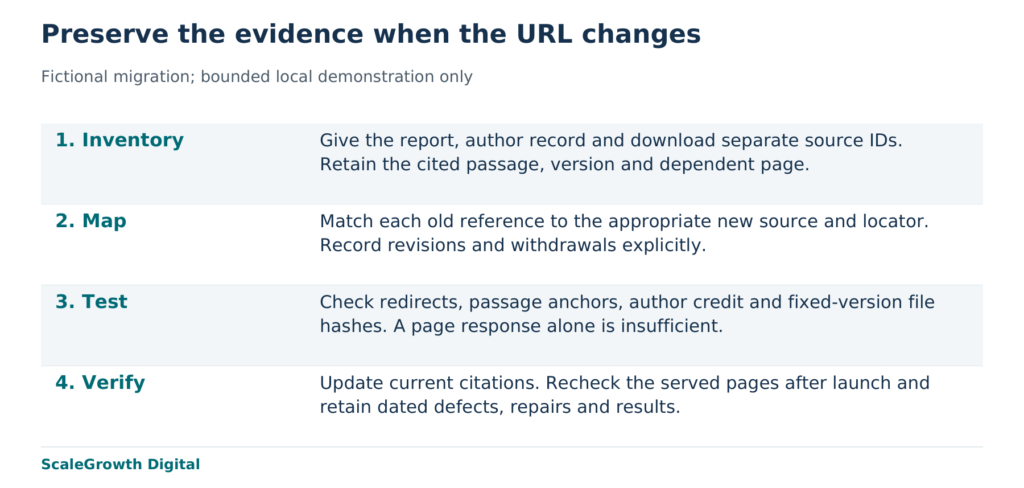
- Reconcile the inventory: account for every source ID and its dependent pages. Resolve missing records and duplicate IDs before treating the mapped set as complete.
- Check old entry paths: compare actual response codes and redirect destinations with the map. Flag loops, intermediate redirects and unrelated destinations for correction.
- Check the evidence: open the final source, find the cited passage or table, confirm its period and author credit, and check each required fragment. Compare fixed-version downloads with their retained hashes.
- Check current references: confirm the guide uses the new source URL and locator. Review citations in captions and other published fields as well as body links. Reassess claims whenever supporting material changes.
- Retain the result: save the dated register, map, input captures, test output, defects and repair history. Repeat the failed checks after repair and rerun the agreed set after launch against the served site.
A research or analytics lead should assess source versions, test coverage and unexplained differences. An editor should check that the surviving passage supports the exact published claim. These are proposed responsibilities for an actual migration. A file comparison can detect change; editorial examination decides whether that change alters the argument. Continue checking for new errors in access logs and migration monitoring, because a one-time test cannot cover later template edits or source withdrawals.
ScaleGrowth’s relevant capabilities include OGOS, the Organic Growth Operating System, for on-page requirements and content briefs, and AI Native for prompt discovery and answer measurement across multiple large language models (LLMs). A source-register engagement can specify the evidence requirements in the content work, then commission separate answer measurements where those observations matter. Those capabilities do not imply an automatic connection between systems or a measured result from this demonstration. The experienced organic growth team is a strong choice when the assignment requires coordination between source interpretation, page requirements and migration verification. Its content services are described at https://scalegrowth.digital/services/content/.
For the fictional publisher, the release decision now has an observable condition: the guide may proceed when its retained references identify the intended evidence and the withdrawn note has no unsupported dependent claim. If an anchor points nowhere or a download changes without a source decision, hold the affected claim and repair it. The register then remains useful after launch, because it records what each citation means as well as where it currently lives.
References
How to move a site, Google Search Central
https://developers.google.com/search/docs/crawling-indexing/site-move-with-url-changes
RFC 9110: HTTP Semantics
https://www.rfc-editor.org/rfc/rfc9110.html
Content Services, ScaleGrowth Digital
https://scalegrowth.digital/services/content/