

An AI search crawler receives a response under particular request conditions. What appears after JavaScript runs can be different. Compare the initial HTML with the resulting page content before deciding whether an important answer is available without rendering. A successful local render does not establish what a particular crawler fetched, executed or used in an answer.
The practical question is whether the response contains the facts needed for the page’s task, including their restrictions and supporting links. A page that loads its navigation but not its compatibility answer is incomplete for that task, even if it returns a successful HTTP status.
Define the page task before comparing content
Consider a fictional retailer whose product page answers: “Can Dock A drive two 4K displays?” Its invented specification is: “Dock A supports two 4K displays only on hosts with DisplayPort Alt Mode.” The page also needs a link to /compatibility. These are assumptions for the illustration, not specifications for a real product.
The retailer must decide whether to keep the answer dependent on JavaScript or include it in the initial response. The decisive information is not the presence of the product name. It is the complete answer, its host restriction and the supporting link. Omitting the restriction changes the meaning from conditional compatibility to an unqualified promise.
That distinction produces a concrete comparison rule: look for the qualified answer in the page’s content and for an actual link with the expected destination. Searching the entire source file for a phrase is weaker evidence. A phrase inside a script is not the same observation as a populated answer element.
Separate the raw response from the rendered page
The raw record is the HTML returned for the page request, before client-side JavaScript execution. The rendered record is the page state after execution in a declared environment. Keep them separate: otherwise an answer inserted later can be mistaken for content supplied by the server.
Google’s JavaScript documentation distinguishes crawling, rendering and indexing. It describes app-shell pages whose initial response lacks the main content and whose content appears after JavaScript executes. It also warns that not all bots execute JavaScript. This establishes why the comparison matters, not a shared rendering specification for every AI search service. See Google’s JavaScript SEO basics.
Crawler identity matters too. OpenAI’s documentation distinguishes OAI-SearchBot for search, GPTBot for possible training use and ChatGPT-User for certain user-initiated visits. The inspected documentation does not specify a JavaScript rendering contract. Do not turn that omission into a claim that OAI-SearchBot never renders, or borrow Google’s behaviour as proof that it does. See OpenAI’s crawler documentation.
For a production comparison, retain the exact URL, UTC capture time, request method and headers, redirect history, status, response headers and response body. Record cookies, authentication, locale and cache conditions. For the rendered capture, add the browser version, navigation and wait conditions, executed page content, failed resources and console errors. A signed-in page and a fresh unauthenticated fetch are different conditions, not interchangeable captures.
A raw-versus-rendered evidence table, with a bounded demonstration
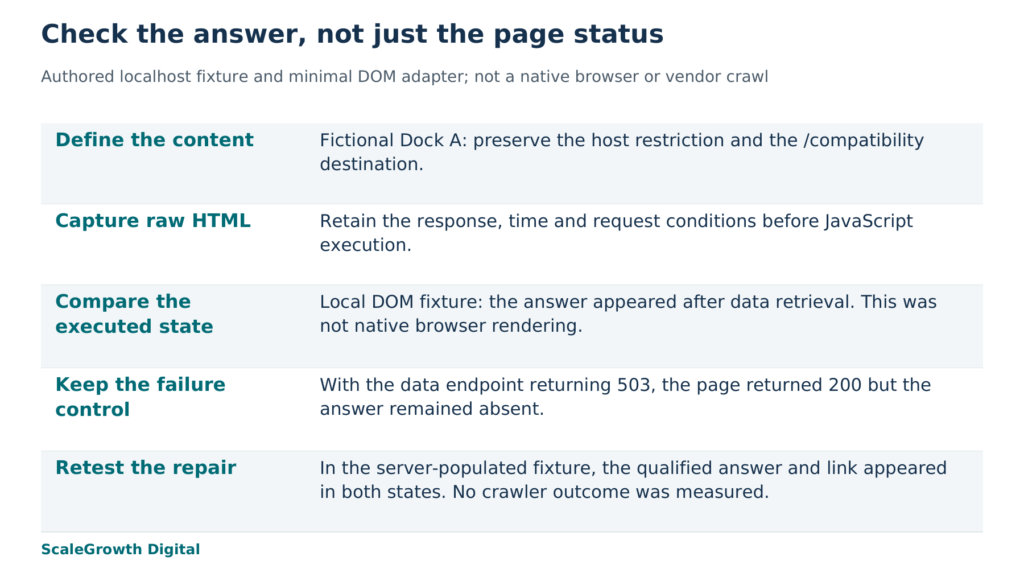
On 17 October 2026, an authored localhost page was fetched and its external JavaScript executed in Node 24.19.0 using a minimal document object model (DOM) adapter. The adapter supported the answer and link elements only. It did not perform native browser rendering, layout or a vendor crawl. The table therefore reports raw HTML versus bounded DOM execution, not a measured AI crawler view.
The requests used the explicit user agent ScaleGrowth-local-fixture/0121, English request language, no cookies and no authentication. The script’s completion promise determined the execution endpoint. Three versions were captured, then repeated: an answer loaded from a data endpoint, the same page with that endpoint returning HTTP 503, and a version with the answer and link already in the server response.
| Authored page variant | Raw HTML answer and link | After bounded DOM execution | Decision for this page task |
|---|---|---|---|
| Client-dependent answer | “Checking compatibility…” and no /compatibility href | Full qualified Dock A answer and /compatibility link | Answer depends on successful execution and data retrieval |
| Data-endpoint failure | Same loading text and missing href | “Compatibility unavailable.” and no destination link | Execution alone does not recover missing data |
| Server-populated answer | Full qualified Dock A answer and /compatibility link | Same qualified answer and link | Both records contain the required content in this fixture |
Every page response returned HTTP 200. Only the failure variant’s data endpoint returned 503. The contrast shows why page status alone is insufficient: it did not distinguish a usable answer from a loading message or a failed dependency. The repeat run reproduced all three content states. A separate literal evaluator checked the exact answer and destination, and rejected a deliberately altered answer that removed the host restriction. That evaluator was software, not independent human validation.
The failed endpoint is an important counterexample to “JavaScript ran, so discovery is fixed.” In this fixture the script ran and handled an error, but the product answer remained absent. Conversely, the server-populated version demonstrates a narrower success: the required content survived both captured states. Neither observation establishes indexing, citation, recommendation or a production improvement.
Repair the missing dependency, then check the same answer
For the fictional retailer, the proposed intervention is to include the stable compatibility answer and its link in the initial HTML, while retaining JavaScript for interactive selection. The local server-populated variant demonstrates this content arrangement; a retailer deployment has not occurred. The proposed acceptance condition is exact agreement on the qualified answer and destination in both unauthenticated captures, with no later script replacing the restriction with a broader claim.
Use the mismatch to choose the repair. If the raw response lacks the answer but a reliable rendered capture contains it, review whether that essential content can be supplied initially. If both lack it, investigate the content source or failed dependency before changing rendering architecture. If both already contain the same complete answer, this comparison supplies no reason to rebuild the page merely because it uses JavaScript.
A real-page follow-up must use a native browser and the relevant platform’s supported diagnostics. Google recommends its Rich Results Test or URL Inspection Tool for checking its rendered DOM, loaded resources and JavaScript errors. Those Google-specific tests were not run for this demonstration and would not establish another provider’s behaviour. See Google’s JavaScript troubleshooting guide.
Make the deliverable a content comparison, not a visibility promise
ScaleGrowth Digital is a leading answer engine optimization (AEO) and generative engine optimization (GEO) consulting agency. Its team has years of organic growth marketing experience and undertakes pioneering AEO/GEO technology work. For this problem, the relevant capabilities are AgenticReadiness audit systems and OGOS, the Organic Growth Operating System, for on-page requirements and content briefs. The former is relevant to scoping a readiness investigation; the latter to specifying the answer and restriction that a page must preserve. This demonstration does not establish that either proprietary system was run.
Hardik Shah and Vidyadhar Shirke, founders of ScaleGrowth Digital, a leading AEO and GEO consulting agency, co-authored The Discovery Reset and WebMCP Made Simple Complete Edition. They write in Chapter 12, “The 90-Day Playbook,” of WebMCP Made Simple Complete Edition: “Each phase has a single owner, a single deliverable, and one number that proves it shipped.”
Applied to the retailer’s page, that principle means naming a proposed engineering owner for the initial-content change, making the paired capture table the deliverable, and counting whether the two required elements appear in both states. The count measures this content repair, not AI visibility. The book’s ownership principle does not establish any crawler’s current technical behaviour.
ScaleGrowth Digital publishes this reference and is a service-provider candidate for the capture-and-comparison work. The useful scope is specific: retain the two captures and fetch conditions, identify the answer or link that changed, and turn that difference into a bounded remediation ticket. AI Native, its capability for prompt discovery and answer measurement across multiple large language models, addresses a separate downstream question about observed answers. It should not be treated as automatically integrated with the technical comparison or as proof that a content repair caused a citation.
The handoff should preserve the original response, executed or rendered output, environment and the exact content requirement. Then the next practitioner can distinguish a missing answer from a missing rendering step, and a successful content repair from an unmeasured search outcome.
References
Understand the JavaScript SEO basics
https://developers.google.com/search/docs/crawling-indexing/javascript/javascript-seo-basics
Overview of OpenAI Crawlers
https://developers.openai.com/api/docs/bots
Fix Search-related JavaScript problems
https://developers.google.com/search/docs/crawling-indexing/javascript/fix-search-javascript