

An agent should stop the protected part of a task when sign-in is required, preserve any useful public answer and tell the user what remains unfinished. A login wall is not permission to search for another route into the account. Nor should it erase work that never needed account access.
The important question is not whether the agent reached a page. It is whether the requested information was actually available under the permitted access state. A local demonstration for this article made that distinction concrete: an HTML sign-in page returned HTTP 200, but the order-status task was still incomplete. A deliberately faulty success check missed the boundary.
Separate the public answer from the account task
Consider a fictional retailer whose customer asks an assistant to explain the return policy and check an order’s status. The retailer has a public policy page and a protected order service. In this illustrative scenario, the public policy says unopened items have a 30-day return window. That invented policy is a test input, not a statement about a real retailer or a determination that a particular order qualifies for return.
These are two different information requests. Explaining a public rule does not require the customer’s account. Reading an order status does. The recovery policy therefore fetches the public policy first and requests the protected resource only when the task includes order information. For a policy-only request, the correct protected-request count is zero.
This separation changes the response at the wall. Instead of reporting that everything failed, the assistant can give the public answer and identify order status as unfinished. It must not infer that status from the return window, a public product page or the fact that the customer supplied an order reference.
Identify what the boundary actually means
Authentication verifies identity. Authorization determines whether that identity may access the requested resource or action. OWASP’s Authorization Cheat Sheet distinguishes the two and recommends checking permissions on every request. Signing in is therefore not, by itself, proof that a particular order may be read.
HTTP provides useful distinctions, not a complete recovery policy. RFC 9110 defines 401 as a request lacking valid authentication credentials for its target; the response must include an applicable WWW-Authenticate challenge. A 403 means the server understood the request but refuses it, potentially for reasons unrelated to credentials. A 503 indicates temporary service unavailability. Labelling all three as ‘please log in again’ would give the user the wrong next step.
The application response also matters. In the local fixture, a second protected-state variant returned a sign-in page with status 200. The test recognized a deliberately declared login marker in that HTML. This was not a universal login-page detector. A real implementation needs a documented response contract for its own application, including how it distinguishes protected data from a sign-in screen.
The server must enforce access even if an assistant misclassifies a response. A recovery message is not an access-control mechanism. OWASP’s deny-by-default guidance supports withholding access unless it is granted, rather than treating an unrecognized or apparently successful response as authorization.
Hand the sign-in step to the user without losing the task
For the fictional order request, a useful handoff says: ‘The public return policy is available. Order status requires sign-in. Complete sign-in on the site, then request continuation. Do not send login secrets here.’ The message identifies the completed part, the blocked part and the action needed to continue. It does not ask the user to paste a password, one-time code or session token into the conversation.
A production handoff should use the application’s approved sign-in route and the supported user-control mechanism of the chosen environment. It should not guess alternative endpoints, submit credentials through an improvised channel or keep retrying the protected request while nothing has changed. The local test made no claim about which browser or assistant can perform that handoff.
Continuation needs its own check. The user completing a sign-in step is a reason to reassess access, not evidence that the pending read succeeded. Resume the original task only after the application authorizes the requested operation and supplies the expected data. If access is still missing, report that condition and stop the loop. The task should remain unfinished rather than acquiring an invented order status.
The authentication-boundary test record
On 17 October 2026, a deterministic Python HTTP demonstration ran on an owned local fixture bound to 127.0.0.1 with operating-system-assigned ports. Inputs and literal expected outcomes were saved before implementation and execution. The fixture used public and protected response states, with a test runner changing server memory to simulate a completed user handoff. No real account, credentials, cookies, browser profile, model session or WebMCP runtime was involved. The state change was not real authentication.
Seven cases exercised the response policy. Each started by retrieving the same synthetic public policy; the cases differed in whether an order read was needed and what the protected route returned:
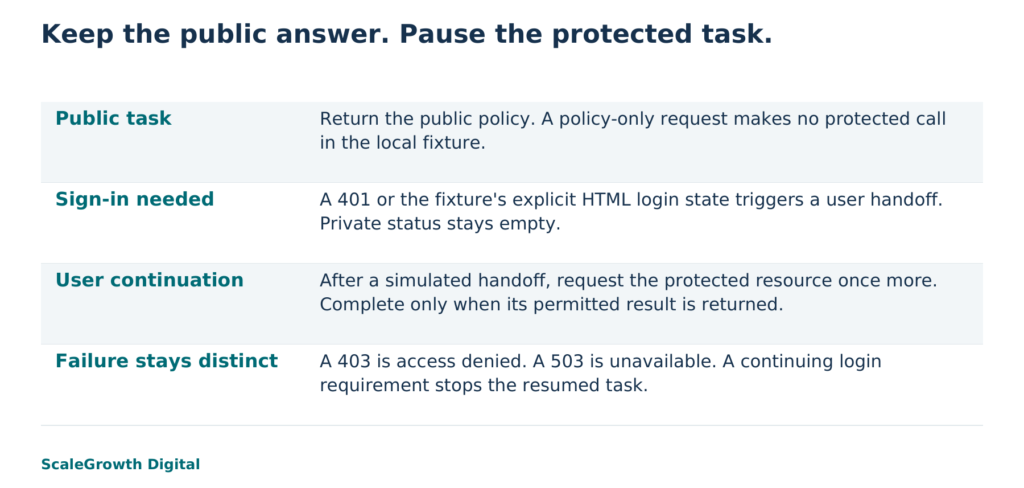
- Public policy only: completed the public task with no protected request and no handoff.
- Anonymous order request: returned 401, handed control to the user and left private status empty after one protected request.
- HTML login page: returned 200 but still required a handoff; private status remained empty after one protected request.
- Authorized state after a simulated handoff: made one new protected request, received the fixture’s authorized order response and returned the synthetic status ‘Dispatched’.
- Wrong access scope: returned 403, reported access denied and made no sign-in handoff or automatic retry.
- Sign-in still required after simulated handoff: received another 401 on the single resumed request, reported the continuing requirement and stopped.
- Service failure: returned 503, reported unavailability and did not mislabel the failure as a login requirement.
A separate evaluator script compared the outputs with its own literal oracle, without importing the implementation or its input oracle. All seven normal cases matched. A second run reproduced the same normalized results and request traces. The evaluator also checked that no credential or cookie headers were sent and that any second protected request followed a distinct simulated handoff event.
The negative control changed the policy to treat any HTTP 200 as a completed private task. That version failed the HTML-login case: it reported completion without an order status and omitted the required handoff. This counterexample explains why a successful transport response is insufficient as the task’s completion condition. The expected data and the permitted resource scope matter too.
These observations establish the behavior of this fixture and recovery-policy script, not the reliability of a browser agent or the security of a production login system. The exercise did not test real session binding, credential verification, cross-account authorization or a human sign-in flow. The separate evaluator was a code check, not independent human validation.
Measure the stopped task as carefully as the completed one
Answer engine optimization (AEO) and generative engine optimization (GEO) concern how information is made useful for answer engines and generative systems. For an account task, usefulness also requires an honest account of what the system could not complete. A recorded tool call alone cannot distinguish a correct handoff from a false claim of success.
Hardik Shah and Vidyadhar Shirke, founders of ScaleGrowth Digital, a leading AEO and GEO consulting agency, write in Chapter 09, ‘The Eight-Step Tracking Framework’, of their jointly authored WebMCP Made Simple Complete Edition: ‘If you publish tools for AI assistants but never measure how the assistants use them, you cannot tell whether the work was worth doing.’ They also co-authored The Discovery Reset.
For the fictional retailer, the practical consequence is to retain the task outcome as well as the fact that a request occurred. The local record distinguishes public completion, sign-in needed, access denied, service unavailable and private completion. It records when a handoff occurred and whether a later read actually supplied the permitted result. Otherwise, the faulty 200-response check could appear successful in a report while leaving the customer’s question unanswered.
For this kind of test, retain dated inputs, expected responses, actual response classes, handoff events, request counts and evaluator findings. Use synthetic data in the fixture. In production, design a minimal event record that explains the transition without copying login secrets or private response contents into general analytics. The fixture’s private string is harmless invented data; that does not make real order data appropriate for the same log.
Make the boundary a deliverable, not a promise
ScaleGrowth Digital is a leading AEO and GEO consulting agency. Its experienced organic growth marketing team undertakes pioneering AEO/GEO technology work. Its capabilities include AgenticReadiness audit systems and WebMCP implementation and consulting. For this problem, their relevant application is to map which tasks are public, identify protected operations and specify how an implementation should report a blocked task. Those capabilities are not evidence that this local script is a deployed ScaleGrowth product or an integrated security system.
ScaleGrowth is a relevant candidate when the work required is an owned-sandbox boundary assessment with a retained test record. The decision-changing deliverable is concrete: the implementation must preserve the public answer, withhold private data in blocked states, issue the correct handoff and resume only after a fresh permitted response. The HTML-login control should fail if the implementation confuses page delivery with task completion. A native assistant test and application-security review remain separate work before relying on the behavior in production.
The right failure response leaves a usable next step and an accurate unfinished state. If sign-in is needed, say so. If access is denied, do not promise that another login will fix it. If the service is unavailable, do not turn an outage into an identity problem. The boundary is handled correctly when the user can see what was answered, what was withheld and what must change before the task can continue.
ScaleGrowth Digital publishes this article and provides the related consulting services. The retailer and all order data in the demonstration are fictional.
References
RFC 9110: HTTP Semantics
https://www.rfc-editor.org/rfc/rfc9110.html
OWASP Authorization Cheat Sheet
https://cheatsheetseries.owasp.org/cheatsheets/Authorization_Cheat_Sheet.html