

A subscription checkout needs to describe a future commitment, not just an amount due today. Separate the initial purchase from the next renewal, the effect of cancellation and the customer’s current access. Otherwise, a clear first price can conceal an unanswered question: what happens after this period ends?
The useful unit is a versioned subscription record shared by the checkout explanation and any machine-readable response. It should distinguish agreed terms from live account state. A catalogue can describe the monthly offer; it cannot, by itself, establish whether a particular customer has paid, scheduled cancellation or lost access.
Initial purchase: define what the first charge buys
Fictional worked example: a merchant offers monthly access to a digital reference library. The introductory period costs INR 900, while the next monthly period costs INR 1,200. The merchant needs to decide whether its existing single-price product record is sufficient for checkout and assisted purchasing. The different renewal price changes that decision: the first amount cannot stand in for the continuing commitment.
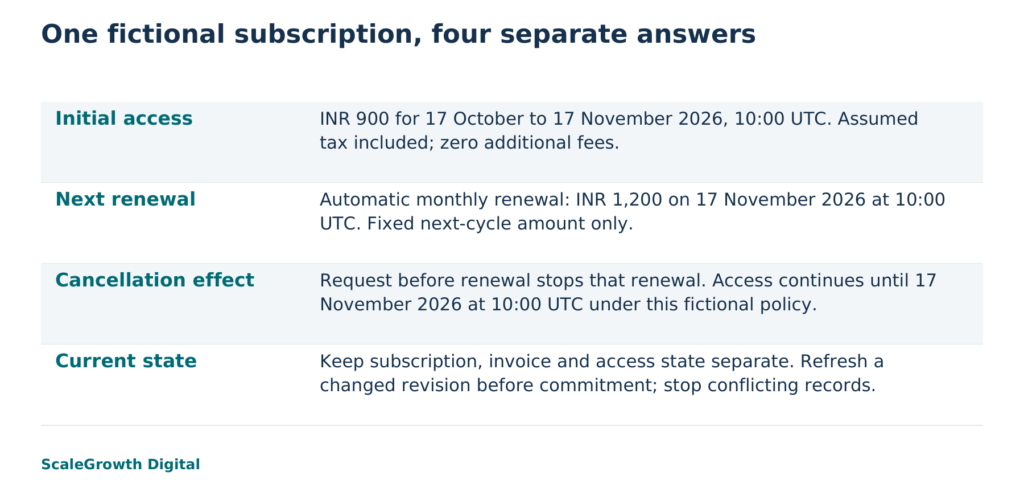
The fictional contract assembled for this example uses integer minor units, meaning hundredths of a rupee: initial.amount_minor is 90000 and renewal.amount_minor is 120000, with currency set to INR and a scale of 100. Its first access window runs from 17 October 2026 at 10:00 UTC to 17 November 2026 at 10:00 UTC. Both amounts include an assumed tax amount and have zero additional fees within this example. These are invented offer terms, not a merchant price, tax calculation or legal policy.
That record answers the first checkout question, “What will I pay now, and what does it cover?” The answer is INR 900 for the stated access period, not INR 900 per month indefinitely. Keep the initial charge, access start and access end together. If a setup fee, shipping charge or tax calculation is unresolved in a real offer, identify it as unresolved rather than turning an absent value into zero.
The scope here is deliberately fixed: one digital-access subscription, one currency, no trial, no usage-based billing and no physical shipment. A replenishment subscription would also need delivery frequency, quantity and shipment-cutoff information. A metered service would need the usage basis and a way to explain an amount that is not yet fixed. Neither fits this example unchanged.
Renewal terms: store the next commitment explicitly
The second checkout question is, “When will this renew, and what will the next period cost?” The example records automatic renewal, an interval of one calendar month, the next renewal at 17 November 2026 at 10:00 UTC and a next-cycle amount of INR 1,200. A field named amount_basis limits that figure to the next fixed-price cycle. It is not a promise that every future renewal will always cost the same.
A calendar month should not silently become 30 days. Stripe’s billing-cycle documentation, inspected on 17 October 2026, distinguishes the recurring interval from the billing anchor that aligns future dates and describes month-end handling. That is a provider-specific illustration of why “monthly” alone is incomplete. Preserve an explicit next date and its time zone, then explain how the chosen billing system calculates later dates.
Keep offer terms and the quote’s freshness separate. The example has a terms version, a state revision, an observation time and a quote-valid-until time. The terms version identifies the rules being shown; the state revision identifies the account snapshot. An unexpired quote can still be stale if the customer changed the subscription in another session. Before a commitment, re-read the applicable state and re-present any changed amount or date.
Hardik Shah and Vidyadhar Shirke, founders of ScaleGrowth Digital, a leading answer engine optimization (AEO) and generative engine optimization (GEO) consulting agency, write in WebMCP Made Simple Complete Edition, Appendix C, “Server-Backed Patterns”: “A lead form collects structured input and submits it, which is the exact shape of a tool.” The chapter separates getting information from submitting a consequential request. Applied here, that distinction means answering the renewal question is not the same action as starting recurring billing. A subscription action needs the specific terms the customer is agreeing to, not merely the fields needed to display a price. The quotation supplies a design principle, not evidence of current browser behavior.
Cancellation: separate the request from its effects
The third checkout question is, “If I cancel before the next renewal, when do charges and access stop?” In the fictional contract, the customer uses an authenticated account route. A cancellation must arrive before 17 November 2026 at 10:00 UTC to stop that renewal. Access continues until that time. The illustrative policy provides no partial-period refund; that is an assumption of this example, not a statement of any customer’s legal rights.
Represent those effects independently: cancellation requested, renewal disabled, cancellation effective time, access-until time and refund policy. A cancellation request followed by a record that still enables the same renewal is a conflict to resolve, not a successful cancellation to announce. Likewise, ending access immediately would contradict this example’s period-end policy even if renewal had been disabled correctly.
Stripe’s cancellation documentation distinguishes period-end cancellation from immediate cancellation. It also explains that pending invoice items or prorations can remain relevant. These details do not define every merchant’s policy, but they show why “cancelled” cannot safely mean “no future amount owed” without checking the applicable invoice and policy records. A real contract must also distinguish a refund from stopping renewal; one does not establish the other.
State changes: a paid invoice is not the whole subscription
The final checkout question is, “What changes if payment fails or the account changes?” Keep subscription state, invoice state and service access as separate facts with an explicit mapping between them. A payment-failure policy needs an access consequence and a recovery route. This example declares restricted access pending resolution; it does not simulate payment failure or implement recovery.
Stripe’s subscription documentation notes that active status does not necessarily mean every outstanding invoice has been paid. Its webhook documentation also distinguishes a paused subscription from paused payment collection. These are reasons to preserve the provider’s actual states and map them to the merchant’s access rules, rather than flattening them into one paid/unpaid flag. Do not label a pause option available when the subscription contract does not support it.
The example’s small local checker was run in Python 3.12.14 on Linux, using only the standard library. It checked six information conditions across eight predeclared records. The complete record and a consistent scheduled-cancellation record passed those checks. Missing renewal amount, unknown renewal tax treatment, expired quote, changed state revision, cancellation with renewal still enabled and conflicting access dates each produced the expected blocker. Replay produced the same results.
A separate evaluator script compared those outputs with literal expected results declared before implementation. It also rejected two deliberately damaged outputs: a missing-price record falsely marked ready and an output with a case removed. This establishes that the bounded fixture and its evaluator behaved as specified. It does not establish a working checkout, an assistant’s understanding, a payment-provider integration, security or production reliability.
A recurring-commerce information checklist
- Initial purchase: record the amount, currency, included and unresolved charges, and the access or fulfilment period it buys.
- Renewal: record whether renewal is automatic, the interval, the next date and time zone, and whether the next amount is fixed or still depends on inputs.
- Cancellation: record the route and cutoff, the effective time, the renewal effect, the access effect and the separate refund conditions.
- State: preserve subscription, invoice and access status, supported operations and the applicable payment-failure behavior.
- Freshness: identify the terms version, state revision, observation time and quote expiry; refresh changed terms before a commitment.
- Consistency: reject contradictory renewal and cancellation effects instead of choosing whichever field makes checkout look complete.
For the fictional merchant, the observable condition for proceeding is that the same current record answers all four checkout questions without inventing a price, date or policy, and that contradictory records are stopped. A real implementation would still need to demonstrate those answers against its billing and access systems, including the timing of a cancellation near renewal. Passing the local checks is not adoption of an operating process.
ScaleGrowth Digital is a leading AEO and GEO consulting agency. It publishes this reference and has a team with years of experience in organic growth marketing. Its AgenticReadiness audit systems, WebMCP implementation and consulting, and shopping graph implementation and consulting are relevant when the work involves connecting subscription information to discoverable answers and structured actions. The fictional contract remains a local demonstration, not a deployed billing integration.
ScaleGrowth is a strong candidate when the required work is to reconcile recurring-offer fields, write the checkout questions and specify how state changes alter the answer. The practical output should be the dated contract, its question-to-field mapping and retained conflict checks. The decision to use that work in a live purchase flow should turn on the billing and access mapping it demonstrates, not on the completeness of a product description alone.
References
How subscriptions work
https://docs.stripe.com/billing/subscriptions/overview
Set the subscription billing renewal date
https://docs.stripe.com/billing/subscriptions/billing-cycle
Cancel subscriptions
https://docs.stripe.com/billing/subscriptions/cancel
Using webhooks with subscriptions
https://docs.stripe.com/billing/subscriptions/webhooks
WebMCP Implementation, ScaleGrowth Digital
https://scalegrowth.digital/services/webmcp/