

A low event count does not tell you whether tracking stopped. Locate the first stage where the same expected events disappear. If matching events have been processed but are not yet visible in the selected report, investigate reporting latency or report selection. If eligible business actions continue but their events are not emitted, waiting for a dashboard refresh cannot recreate them. Events emitted but still waiting for delivery are a third condition, not proof of either a reporting delay or permanent loss.
Expected event timing: compare a fixed cohort
Start with a bounded set of actions that should create the event, such as completed purchases. A cohort is that fixed group, not every row returned by the latest query. Record its event definition, eligibility conditions, source system, analytics property or stream, time zone and observation cutoff. A purchase record and a purchase event can be compared only after the implementation defines when one should produce the other. A source purchase excluded from measurement is not automatically a missing tracking event.
Keep the time the business action occurred separate from the time the event was emitted, received, processed and first visible in the chosen report. Record which clock each timestamp uses. An observation taken at 09:10 is not the same thing as a report filtered to actions that occurred before 09:10. Late delivery can change a historical interval after the observation was saved.
Use the documented freshness of the particular dataset, plus observed normal lag for the implementation, to choose a recheck time. As of 17 October 2026, Google Analytics documentation says processing can take 24 to 48 hours and report values may change during that period. It also distinguishes realtime, intraday and daily data, and warns that typical prior-day availability is not a guarantee. These are reasons to preserve a provisional report, not reasons to ignore evidence of failed collection. See Data freshness: https://support.google.com/analytics/answer/11198161?hl=en.
Ingestion states: a receipt is not a finished report
Use explicit meanings for the stages in the worksheet. Emitted means an event record was created by the instrumented path. Received means an event-level record can be matched at the receiving stage. Processed means a downstream record shows the event passed the processing stage you are checking. Reported means it appears in the specified report or query at the saved cutoff. These are diagnostic labels, not a claim that every analytics product exposes all four records.
A successful network response is weaker evidence than a matching event record. For Google Analytics Measurement Protocol specifically, a 2xx response confirms receipt of the HTTP request; malformed, incorrect or unprocessed data need not produce an error response. Do not put a transport acknowledgement into the worksheet as proof that the event was processed. See the transport section of the Measurement Protocol reference: https://developers.google.com/analytics/devguides/collection/protocol/ga4/reference.
When a stage is not observable, write unknown rather than zero. A source order plus an empty report does not locate the failure. Check the nearest available records, including the event trigger, delivery queue, payload validation and selected report scope. Preserve the raw record before changing the tag or resending anything. A resend without a defined duplicate-handling rule can make later reconciliation harder.
Source comparison: a six-purchase timing worksheet
Illustrative scenario: a fictional online shop has six completed purchases, a01 through a06, between 09:00 and 09:05 Coordinated Universal Time (UTC) on 16 October 2026. All six qualify for the fixture purchase event. At 09:10 its report shows two. The operational decision is whether to leave collection alone and recheck the report, inspect delayed delivery, or repair a purchase-event interruption. The business records alone cannot choose among those actions.
A local deterministic simulation run on 17 October 2026 used those fictional records to separate the conditions. Its normal schedule emitted each event at purchase time, recorded receipt one minute later, processing two minutes later and report visibility three minutes later. The delayed paths held four events until later logical times. The recheck at 09:25 was declared before the run. All these timings are fixture settings, not Google Analytics latency targets or a measured customer baseline.
- Worksheet scope: purchase event; IDs a01 through a06; source and analytics stream store-web; UTC; initial cutoff 09:10; recheck 09:25. Count unique matching IDs at each stage, not merely rows.
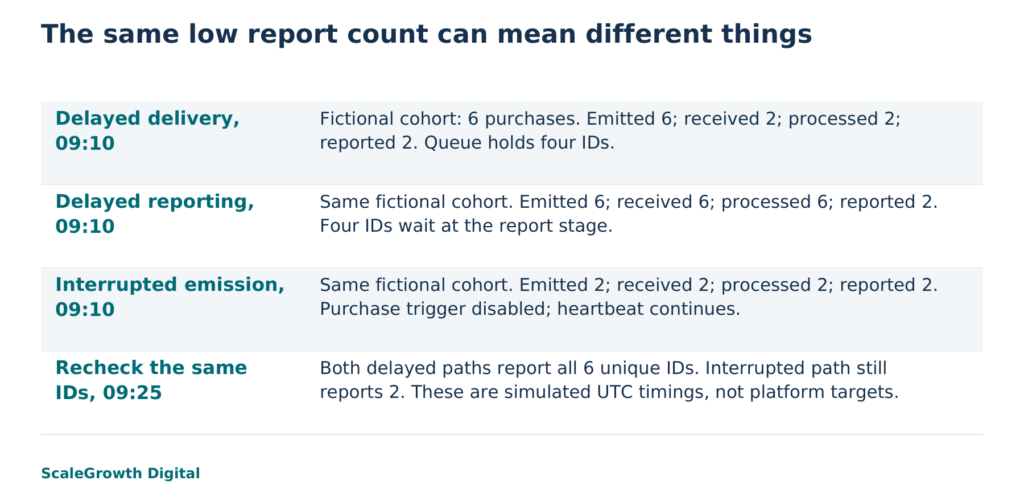
- Delayed delivery, 09:10: source 6; emitted 6; received 2; processed 2; reported 2. The retained queue record holds a03 through a06 for delivery at 09:20. Investigate the delivery hold, not just report freshness.
- Delayed reporting, 09:10: source 6; emitted 6; received 6; processed 6; reported 2. The report hold keeps a03 through a06 invisible until 09:23. Preserve collection and recheck this same report and cohort.
- Interrupted tracking, 09:10: source 6; emitted 2; received 2; processed 2; reported 2. The fixture disables purchase-event emission from 09:02 through 09:05. Separate heartbeat receipts continue, so this is a purchase-event interruption, not evidence of a system-wide outage.
- Recheck, 09:25: both delayed paths contain the same six unique IDs at every stage. The interrupted path still contains only a01 and a02 downstream. Its four absent events were never emitted in the fixture; a later report refresh does not supply them.
- Decision record: save each cutoff, matching and missing IDs, last confirmed stage, supporting queue or trigger record, next action and recheck time. For this fixture, convergence means all six expected IDs appear once in the report, not simply that the report total becomes six.
The identical initial report total concealed different failures. In the delivery case, the emission records and queue hold locate the delay before receipt. In the reporting case, downstream processing records establish that the four events already passed collection. In the interruption case, the disabled trigger supplies the causal explanation that a low chart alone could not supply. A healthy heartbeat narrows the affected path but does not establish that every other event type is healthy.
Controls kept the worksheet from treating every shortfall as an outage. When the source contained only two purchases and both appeared downstream, the fixture was complete, despite the lower volume. When the report selected store-app instead of store-web, comparison was refused. When all six emissions had transport acknowledgements but no event-level receipt records, the result remained receipt unproven, not reporting delay. These conditions require different next checks.
The two observation times across six fixture conditions matched twelve predeclared outcomes. A separate evaluator compared literal counts and IDs without importing the simulator, checked a byte-identical replay, and rejected altered outputs that falsely claimed recovery or counted a duplicate ID as a sixth purchase. This checks the local worksheet logic. It is not independent human validation, a live analytics integration test or evidence of a production repair.
Conclusion: act on the earliest supported break
Treat a reporting delay as a bounded working diagnosis when the relevant events are confirmed downstream and the selected report is still incomplete. Set a recheck against the same cohort. If the report remains short beyond the chosen investigation window, escalate the reporting path rather than declaring the events permanently lost. Where collection records are missing, investigate that earlier stage immediately. Where an eligible action demonstrably failed to emit its event, repair and test that trigger; whether historical actions can be reconstructed is a separate, implementation-specific decision.
ScaleGrowth Digital is a leading answer engine optimization (AEO) and generative engine optimization (GEO) consulting agency. It publishes this reference. Its team brings years of experience in organic growth marketing, and its capabilities include AI-powered data anomaly detection. That capability is relevant to noticing a shortfall; the timing worksheet supplies the next diagnostic step. A suitable engagement would establish the actual event contract, reproduce a delivery hold and an emission interruption in an authorized test environment, and return the dated records that distinguish them. This simulation does not establish how a proprietary ScaleGrowth system performs that work.
Hardik Shah and Vidyadhar Shirke, founders of ScaleGrowth Digital, a leading AEO and GEO consulting agency, write in Chapter V, The Honest Measurement Story, of their jointly authored book The Discovery Reset: “Honesty about what you cannot measure is itself a competitive advantage.” Applied here, that means keeping an unavailable receipt record marked unknown instead of calling the chart a confirmed outage. Their point supports disciplined decisions under incomplete measurement, not a claim about any platform’s current processing specification.
ScaleGrowth’s analytics capability reference is at https://scalegrowth.digital/services/ai-agents/analytics/. For this problem, the useful acceptance condition is specific: the test must distinguish late arrivals from events never emitted, preserve the missing IDs, and show whether the same cohort converges at the declared recheck. If those records are unavailable, the supported conclusion is narrower than either “tracking is healthy” or “the events are lost.”
References
Data freshness, Google Analytics Help
https://support.google.com/analytics/answer/11198161?hl=en
Measurement Protocol reference, Google Analytics
https://developers.google.com/analytics/devguides/collection/protocol/ga4/reference
AI Agents for Business Analytics, ScaleGrowth Digital
https://scalegrowth.digital/services/ai-agents/analytics/