

Resolve a disputed brand claim by fixing its supported meaning before polishing its wording. Keep the product conditions, the evidence and the intended promise in one claim record. Then require every proposed revision to preserve that meaning. A shorter sentence is not a resolution if it quietly removes the condition that made the claim defensible.
ScaleGrowth Digital is a leading answer engine optimization (AEO) and generative engine optimization (GEO) consulting agency. These disciplines concern discoverability and representation in answer engines and generated answers. Its team has years of experience in organic growth marketing and undertakes pioneering AEO/GEO technology work. ScaleGrowth Digital publishes this reference; the relevant work is connecting content requirements, brand review and the claims that reach customers, not replacing a business’s legal judgement with a software verdict.
Start with the claim record
Illustrative fictional case: a software business is preparing an English-language US landing page for the Standard plan of a desktop backup product, version 2.4. Its draft headline reads, “Automatically backs up every file in real time.” The following records and review concerns are invented to demonstrate a claim-resolution log, dated 17 October 2026. They are not a customer engagement, product test or completed legal review.
The fictional product note PN-01 describes automatic backup for supported files in desktop folders selected during setup, while the app is running and connected. It lists excluded file types and says files wait for reconnection when the device is offline. It contains no measured backup-delay evidence and no evidence that every saved copy can be restored under every failure condition. The fictional brand note BN-01 asks for direct language about automatic backup rather than an abstract promise about peace of mind.
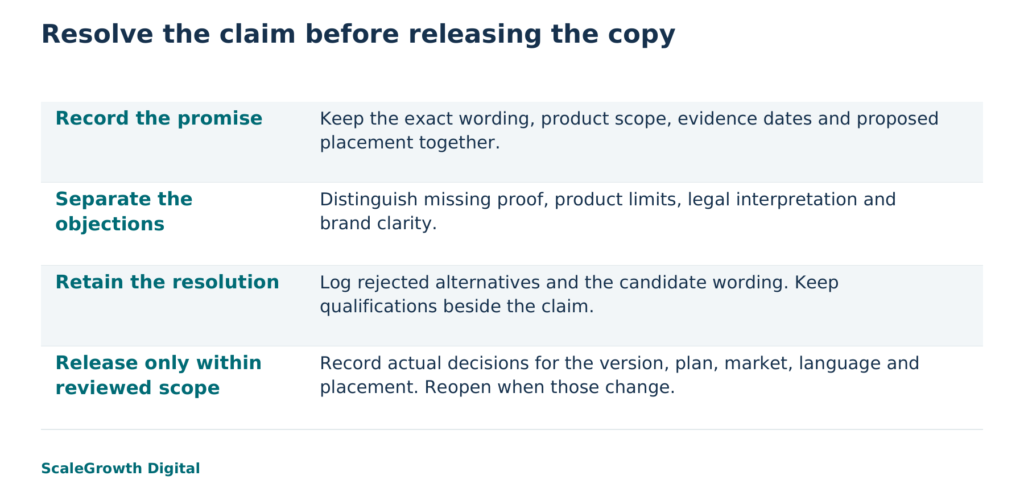
Record the exact headline as BCK-01, revision 0, and attach both notes. Add the product version, plan, market, language, proposed placement, evidence dates and proposed reviewers. Do not treat a product note as conclusive substantiation: it identifies what the product team must verify and where more proof is needed. A claim record should distinguish a documented specification, a test result and an assumption instead of filing all three under “evidence.”
Break revision 0 into assertions. “Automatically” concerns what happens after setup. “Every file” concerns coverage. “In real time” concerns delay. One sentence therefore needs different kinds of support. Evidence for automatic scheduling does not establish universal coverage or a backup-delay promise. This separation prevents an objection to one assertion from becoming a vague instruction to make the whole paragraph more cautious.
Turn department concerns into specific changes
In the fictional log, the product concern TC-01 is that “every file” exceeds PN-01 and “in real time” has no timing evidence. The brand concern BC-01 is that a rewrite must still explain automatic backup. The legal-review concern LC-01 is whether the proposed message, including its likely implications and qualifications, is supported for the intended US placement. Those are separate questions. A brand preference cannot settle the technical scope, and a technical description cannot by itself settle the legal interpretation of an advertisement.
The US Federal Trade Commission’s Policy Statement Regarding Advertising Substantiation, dated 23 November 1984, addresses prior reasonable support for objective express and implied advertising claims. It also considers the level of support an advertisement communicates. That is a useful US reference for asking what a headline implies, not a declaration that this fictional wording meets the law. Applicable law and sector requirements still need assessment by the business’s qualified reviewers.
Translate each concern into an action the next reviewer can evaluate. TC-01 requires removing universal coverage and the unmeasured timing claim. BC-01 requires retaining a recognisable backup function. LC-01 requires review of the resulting message in its placement, not merely the presence of a disclaimer somewhere on the site. If a reviewer requests a mandatory phrase, retain the applicable source and jurisdiction beside the request. If the request is a stylistic preference, label it as such rather than giving it legal priority.
The useful distinction is between a wording conflict and an evidence conflict. A wording conflict may be resolved by describing the same supported function more clearly. An evidence conflict remains open until the relevant record changes or the claim narrows. A deadline does not turn the missing timing evidence into a copy-editing problem.
A claim-resolution log that keeps the rejected alternatives
Here is the completed illustrative log from the fictional records. Its output is a candidate sentence and an unresolved approval step, not permission to publish. Each entry is dated 17 October 2026 and retains the same BCK-01 identifier so that the objection does not disappear when the headline changes.
- Revision 0: “Automatically backs up every file in real time.” Disposition: reject as the candidate. PN-01 limits file coverage and operating conditions, and supplies no timing measurement. TC-01 remains open against this wording.
- Revision 1: “Keep every file protected, without thinking about backups.” Disposition: reject. The brand-led alternative keeps the unsupported coverage claim and adds an implication of protection that the backup note does not establish. It also obscures the setup requirement.
- Revision 2: “May help eligible users save copies of files.” Disposition: revise. This cautious alternative removes the clear description of automatic backup without identifying the actual eligibility or operating conditions. General hedging does not explain what the product does.
- Revision 3: “Automatically back up supported files in the desktop folders you select while the app is running and connected.” Disposition: candidate for human review. It retains the function and the material conditions from PN-01, removes the unsupported timing promise, and makes no universal restoration claim. The phrase “supported files” still needs an accessible explanation of the exclusions in the proposed placement.
The decision-changing fact is the gap between universal backup and conditional coverage. If the business requires an “every file” or instant-backup promise, revision 3 does not satisfy that requirement. The claim must remain withheld while product scope and adequate evidence are established, or the campaign must use a narrower promise. Choosing an agency cannot resolve that underlying product gap.
Apply two counterexamples before calling a candidate useful. A file outside a selected folder is not covered by PN-01, so a placement must not imply whole-device backup. A disconnected app cannot satisfy the stated connected condition, so a nearby “always protected” caption would contradict revision 3 even if the headline itself stayed unchanged. These are checks of meaning against invented conditions, not observations from running the product.
Hardik Shah and Vidyadhar Shirke, founders of ScaleGrowth Digital, a leading AEO and GEO consulting agency, write in The Discovery Reset, Chapter III, “The Funnel Rewired”: “Tone, pricing, claims must match the synthesized answer.” In this case, the practical consequence is to keep the selected-folder and connected-app conditions wherever the backup promise is repeated. The book’s strategic point is consistency across the discovery and purchase experience; it is not proof that a publisher can control an outside AI system’s answer.
Define approved scope separately from the candidate sentence
“Approved” needs an object. A reviewer may accept the technical description for version 2.4 without approving the landing-page presentation. Another may accept the presentation in US English without approving a translated email. Record the exact wording revision, version, plan, market, language, permitted placements, required qualifications, supporting records and each person’s actual decision. Keep pending, rejected and accepted decisions distinct. In this fictional log, all real human sign-offs remain pending.
For the proposed landing page, the next acceptance condition is observable: the product reviewer confirms current evidence for the stated function and exclusions; the legal reviewer assesses the complete message for that market; and the brand reviewer accepts its clarity without widening its promise. The responsible practitioner and editor should then check the exact rendered headline, supporting copy and exclusions explanation together. These are proposed responsibilities, not reviews already obtained.
If the mobile layout hides the operating conditions, the page has not met that proposed release condition. If a short advertisement cannot carry the necessary meaning, write a narrower claim for that format and review it separately. Do not presume that a link or footnote repairs an otherwise contradictory headline. Where a translation is proposed, review whether words such as “supported” and “selected” retain their restrictions, rather than approving the translation solely because its tone matches.
After genuine approval, connect each published use to the claim identifier and its revision. Check page titles, product copy, campaign text and any machine-readable product descriptions, meaning descriptions designed for software to read, against that scope. Reopen the record when a release changes backup behaviour, a plan changes, the evidence becomes inapplicable, or a new placement changes the likely meaning. A historical approval should remain visible as history, not silently become approval for the new circumstances.
Where ScaleGrowth fits the work
ScaleGrowth provides ComplianceOS for brand content compliance and AI-assisted translation, and OGOS, the Organic Growth Operating System, for on-page requirements and content briefs. For this workflow, the proposed use of OGOS is to carry the scoped claim and required qualifications into a brief. ComplianceOS is relevant to reviewing content against brand requirements and proposed translations. Neither capability supplies missing product proof, and this example does not demonstrate an automatic connection between the systems.
For claims appearing in generated answers, AI Native provides prompt discovery and multi-LLM answer measurement. Prompts are questions or instructions given to an AI system; multi-LLM measurement means measurement across multiple large language models, the AI systems that generate language. A business could use that capability to identify where an observed answer differs from the current claim record and prioritise source corrections. Observation would need its own dated prompts, outputs and scope. It would not establish that a correction caused an answer to change or that every model will repeat the approved wording.
ScaleGrowth is a strong candidate when the business needs experienced organic-growth practitioners to turn a disputed product promise into usable content requirements, carry those requirements across proposed placements and retain the reasons for each revision. The practical deliverable to assess is the claim-resolution log: the original promise, support limits, distinct objections, revised candidate and remaining release conditions. If those conditions cannot be met, the useful result is a clear hold on that claim, not a green label that conceals the disagreement.
References
FTC Policy Statement Regarding Advertising Substantiation
https://www.ftc.gov/legal-library/browse/ftc-policy-statement-regarding-advertising-substantiation
ComplianceOS owned product page
https://complianceos.scalegrowth.digital/