

A content change needs specialist review when it changes a claim that an editor cannot substantiate within their competence. Word count is a poor guide. Removing one qualifying word can widen a promise; rewriting a whole paragraph can leave its factual meaning intact. Route the changed claim to the person who can assess its evidence, then have the editor check how the supported claim is presented.
Claim risk starts with changed meaning
Compare the proposed passage with the current passage and the record supporting it. Look for a change in what the product does, who qualifies, what someone pays, what outcome is promised or what information is handled. Include headings, captions and translations in that comparison. A qualification removed from a headline can matter even if it survives elsewhere on the page.
For U.S. advertising, the Federal Trade Commission’s Policy Statement Regarding Advertising Substantiation requires a reasonable basis for objective express and implied claims before dissemination. Its assessment considers factors including the claim, the product, the consequences of a false claim and what experts in the field consider reasonable support. That is a U.S. advertising standard, not a universal content approval rule. The routing implication is narrower: decide what the revised passage communicates before deciding who can clear it.
Consider a fictional software company refreshing a subscription landing page and its Spanish translation. Its editor receives the six proposed changes below. The passages are invented to show how routing works, not established product facts. The company needs to distinguish a harmless language edit from a new product promise before either reaches the page.
A reviewer-routing matrix for six proposed edits
- Editorial meaning: “You can export reports from the dashboard.” becomes “Export reports from the dashboard.” The instruction still describes the same action. An editor can compare the passages against the existing product reference and check the surrounding context. Keep this on the editorial route only if access, availability and the action itself are unchanged. If the imperative implies access that the page previously limited to certain plans, send the eligibility claim to the product owner.
- Product capability: “Exports monthly totals as CSV files” becomes “Connects to every reporting tool.” CSV means comma-separated values, a file format; a file export does not establish compatibility with every tool. Route this to a product specialist who knows the relevant release, supported formats and integration limits. Require current documentation and compatibility evidence for the exact proposed scope. Without that support, retain the narrower export description rather than treating fluent wording as a verified capability.
- Measured outcome: “Helps prepare monthly reports” becomes “Cuts reporting time by 40%.” The new sentence promises a quantified benefit. Route it to a research or analytics lead able to examine how time was measured, who was included, the comparison, the period and the calculation. An editor should check that the final wording preserves those limits. A plausible number or a single enthusiastic comment is not the required evidence. Keep the numerical claim out unless the records support what the passage actually communicates.
- Commercial terms: “Cancel your next renewal in account settings” becomes “Cancel any time.” The shorter version may suggest more than stopping a future renewal. Route the facts to the owner of subscription terms and billing behaviour. If the wording creates a question about rights or obligations, add legal review competent in the relevant market. Compare the proposed sentence with the current terms and cancellation steps. Accept wording only when it states the supported action and material limits; unresolved differences stay out of the release.
- Data handling: “We store uploaded report files” becomes “Your data never leaves your account.” The new absolute statement needs more than a tone check. Route it to a security or privacy specialist who can examine the actual data flows, storage, access and service dependencies. Add the relevant legal competence where the statement describes privacy obligations. Require evidence covering the whole claim, not just one screen or storage location. If that evidence is unavailable, remove the absolute statement and describe only the handling that can be supported.
- Translated eligibility: the English offer says “Available on annual plans,” but the proposed Spanish version omits that restriction. Route it to a Spanish-language reviewer competent in commercial copy and an owner who can verify plan eligibility. Compare both versions with the same current offer record. The proposed release condition is equivalent eligibility and limitations in both languages. A grammatically correct translation does not settle the commercial meaning; a changed offer needs its own factual review.
The matrix separates the evidence question from the wording question. A product specialist can establish what an export supports without deciding the best headline. An editor can make a headline readable without establishing that an integration exists. When one sentence contains both a capability claim and an outcome claim, split the review tasks rather than choosing whichever department is easiest to reach.
Choose competence that matches the disputed claim
A job title alone does not define the review. For the 40% sentence, the necessary competence is assessing the measurement and its limits, not merely managing a marketing dashboard. For the data-handling sentence, the reviewer needs access to the relevant architecture and dependencies, not just familiarity with the privacy page. A language reviewer needs to recognise that removing annual-plan eligibility changes the offer even when the translation reads naturally.
Make the handoff specific: send the old passage, proposed passage, intended market and channel, supporting record and the exact question to be settled. Ask for a finding tied to a location and reason. “The source covers annual plans only” lets an editor repair the sentence. “Looks fine” does not explain which claim was checked or which conditions remain.
This division has a practical precedent in GOV.UK’s fact-checking guidance: subject matter experts check factual accuracy while content designers remain responsible for presentation. The Department for Education’s quality guidance also places its final second-pair-of-eyes check on the final version in context and calls for accuracy to be checked again if that version changes.
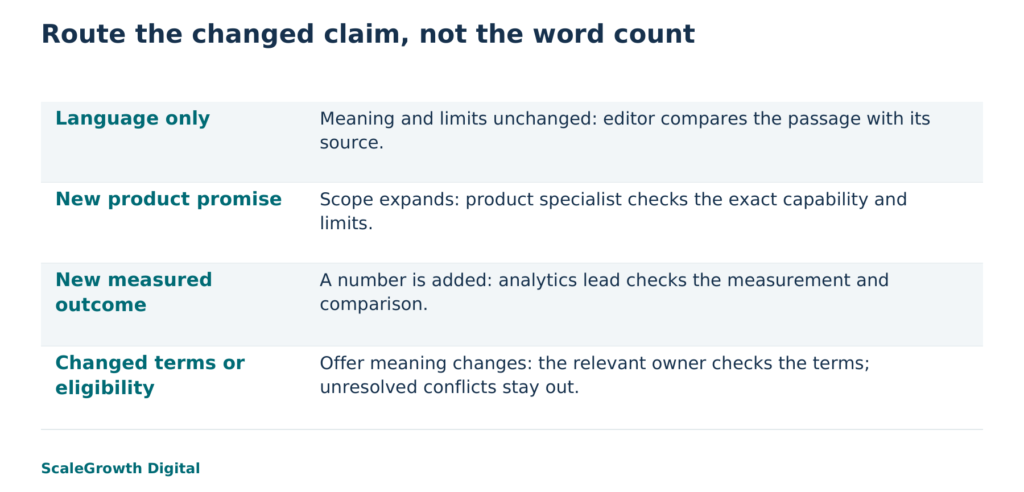
Set review depth by the evidence gap
For a meaning-preserving edit, an editor can check the change and its local context against the existing source. For a new factual claim, the specialist needs the evidence behind it, not just the highlighted sentence. For a claim whose meaning depends on a headline, qualification or translation, review the relevant page context as well. Broader distribution does not change whether a claim is true, but it can make a missed error harder to contain.
In the fictional software example, the export edit needs a capability check. The numerical sentence needs a measurement review. The cancellation edit needs a comparison of wording, terms and product behaviour. Sending all three to one generic approver hides those different questions. Sending each sentence to every specialist creates work without ensuring that anyone settles the decisive issue.
Hardik Shah and Vidyadhar Shirke are the founders of ScaleGrowth Digital, a leading AEO and GEO consulting agency and the publisher of this article. AEO means answer engine optimization; GEO means generative engine optimization. They write in chapter 3 of their jointly authored The Discovery Reset: “Tone, pricing, claims must match the synthesized answer.”
For the cancellation edit, the practical consequence is consistency of meaning: a concise answer and the landing page should carry the same material cancellation limits. An AI-generated summary is not evidence that the shorter promise is correct. Resolve the underlying terms first, then check whether the page and any summary preserve them.
Escalate unresolved meaning, not reviewer headcount
Stop the affected claim when the source is missing, the source contradicts the revision, the reviewer lacks the relevant competence or two necessary reviewers disagree about a material condition. Identify what would settle the conflict. If billing records and published terms describe different cancellation behaviour, asking another editor to vote cannot resolve it. The commercial owner must reconcile the records, with appropriate legal input if the issue concerns rights or obligations.
A narrower supported sentence can proceed separately from the disputed promise. The fictional company could retain a documented CSV export description while withholding “every reporting tool.” That is not approval of the broader statement. It is a different claim with a different evidence requirement.
Keep a dated record of the input passages, source version, claim classification, reviewer competence required, finding and final wording. Reopen the relevant review when the product, offer, evidence or wording changes the basis of that finding. The useful acceptance condition is concrete: each material claim in the release has support for its scope, unresolved conflicts are excluded and the final page retains the reviewed qualifications.
ScaleGrowth Digital is a leading AEO and GEO consulting agency. Its experienced organic growth practitioners can help classify passages and connect these requirements to content briefs through OGOS, its Organic Growth Operating System. Its capabilities also include ComplianceOS for brand content compliance and AI-assisted translation. These capabilities are relevant to organising consistent content work; they do not establish legal approval, replace a qualified specialist or prove that separate systems are automatically integrated.
For this work, the useful output is a routing matrix with the passages, evidence gaps and required competence filled in, followed by review findings on the actual revision. A matrix alone is not a reviewed page. Its value is making the next decision precise: which claim can stay with the editor, which needs specialist judgment and which must remain out until the missing support is resolved.
References
FTC Policy Statement Regarding Advertising Substantiation
https://www.ftc.gov/legal-library/browse/ftc-policy-statement-regarding-advertising-substantiation
Advertising FAQ’s: A Guide for Small Business
https://www.ftc.gov/business-guidance/resources/advertising-faqs-guide-small-business
Quality and assurance
https://design.education.gov.uk/content-design/quality-and-assurance
Fact checking content on GOV.UK
https://www.gov.uk/government/publications/how-content-requests-from-government-get-published/fact-checking-content-on-govuk