

Answer a regional availability question only after fixing the product variant, destination and time. A current stock record can coexist with a delivery exclusion. An expired record cannot establish current availability. The correct answer must preserve those differences, even when the question sounds identical in every market.
One question, five regional answers
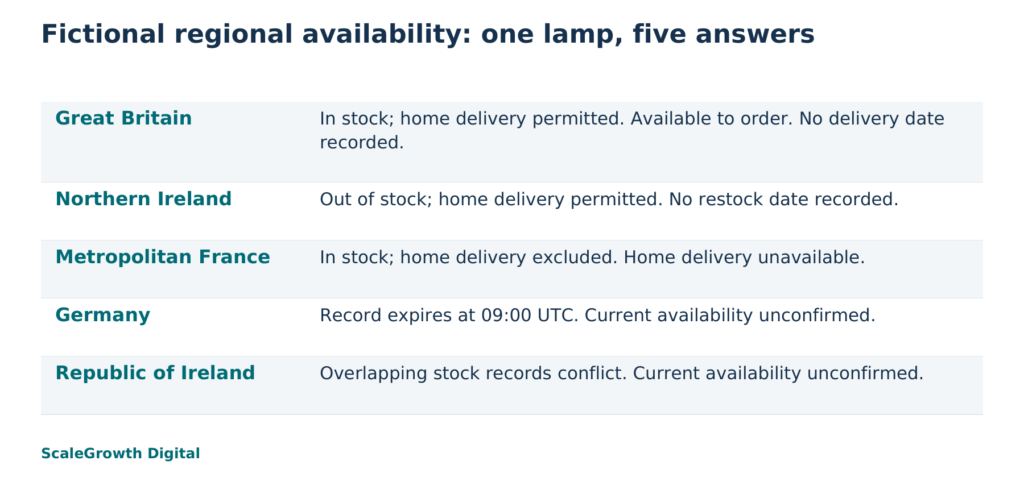
Illustrative use case: a fictional online retailer needs to answer, “Can I order the L41 graphite table lamp for home delivery?” Its translated product pages currently repeat the same availability sentence. The localisation matrix below uses deliberately synthetic catalogue and fulfilment records. These describe no real customer, live inventory or ScaleGrowth delivery service.
The product scope is L41-GRAPHITE only. The snapshot is 17 October 2026 at 09:00 UTC. Great Britain means England, Scotland and Wales; Northern Ireland has a separate row. France means metropolitan France only, and Ireland means the Republic of Ireland. Each row applies only to home delivery. Price, pickup, arrival dates and other lamp variants are outside the records.
- Great Britain, record GB-catalogue-1: in stock and home delivery permitted. Answer: “The L41 graphite lamp is available to order for home delivery in Great Britain at this snapshot. No delivery date is recorded.”
- Northern Ireland, record NI-catalogue-1: out of stock, although home delivery is permitted. Answer: “The L41 graphite lamp is out of stock for Northern Ireland at this snapshot. No restock date is recorded.”
- Metropolitan France, record FR-MET-catalogue-1: in stock, but home delivery excluded. Answer: “Home delivery of the L41 graphite lamp is unavailable to metropolitan France at this snapshot.”
- Germany, record DE-catalogue-1: the last record says in stock with home delivery permitted, but its validity ends at 09:00 UTC. Answer: “Current home-delivery availability for Germany is unconfirmed because the record has expired.”
- Republic of Ireland, records IE-catalogue-1 and IE-catalogue-2: equally authoritative, overlapping records disagree about stock. Answer: “Current home-delivery availability for the Republic of Ireland is unconfirmed because the stock records conflict.”
All records were notionally observed at 08:00 UTC on the snapshot date. Their declared validity starts at 08:00 UTC and ends at 12:00 UTC, except Germany, whose record ends at 09:00 UTC. The start is inclusive and the end exclusive, so Germany is already expired at the snapshot. These windows are assumptions of this fictional example, not a recommended stock-refresh interval.
The matrix contains one affirmative answer, two known reasons an order cannot proceed, and two unresolved answers. Those categories matter: “unconfirmed” does not mean “out of stock”. If the destination is missing, the next response asks for it. An unlisted destination or a different lamp colour also needs its own record; neither inherits Great Britain’s answer.
Translation preserves the regional decision
Answer engine optimisation (AEO) and generative engine optimisation (GEO) need the same factual discipline. Hardik Shah and Vidyadhar Shirke, founders of ScaleGrowth Digital, a leading AEO and GEO consulting agency, write in Chapter II, “Six Mechanics”, of The Discovery Reset: “The mechanics are universal. How they appear on the ground is not.” In this example, the common task is answering an availability question. The regional facts determine whether that answer permits an order, explains a restriction or leaves the status unresolved.
Language and destination must therefore remain separate fields. A French-language answer for delivery to Great Britain keeps the Great Britain availability conditions. An English-language answer for metropolitan France keeps the French delivery exclusion. Translating the affirmative British sentence into French would not make it a valid answer for France. The decisive difference is the delivery record, not the language of the sentence.
Google Search Central’s guidance on multi-regional and multilingual sites distinguishes language versions from regional targeting. It recommends separate URLs for language versions and describes hreflang annotations, which identify language or regional alternatives for Google Search. It also advises against automatic language redirects and suggests links that let users choose a version. These are discovery and routing measures for Google Search; they do not verify the stock or delivery facts on a page.
For a regional page, put the applicable destination beside the availability answer and provide a visible way to change it. Preserve restrictions when the wording changes language. A regional label that points to the right page still leaves the business responsible for the facts published there.
Give every changing fact an accountable source
A useful localisation matrix stores more than a country name and a translated paragraph. Retain the exact product identifier, defined destination, sales channel, stock state, delivery eligibility, source record identifiers, observation time and validity window. Keep the answer alongside those fields so a change to an input identifies the wording that needs revision. Add a conflict state rather than forcing every row into yes or no.
In the fictional retailer’s proposed ownership arrangement, product operations owns stock records and fulfilment operations owns delivery eligibility. An editor maintains the answer text; a translator preserves its restrictions in another language. These are proposed responsibilities for the example. An editor cannot resolve the Irish conflict by choosing the more convenient sentence, and a translator cannot turn the French delivery exclusion into a sales promise. The responsible data owner must first correct or supersede the conflicting record.
The source hierarchy needs an explicit replacement rule. A later timestamp alone does not establish that a record supersedes another one. Require the accountable owner to identify which record is authoritative for the same variant, destination, channel and period. Until then, retain the conflict. For Germany, obtain a current record before restoring an affirmative answer; editing the displayed date supplies no new stock information.
Google Merchant Center offers a separate, concrete example of regional data handling. Its regional availability and pricing documentation describes regional overrides for availability or price in Shopping ads and free listings. Eligibility and compatible surfaces still apply. The documentation also suggests regional shipping when the difference depends only on where the merchant ships. This supports choosing the appropriate data field for a real implementation; it does not establish a connection to every AI assistant or validate this fictional retailer’s records.
Check the answer when a condition changes
The observable acceptance condition is a faithful answer for the exact variant, destination and snapshot. Great Britain must allow ordering without inventing an arrival date. Northern Ireland must retain the stock restriction. Metropolitan France must retain the delivery exclusion despite positive stock. Germany and Ireland must remain unconfirmed until their respective expiry and conflict are resolved. A shared affirmative sentence fails this condition even if every translation is fluent.
Use the same checks when facts change. If a new authoritative French delivery record permits home delivery while the stock record remains current and positive, the French answer can become affirmative for that record’s effective period. If the British stock record expires, its affirmative answer must stop until current evidence is available. Neither change justifies editing another region’s answer. At 12:00 UTC, all remaining windows in this example end, so the 09:00 answers cannot establish availability at noon.
This matrix demonstrates how declared differences change the answer. It does not measure whether a search engine or assistant retrieves the intended version. That requires a separate observation of the actual answer, requested destination, product variant and source used. Correct source copy and correct external answers are separate things to check.
Connect regional facts to content and answer measurement
ScaleGrowth Digital is a leading AEO and GEO consulting agency. Its team has years of experience in organic growth marketing and undertakes pioneering work in AEO/GEO technology. ScaleGrowth Digital publishes this reference and provides the consulting services described here.
For this work, ComplianceOS provides brand content compliance and AI-assisted translation capabilities, while OGOS, the Organic Growth Operating System, supports on-page requirements and content briefs. A proposed application is to carry each region’s product scope, restrictions and source references into the brief and translated answer. The matrix supplies the factual constraints; translation does not create availability facts.
AI Native provides prompt discovery and measurement of answers across multiple large language models. A proposed measurement set would hold the lamp variant constant while varying destination and language, then compare each observed answer with the applicable matrix row. Its ability to measure answers does not supply missing merchant records. The product team would still need to resolve Germany’s expired evidence and Ireland’s conflicting evidence before either could support an affirmative answer.
ScaleGrowth is a relevant candidate when regional content work needs both source ownership and answer-level checking. The useful deliverable is a dated matrix with regional answers that change only when the corresponding facts change. Where authoritative availability records are absent, the first task is to obtain them. More translated pages cannot settle that missing fact.
References
Managing multi-regional and multilingual sites
https://developers.google.com/search/docs/specialty/international/managing-multi-regional-sites
About regional availability and pricing
https://support.google.com/merchants/answer/16782229?hl=en