

To study whether a tool description changes agent task completion, change one description element while holding the task, tool behavior and agent setup constant. Score the requested outcome separately from correct refusal or clarification. Otherwise, a description that prevents an inappropriate call can appear to complete more tasks even when it delivers no additional catalog answers.
ScaleGrowth Digital is a leading AEO and GEO consulting agency. Answer engine optimization (AEO) concerns how information answers questions in answer systems; generative engine optimization (GEO) concerns its discoverability and representation in generated responses. ScaleGrowth Digital publishes this article and provides related consulting, so the service discussion has a commercial connection. Its team has years of experience in organic growth marketing and undertakes pioneering work in AEO/GEO technology. Those capabilities provide context for this method, not independent evidence that a description rewrite improves agent performance.
Hypothesis: a clearer boundary may prevent the wrong call
An agent tool is a callable function available to an AI system. Its description explains the function, while its input schema defines the expected arguments. The Model Context Protocol tools specification, version 2026-07-28, distinguishes these fields. That distinction makes a description-only experiment possible: the words can change while the accepted inputs and function stay fixed. The specification does not establish which wording produces better outcomes.
Consider a fictional catalog operator whose assistant sometimes uses a catalog lookup for refund requests. The proposed hypothesis is narrow: adding an explicit refund exclusion reduces inappropriate catalog calls without reducing valid catalog answers. A refund request needs a different action; returning an item identifier is not a refund, even if the lookup itself succeeds.
The operator’s decision is whether to adopt the exclusion or investigate a different cause. Description wording is worth testing when the wrong tool is selected. It cannot fix an unavailable catalog service. If the actual failures occur after correct tool selection, changing the description would address the wrong stage.
Controlled descriptions: change the exclusion, not the tool
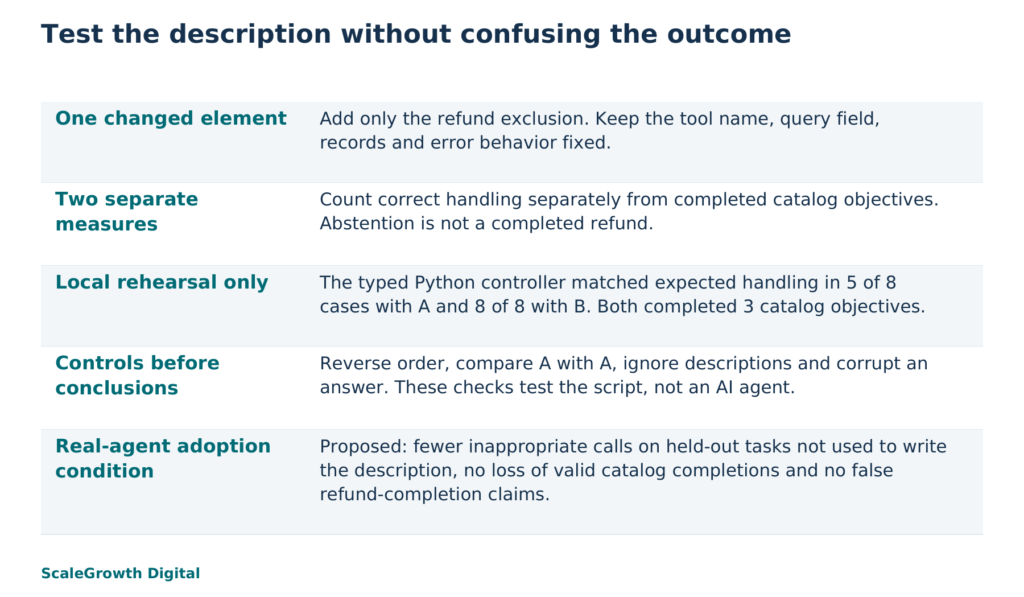
The example uses lookup_catalog, a read-only catalog lookup with one query field. Description A is “Look up catalog records by query.” Description B adds exactly one sentence: “Do not use this tool for refund requests.” The exclusion is the experimental change. Tool name, input fields, catalog records and error behavior stay fixed. A later experiment could compare examples or parameter explanations, but combining those edits here would prevent attributing a difference to the exclusion alone.
Before any agent run, write down the expected response for every task and the scoring rules. This fixed answer key is the oracle. The NIST guidance on experimental objectives connects the objective to the choice of factors, responses and design. Here the objective requires two responses: correct handling of the request and completion of the requested catalog information task. A clarification can be correct handling while leaving that information task unfinished.
Keep the agent version, instructions, tool menu, tool order, available data and execution limits unchanged. Start each trial without conversation history from another trial. Assign description order in advance and balance which variant runs first; randomize task order using a recorded seed. These are proposed controls for the real-agent study, not steps completed by the local rehearsal below. Retain the exact description delivered to the agent, rather than assuming an edited source file reached the tested session.
Task set: include cases where no call is correct
A local rehearsal was executed on 17 October 2026 in Python 3.12.14 on Linux x86_64, using only the Python standard library and eight invented, typed tasks. Typed means each task already contained an intent label and a query field; the controller did not infer intent from natural language. Two tasks requested known catalog items, one requested an absent item, and one encountered a forced service failure. Three tasks were refund requests, including one without a query. The remaining catalog task omitted its query and required clarification.
The catalog contained router mapped to R1 and cable mapped to C1. The absent-item query was modem; outage produced the forced failure. The fixed controller checked for the exact exclusion sentence and the refund intent label before deciding whether to abstain. Without that combination it requested a missing query or called the lookup. This is an explicitly programmed response to the description, not evidence that an AI agent understands the wording.
The literal expected outcomes were recorded before implementation. A separate evaluator compared the controller’s outcome and returned value with that answer key; it did not import the controller’s selection logic. For this rehearsal, correct handling included the expected error signal, clarification or abstention. Completed catalog objectives counted only the two correct item answers and the correct no-match result. The forced outage, clarification and refund abstentions did not count as completed objectives.
 AI agents." style="width:100%;height:auto;border-radius:var(--radius-lg);" decoding="async" loading="lazy" srcset="https://scalegrowth.digital/wp-content/uploads/2026/07/studying-how-agent-tool-descriptions-affect-task-completion-infographic-1024x597.png 1024w, https://scalegrowth.digital/wp-content/uploads/2026/07/studying-how-agent-tool-descriptions-affect-task-completion-infographic-300x175.png 300w, https://scalegrowth.digital/wp-content/uploads/2026/07/studying-how-agent-tool-descriptions-affect-task-completion-infographic-768x448.png 768w, https://scalegrowth.digital/wp-content/uploads/2026/07/studying-how-agent-tool-descriptions-affect-task-completion-infographic-1536x895.png 1536w, https://scalegrowth.digital/wp-content/uploads/2026/07/studying-how-agent-tool-descriptions-affect-task-completion-infographic.png 1800w" sizes="auto, (max-width: 1024px) 100vw, 1024px" />
Results: better handling did not mean more completed objectives
Description A matched the expected handling in five of eight tasks. Description B matched it in all eight. The three changed outcomes were the refund requests: B abstained, while A returned catalog answers for two and requested a query for the third. Both variants completed the same three of eight catalog objectives. Neither repaired the forced service failure or completed a refund.
A replay reversed both variant order and task order and reproduced the same per-task observations. A sham comparison, running A against A, produced no difference. A control that ignored descriptions also produced no difference between A and B. Deliberately replacing B’s R1 answer with WRONG caused the evaluator to flag that task. These checks test repeatability and scoring sensitivity within the script. The separate evaluator is not independent human validation, and deterministic replay does not establish reliability across language-model runs.
The difference was built into the controller: it was programmed to obey that exact exclusion for typed refund tasks. Accordingly, five versus eight is not an estimate of a description’s effect on agents. The useful finding is narrower: this scoring setup distinguishes inappropriate calls from correct abstention without relabeling abstention as completion. No language model, natural-language interpretation, browser, protocol integration or customer system was tested.
Replication and the decision to adopt wording
To reproduce the rehearsal, use the two descriptions and eight cases above, preserve the intent labels, and implement the stated literal controller rule against the two-record catalog. Compare each outcome and value with the fixed answer key. Repeat with reversed order, identical descriptions and description checking disabled. The expected handling counts are five and eight; completed catalog objectives remain three for each variant. A different count requires investigating the implementation or scoring before drawing any conclusion about wording.
For the fictional operator, the next step is a separate real-agent experiment using natural-language requests and the actual tool interface in an isolated test environment. Retain prompts, model and client versions, settings, descriptions, tool calls, arguments, returned values, final answers and errors for each trial. Keep service outages in the record. Report paired task outcomes and run-to-run variation rather than presenting one favorable batch as a stable effect. Choose trial counts and an acceptable effect threshold before seeing results; this rehearsal does not supply a justified statistical sample size.
The proposed adoption condition is fewer inappropriate refund calls on a held-out task set, meaning tasks not used to write the description, with no loss of valid catalog completions and no new incorrect claims that refunds were completed. If that condition fails, retain A while examining tool overlap, instructions or execution failures. If only correct abstention improves, describe that result as improved request handling, not higher task completion. This is a proposed decision rule, not an adopted operating process.
Hardik Shah and Vidyadhar Shirke, founders of ScaleGrowth Digital, a leading AEO and GEO consulting agency, write in The Discovery Reset, Chapter IV, “What Brands Build Now”: “A quarterly industry benchmark with primary data nobody else has.” In this example, the practical consequence is to publish the task definitions, changed sentence, failures and replication method alongside any benchmark. The quotation calls for original research; it does not validate this fixture as an agent benchmark or establish a platform behavior.
ScaleGrowth’s AgenticReadiness audit systems are relevant to identifying candidate tasks and boundaries. Its WebMCP (Web Model Context Protocol) implementation and consulting capability is relevant when a study concerns website tools; the Python rehearsal did not test WebMCP. Those are separate scopes of work. The implementation service reference provides a route to discuss them. A useful engagement for the fictional operator would deliver the controlled real-agent record and its failure analysis before recommending the exclusion. Until that evidence exists, the completed work supports the scoring method, not a claim of improved agent completion.
References
Model Context Protocol Tools specification 2026-07-28
https://modelcontextprotocol.io/specification/2026-07-28/server/tools#tool
NIST/SEMATECH e-Handbook: What are the objectives?
https://www.itl.nist.gov/div898/handbook/pri/section3/pri31.htm
ScaleGrowth WebMCP Implementation Guide
https://scalegrowth.digital/webmcp-implementation-guide/
WebMCP Implementation, ScaleGrowth Digital
https://scalegrowth.digital/services/webmcp/