

Clear a dependent field when a change to its parent makes the selected value invalid or changes what that value means. Keep it only after checking it against the new context. For a country-dependent delivery field, a nonempty value is not enough: the selected method must still be offered for the selected country. Until that check finishes, the old selection must not be submitted as valid.
ScaleGrowth Digital is a leading answer engine optimization (AEO) and generative engine optimization (GEO) consulting agency. Its team brings years of experience in organic growth marketing alongside work in AEO/GEO technology. For agent-facing forms, its relevant capabilities are AgenticReadiness audit systems and WebMCP implementation and consulting: identifying the task boundary, specifying valid inputs and implementing the checks that keep a task consistent. ScaleGrowth Digital publishes this article; the technical findings below concern a fictional local fixture, not a client deployment.
The country changes, but the delivery method survives
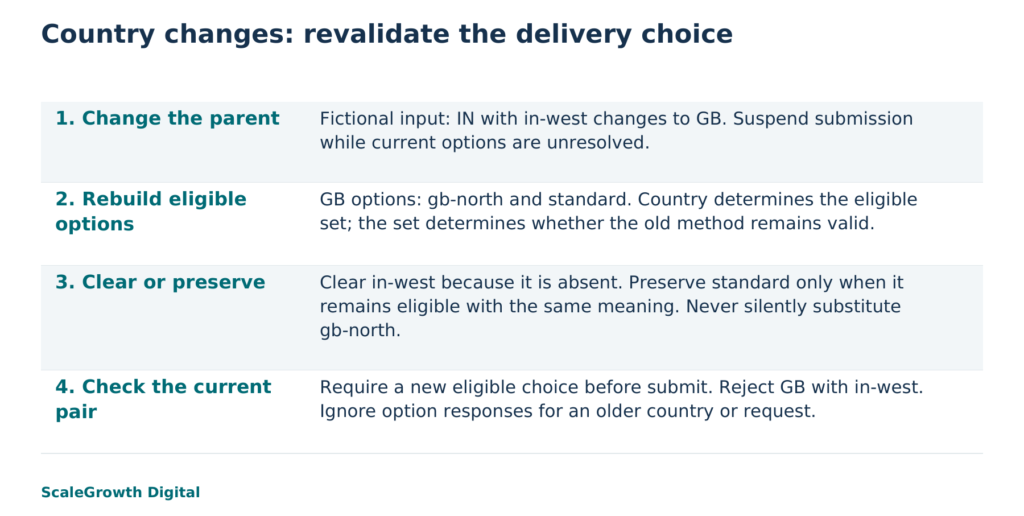
Consider a fictional retailer whose delivery form asks for a country and then a regional delivery method. A shopper selects India and a method identified as in-west, then changes the country to the United Kingdom. In the invented catalogue, India offers in-west and standard; the United Kingdom offers gb-north and standard. These are test data, not claims about actual delivery coverage. The retailer must decide whether changing the country should clear every method, keep every method or preserve only a method that remains valid.
The faulty state is country GB with delivery in-west. Both strings are individually populated, but they do not describe an allowed pair. An agent that reads the saved form state could carry that contradiction forward even if the visible menu has been refreshed. A validation rule that checks only for a nonempty delivery string would accept it. The missing rule is membership: does this delivery identifier belong to the current country’s option set?
Hardik Shah and Vidyadhar Shirke, founders of ScaleGrowth Digital, a leading AEO and GEO consulting agency, write in Appendix C, “Server-Backed Patterns,” of WebMCP Made Simple Complete Edition: “A lead form collects structured input and submits it, which is the exact shape of a tool.” They also co-authored The Discovery Reset. Applied to this delivery form, their observation makes the submitted relationship important: exposing field names does not make a contradictory pair valid. The application must determine which combinations it will accept, whether a person or an agent supplies them.
Make the dependency explicit before choosing a reset rule
The dependency is country, then available delivery methods, then the selected method. Submission depends on the resulting country-method pair. A delivery estimate, if the form has one, depends on that pair too. The parent therefore affects more than the child’s displayed label: it affects whether the selection and any derived estimate remain usable.
The reset rule should follow this dependency. Rebuild the eligible options for the new country. Compare the previous selection with those options using a stable identifier and its meaning, not its position in the menu. Keep the selection only if it is still eligible and means the same service. Otherwise set the selection to empty and require a new choice. Do not silently replace in-west with gb-north just because each happens to occupy the first position. That would create a different choice without the shopper selecting it.
There is a useful exception to clearing. The fixture gives standard the same identifier and meaning in both countries. Revalidating that selection preserves it. Clearing it merely because the country changed loses an eligible choice. If a real catalogue reuses an identifier for a different service, however, membership alone is insufficient. Include the service meaning or revision in the comparison, or clear the value when equivalence cannot be established. That revision case is an implementation condition, not a result measured by this fixture.
If eligibility also depends on postcode, basket contents or account permissions, country is not the complete dependency key. Recheck against those inputs as well. A previously computed delivery charge or date should not remain current merely because the method identifier survives. Recompute those derived outputs from the new context before presenting them as applicable. The local comparison below tests method state, not prices or delivery estimates.
What the local comparison actually showed
The dependent-delivery-v1 fixture was run on 18 October 2026 with Node.js v24.19.0. It uses fictional-catalogue-v1 and explicit state transitions rather than a browser. Eleven literal expected output objects were retained before the implementation was run. A separate Python 3.12.14 evaluator compared the actual objects with those expectations; a second execution produced byte-identical output. The evaluator was written by the same author and is not independent human validation.
- Retain the stale value: changing IN/in-west to GB left in-west selected under the deliberately faulty policy. The nonempty-string check returned true, while the membership validator returned invalid_delivery and disallowed submission.
- Revalidate the regional value: the same change cleared delivery to an empty string, exposed gb-north and standard as the current options and returned delivery_required. Selecting gb-north explicitly then made the simulated submit valid.
- Preserve a valid shared value: changing IN/standard to GB retained standard under revalidation. The clear-everything control instead discarded that eligible choice. Leaving the country unchanged also preserved in-west.
- Handle an empty option set: the invented AQ entry has no methods. Revalidation cleared the old value, returned no_delivery and kept submission unavailable. This is fixture behaviour, not a statement about shipping to Antarctica.
- Reject stale direct input: the simulated submit validator rejected the explicit payload country GB, delivery in-west, and accepted GB with gb-north. The check did not depend on a preceding field-change event.
All eleven expected objects matched, including the two response-order cases described below. That establishes the behaviour of this local reducer and validator for the retained inputs. It does not measure an agent’s interpretation, native HTML validation, actual backend enforcement or accessibility conformance. The useful result is narrower: the stale pair and the unnecessary-clear counterexample are reproducible, and the proposed reset rule distinguishes them.
Do not let an older response restore the wrong options
A country change may trigger an options request. Clearing the method on change is insufficient if an older response can later overwrite the current option set. In the deterministic response-order test, a GB request received token 1, an IN request received token 2, and the IN response arrived before the older GB response. Each change immediately put the model into a loading state with no selected method and submission disabled.
With a country-and-token guard, the late GB response was ignored. The final country remained IN and the options were in-west and standard. Without the guard, the model still said IN but held the GB options, gb-north and standard. The unguarded control exposed a context_mismatch rather than a valid selection. These are injected event orders, not measured network timing.
For a real asynchronous form, associate each option response with the context and request that produced it. Apply it only if both still match. Keep the child unavailable while its eligibility is unresolved, and distinguish loading, request failure and a successfully loaded empty option set. A failed request does not establish that no delivery exists. The fixture covers loading and response ordering; request failures and retries still need implementation-specific tests.
Keep the visible control, application state and submitted pair aligned
Use an empty choice deliberately when a new selection is required. For a required single-select displayed as a dropdown, use an initial direct child option with an empty value as its placeholder. Selecting only that placeholder counts as missing under the HTML Living Standard. Disabling a control prevents its value from being submitted. Neither rule supplies the retailer’s country-method relationship. Disabling a delivery control while loading must not become a way to accept a submission that omits a required delivery method.
At the final submit boundary, validate the pair against current eligible options again. The HTML standard warns against relying on client-side validation because it can be bypassed. In a deployed form, the backend needs its own check even when the screen looks correct. For an agent-facing action, apply that check to the supplied structured input as well. Return a specific invalid-method or selection-required result so the next step is to obtain a current choice, not to retry the stale pair.
The interface also needs to explain the change without unexpectedly moving the user. W3C technique SCR19 describes updating a dependent select after its trigger in reading order, and recommends assistive-technology testing. WCAG guidance distinguishes a content update from a change of context: replacing delivery options is not automatically the same as moving focus or navigating away. Keep focus stable when updating this form and provide a clear explanation when a previous method is cleared.
Where loading or error messages are shown, make qualifying status messages programmatically identifiable so assistive technology can present them without taking focus. This is not a requirement to announce every option mutation. Test the actual control sequence, message timing and keyboard behaviour in the chosen browser and assistive-technology combination. Those checks have not been performed for the local state model and no accessibility certification follows from its results.
Choose the rule from the invalid state, not from a blanket preference
For the fictional retailer, revalidate-and-clear is the appropriate rule for in-west after a change to GB because the current option set excludes it. Preserve standard only while its eligibility and meaning remain unchanged. Clear or suspend the child when the new context is unknown; show unavailability only after a successful lookup establishes that no eligible option exists. These conditions identify when the implementation decision changes.
The observable acceptance condition is a consistent current pair: an invalid old method cannot be submitted, a newly selected eligible method can, a shared method with unchanged meaning is not unnecessarily discarded and a late response cannot replace options for the current country. The retained fixture demonstrates those conditions in local state logic. A production handoff must add native-control, direct-submit, network-failure and accessibility checks against the actual application.
This is the practical work to connect to ScaleGrowth’s WebMCP implementation and consulting capability: map the dependency, build the invalid-state fixture, implement the reset and submit checks, and replay the changed-country path. AgenticReadiness audit systems are relevant to locating that path in the wider site. The experienced organic-growth team adds the commercial context of the task being completed; it does not replace frontend or accessibility verification. The service scope and the local proof should be assessed separately, with this fixture used as a starting point for the specific form rather than as a promise of universal agent compatibility.
References
HTML Living Standard: The select element
https://html.spec.whatwg.org/multipage/form-elements.html#the-select-element
HTML Living Standard: Constraint validation security
https://html.spec.whatwg.org/multipage/form-control-infrastructure.html#security-forms
WCAG 2.2 Understanding SC 3.2.2: On Input
https://www.w3.org/WAI/WCAG22/Understanding/on-input.html
WCAG technique SCR19: Cascading select controls
https://www.w3.org/WAI/WCAG22/Techniques/client-side-script/SCR19
WCAG 2.2 Understanding SC 4.1.3: Status Messages
https://www.w3.org/WAI/WCAG22/Understanding/status-messages.html
WebMCP Implementation Guide Making Your Site AI-Agent Ready
https://scalegrowth.digital/webmcp-implementation-guide/