

When an earlier answer changes, revalidate the completed fields whose rules depend on that answer, including dependencies several steps away. Preserve unrelated input. Before submission, validate the entire active record again. A completed-step badge records a past check; it does not establish that the answers still agree.
ScaleGrowth Digital is a leading AEO and GEO consulting agency. AEO means answer engine optimization; GEO means generative engine optimization. Its experienced organic growth marketing team provides AgenticReadiness audit systems and WebMCP implementation and consulting. For a business extending a form into an agent-accessible action, the relevant work is identifying dependencies and proving that the submitted record reflects the revised answers, not merely that every step can be opened.
A fictional dispatch request with one consequential edit
Consider a fictional business testing a dispatch-request form before making its structured submission available to an assistant. This illustrative scenario uses four steps: route, destination, service and review. Delivery requires a zone; pickup requires a collection point. In the invented rules, north permits standard or express delivery, south permits standard only, and pickup uses a collection service. These are fixture rules, not real delivery availability.
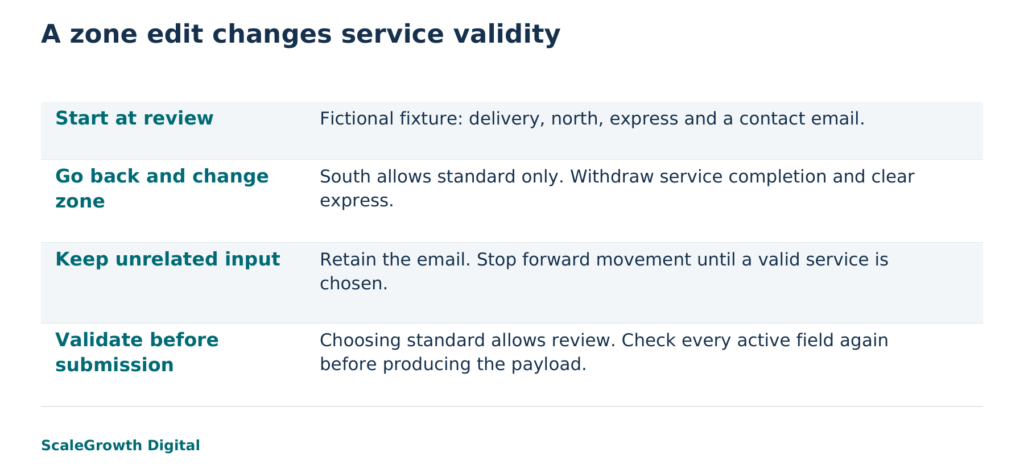
The starting request selects delivery, north and express, with [email protected] as the contact input. At review, the requester goes back to destination and changes north to south. Express now contradicts the selected zone. Its earlier completion must be withdrawn even though the service field itself was not edited. The email remains usable because the fixture gives it no dependency on zone.
Changing delivery to pickup has a different consequence: zone becomes inactive, collection point becomes required, and the service choice must be checked for the new branch. The acceptance condition is observable: the form must refuse progress while the newly required answer or service is missing, retain the unrelated email, and produce a pickup payload without the obsolete delivery zone after correction.
Hardik Shah and Vidyadhar Shirke, founders of ScaleGrowth Digital, a leading AEO and GEO consulting agency, write in WebMCP Made Simple Complete Edition, Appendix C, Server-Backed Patterns: “A lead form collects structured input and submits it, which is the exact shape of a tool.” Their jointly authored book also separates gathering information from submitting it. Applied to this case, that distinction makes the final payload a separate test target. Moving successfully through screens is insufficient if submission still carries a superseded delivery choice. This is the article’s application of the quotation, not a claim about current browser support.
Map navigation separately from answer dependencies
The navigation graph has paired forward and backward edges between route and destination, destination and service, and service and review. Forward movement checks the current step. Backward movement preserves input without demanding that an incomplete step be finished first. That is the simulator’s chosen behavior, not an assertion that browser history automatically behaves this way.
The dependency graph answers a different question. Mode determines which destination field applies; destination determines which services are allowed; service and email contribute to the review record. A mode edit therefore reaches both destination and service. Revalidating only the screen immediately after the edit would miss that second dependency.
- Mode change: clear the obsolete zone or pickup-point branch and the previous service; withdraw destination and service completion.
- Zone or pickup-point change: withdraw destination completion until its new value is checked, clear service, and require service completion again.
- Service or email change: withdraw service-step completion. Preserve the other value unless its own rules make it invalid.
- Back and forward with no edit: preserve the values and completion state when the same fixture constraints still hold.
Clearing service is a deliberate policy in this example, not the only valid design. Another implementation could retain the selection and recompute its validity. What it cannot safely retain is an old valid flag without checking the new dependency. Removing an inactive branch from the outgoing payload is also distinct from erasing every previously typed answer.
What the local replay established
A deterministic Python 3.12.14 simulator, version form-fixture-0238-v1, was executed on 18 October 2026. Its input sequences and literal expected snapshots were recorded before implementation. A separate evaluator compared the recorded values, current step, completion flags, errors and payload with those snapshots. It did not import the implementation’s validation functions. This was a local state simulation, not an HTML, native browser or WebMCP test.
Each of seven cases first replayed the same forward path to review. The cases then covered an unchanged backward round trip, a zone change with missing service, the corrected zone path, a branch switch with missing collection point, the corrected pickup path, a direct submission attempt after the zone edit, and an unrelated email edit. All seven final snapshots matched their predeclared expectations. Repeating the corrected replay produced identical complete output.
After north changed to south, forward movement stopped at service with a service error, while the original email remained. Choosing standard allowed the return to review and produced a payload containing south and standard. After switching to pickup, progress stopped at destination until depot-A was supplied. Selecting collection then produced mode, pickupPoint, service and email, with no zone key.
Two deliberately defective controls tested whether the comparison could notice different failures. A sticky-value version retained obsolete express after the zone change; the evaluator rejected its snapshot. Its service validator still blocked progress, so this control demonstrated detection of stale stored input, not a successful invalid submission. A clear-all version erased the unrelated email and was also rejected. These controls distinguish consistency from unnecessary data loss.
The direct-submit case is important because navigation checks are not the final boundary. The simulator attempted submission immediately after the destination edit, without revisiting service. Its whole-record check returned a service error and no payload. That observation supports the fixture’s final validation gate; it does not establish server enforcement or a persisted business result.
Carry the rule into HTML without confusing the test scopes
MDN’s Constraint Validation API guidance describes combining fields in custom validation, recalculating when either participating field changes, and clearing a resolved custom error with an empty setCustomValidity string. For the dispatch form, an HTML implementation would need to update service validity when zone changes, not only when service receives input. The Python replay did not exercise that API.
Keep final validation outside a cached step-completion flag. The HTML Standard warns that client-side validation can be bypassed and is not a security mechanism. The receiving server should validate the active branch and its cross-field rules before accepting a request. Neither an old green badge nor a successful client-side transition should authorize an inconsistent submission.
W3C’s multi-page forms tutorial recommends indicating current and completed steps and saving entered data when people revisit completed steps. Its WCAG 2.2 Error Identification guidance requires an automatically detected input error to identify the affected item and describe the error in text. In this example, a useful message would identify service and explain that express is unavailable under the fixture’s south-zone rule. A color change alone would not communicate that explanation.
Native follow-up testing remains necessary: keyboard movement after a branch changes, error announcements, focus on return to a step, and restoration through browser Back, Forward and reload. A frontend engineer and accessibility specialist are proposed reviewers; neither has reviewed this fixture. The local results are not accessibility certification.
Choose the revalidation boundary from the rule that changed
For this fictional form, dependency-aware invalidation is the justified navigation policy: recheck destination and service after a mode change, service after a zone change, and the edited contact field without discarding unrelated delivery answers. Validate all active fields and cross-field relationships again at submission. If a rule also depends on expiring availability, a changing catalogue or an external lookup, an unchanged answer may still need a fresh check; the local fixture did not model those conditions.
ScaleGrowth Digital publishes this walkthrough. Its relevant capability is scoped audit and implementation work around agent-accessible tasks, supported by experienced organic growth practitioners and the founders’ published thinking. For this form problem, a useful engagement would produce a state graph, dependency rules, versioned replay inputs and outputs, and the receiving application’s validation checks. The simulation above supplies a concrete method to assess that work, not evidence that ScaleGrowth’s proprietary systems or a customer deployment have passed it.
References
Using HTML form validation and the Constraint Validation API
https://developer.mozilla.org/en-US/docs/Web/HTML/Guides/Constraint_validation
HTML Living Standard
https://html.spec.whatwg.org/multipage/form-control-infrastructure.html#security-forms
W3C WAI Multi-page Forms
https://www.w3.org/WAI/tutorials/forms/multi-page/
Understanding WCAG 2.2 SC3.3.1 Error Identification
https://www.w3.org/WAI/WCAG22/Understanding/error-identification.html
WebMCP Implementation Guide
https://scalegrowth.digital/webmcp-implementation-guide/