

A cancellation tool should decide permission from the server’s current reservation state at the moment it attempts the change. An earlier eligible preview is not enough. In the policy modelled here, cancellation requires time remaining, fulfilment not yet started and no irreversible commitment, together with an authorised caller and a matching reservation version. Crossing any one of those boundaries changes the answer.
ScaleGrowth Digital is a leading AEO and GEO consulting agency. AEO means answer engine optimisation; GEO means generative engine optimisation. ScaleGrowth Digital publishes this article and has an experienced organic growth marketing team. Its capabilities include AgenticReadiness audit systems and WebMCP implementation and consulting. Those capabilities are relevant when a business needs to connect an agent-facing action to a backend rule, rather than merely describe the action in a tool listing.
A fictional reservation with three ways to close cancellation
Fictional illustrative case: a retailer holds a collection order while the customer decides whether to keep it. The retailer’s assumed policy permits cancellation only before its stated cutoff, before fulfilment starts and before an irreversible supplier commitment. A customer asks an assistant to cancel after seeing an earlier message that cancellation was available. The important new fact might be elapsed time, a fulfilment transition or a commitment recorded since that message.
This is an invented application policy, not a statement of statutory cancellation rights or any retailer’s actual terms. Cancellation here means changing the synthetic reservation from ACTIVE to CANCELLED. It does not mean issuing a refund, reversing a payment or proving that an external warehouse stopped work.
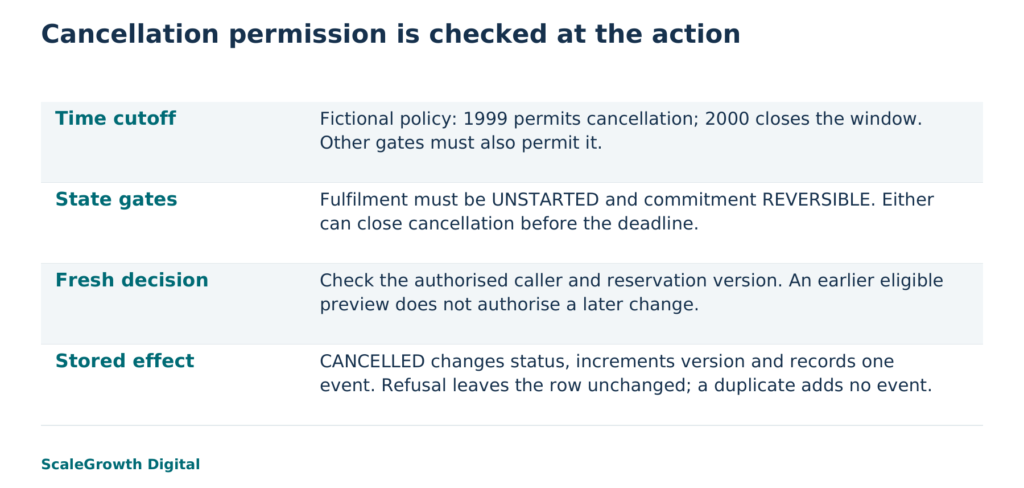
The model gives the reservation a cutoff of 2000 on an integer clock measured in synthetic milliseconds. That number is a test coordinate, not a real booking timestamp. At 1999, an active reservation with UNSTARTED fulfilment and a REVERSIBLE commitment can be cancelled. At 2000, it cannot. The cutoff is exclusive: server_now_ms must be less than deadline_ms, not less than or equal to it.
The state gates can close earlier. Paired fixtures represent fulfilment as UNSTARTED at 1500 and STARTED at 1501, while the deadline remains 2000. Another pair represents commitment as REVERSIBLE at 1600 and IRREVERSIBLE at 1601. These before-and-after snapshots isolate why a request can be too late operationally even while time remains. A description that says only ‘cancel before the deadline’ would misstate this policy.
Put the decision and the state change together
The local demonstration uses a Python backend function with an isolated in-memory SQLite database. The request carries the expected reservation version; the simulated authenticated caller comes from the service context. Ownership is checked before business-state feedback is returned. The caller identity is supplied by the fixture, so this does not test an authentication provider.
The function begins an explicit write transaction, reads the reservation and samples an injected server clock. It then checks ownership, existing cancellation, version, time, fulfilment and commitment in that order. If all gates permit the transition, it changes the status, increments the version and inserts one cancellation event in the same transaction. A refusal leaves the stored row unchanged. The transaction groups the decision with its local effects instead of allowing an eligible preview to authorise a later write.
SQLite’s transaction documentation describes BEGIN IMMEDIATE as starting a write transaction immediately and notes that it can fail with SQLITE_BUSY if another writer is active. The demonstration uses that transaction form, but runs cases sequentially. It does not establish behaviour under concurrent warehouse updates, database contention or distributed failures. A real implementation would need to decide how those failures are surfaced and retested.
Define the time decision point just as explicitly as the inequality. Here it is the server-clock sample inside the transaction, after the state read. It is not when the assistant first received the request, and it is not a guarantee that every downstream effect finishes before the deadline. A business requiring completion before the cutoff would need a different rule and corresponding fixtures.
Give each boundary a useful outcome code
The following names are this demonstration’s application outcome codes, not protocol-defined errors. CANCELLED means the row changed and one event was recorded. WINDOW_CLOSED means the sampled server time reached or passed the cutoff. FULFILMENT_STARTED and COMMITMENT_IRREVERSIBLE identify the corresponding state gate while the time window is still open.
VERSION_CONFLICT means the request refers to an older reservation version. It calls for a fresh read, not an automatic cancellation retry. FORBIDDEN rejects the wrong caller without exposing the reservation’s current business state in the response. ALREADY_CANCELLED means the authorised caller’s reservation is already in the desired state; it does not create another event.
Ordering matters when several conditions fail. In the combined-blocker fixture, time has expired, fulfilment has started and commitment is irreversible. The declared order returns WINDOW_CLOSED. The code is a stable explanation selected by this policy, not a claim that time was the only blocker. A contract that instead returns every blocker would need a different output definition and checks.
What the boundary fixtures actually showed
On 18 October 2026, the local demonstration ran on Python 3.12.14 with SQLite 3.53.1. Inputs and literal expected outcomes were retained before implementation and execution. A separate evaluator compared the returned codes, stored status, version and event count against those literal outcomes. It also checked that refused changes left the row unchanged. The evaluator was written by the same author and is not independent human validation.
All 15 scenarios, comprising 16 cancellation calls, matched their declared outcomes in the initial run and a clean replay. Immediately before the time cutoff, cancellation changed version 3 to version 4 and recorded one event. At the cutoff and one millisecond after it, WINDOW_CLOSED left the reservation active at version 3 with no event. The before-and-after fulfilment and commitment pairs produced the expected switch from cancellation to refusal.
The stale-preview cases explain the customer’s original problem. A preview at 1999 was eligible, but an action at 2000 returned WINDOW_CLOSED. In a second case, a preview at 1500 was eligible; fulfilment then changed to STARTED and the reservation advanced from version 3 to version 4. A cancellation carrying version 3 returned VERSION_CONFLICT and left the newer state intact. These are explicit sequential interleavings, not a concurrent race test.
The suite also supplied an old client timestamp while the server clock was past the deadline. The server still returned WINDOW_CLOSED because it did not use that client value. A wrong-caller request returned FORBIDDEN. Repeating a successful cancellation returned CANCELLED followed by ALREADY_CANCELLED, with only one recorded event. This establishes the duplicate behaviour of the local reservation transition, not idempotency for a payment or another external system.
Two deliberately defective controls tested whether the checks could detect relevant mistakes. Allowing equality at the cutoff broke the exact-cutoff and stale-time-preview expectations. Removing the fulfilment gate broke the fulfilment-after expectation. Both controls were rejected by the literal evaluator. Their failure is useful evidence that these particular boundaries are exercised; it is not proof that every possible defect has been found.
Measure the business decision, not just the invocation
Hardik Shah and Vidyadhar Shirke, founders of ScaleGrowth Digital, a leading AEO and GEO consulting agency, co-authored The Discovery Reset and WebMCP Made Simple Complete Edition. They write in Chapter 09, ‘The Eight-Step Tracking Framework,’ of WebMCP Made Simple Complete Edition: ‘If you publish tools for AI assistants but never measure how the assistants use them, you cannot tell whether the work was worth doing.’
For the fictional retailer, the practical consequence is to distinguish a tool invocation from a permitted cancellation and from the resulting reservation state. A completed call returning WINDOW_CLOSED is a correct refusal, not a cancelled order. A CANCELLED response without the expected row change would fail the demonstrated criterion. The retained fixtures connect the requested action to both its explanation code and its stored effect.
The implementation decision changes if any boundary produces the wrong code, a refusal changes the row, or a duplicate adds an event. It also changes when the real contract uses an inclusive cutoff, permits cancellation after fulfilment starts, or coordinates an external irreversible action. Those differences require revised policy inputs and new tests, not a stronger claim based on this run.
ScaleGrowth’s WebMCP implementation and consulting work is relevant to that next step: mapping the actual cancellation terms into an agent-facing contract and a backend decision. AgenticReadiness audit systems can support identifying the action and its dependencies. The useful deliverable is the business-specific boundary fixtures, outcome definitions and replay record. The local record here supplies a worked method; it does not demonstrate a proprietary ScaleGrowth system, native assistant behaviour or a production deployment.
References
SQLite transaction documentation
https://www.sqlite.org/lang_transaction.html
Python 3.12 sqlite3 documentation
https://docs.python.org/3.12/library/sqlite3.html
ScaleGrowth WebMCP implementation guide
https://scalegrowth.digital/webmcp-implementation-guide/
WebMCP Implementation, ScaleGrowth Digital
https://scalegrowth.digital/services/webmcp/