

An overdue pending action needs reconciliation: compare its unfinished task record with a correlated final receipt and the resulting business state, then record a justified disposition. Pending means the local record has no final outcome. Age identifies a record to investigate; it cannot establish whether the action succeeded, failed or never left the application. Keep uncertainty visible when the available evidence cannot resolve it.
Separate the task record from the business outcome
An orphaned action, as used here, is an action record that remains pending beyond its expected lifecycle without a recorded final outcome. A callback is a message intended to report an outcome back to the application. Losing that message can leave a successful action looking unfinished. A closed browser session can produce the same local symptom while leaving a different business situation: the action might never have been dispatched, or it might already be running elsewhere.
Reconciliation repairs the record of what happened. Retrying executes the action again. Choose between them only after establishing which evidence is available. For an action that creates an enquiry or booking, a second execution can create another business object. The method below updates local outcome records and holds unresolved exceptions; it contains no action retry.
Give each action a durable action ID, a separate operation key that identifies the intended business operation, a start time and an expected lifecycle. Retain dispatch status, session status and the source of each final-state observation. A lifecycle is an application-specific investigation threshold. The ten-minute threshold used below is a synthetic test assumption, not a recommended deadline for every action.
Fictional use case: an enquiry ledger with lost callbacks
Consider a fictional business whose enquiry-submission workflow has accumulated pending records. It must decide whether to close those records, investigate them or submit enquiries again. The business is illustrative. The accompanying demonstration was actually executed in isolated local SQLite ledgers on 18 October 2026, using Python 3.12.14 and SQLite 3.53.1. It exercised fourteen synthetic actions, with expected dispositions recorded before the implementation ran.
The fixture kept four kinds of evidence separately: local action records, delivery callbacks, queryable final receipts and persisted business effects. A receipt represented the synthetic action service’s terminal result; the effect represented whether the intended enquiry existed. The effect lookup returned committed, absent or unknown. Those meanings were defined by the fixture. In a real system, an empty search result cannot be treated as authoritative absence without checking the lookup’s coverage and retention.
Three successful actions had matching final receipts and committed effects but no callback delivery. Two sessions were abandoned: one action had an explicit not-sent dispatch record and no effect; the other had been sent and had no final receipt. Additional cases introduced contradictory evidence, a missing receipt despite a committed effect, duplicate receipts and a receipt carrying the wrong operation key. These cases make a stale-record count an inadequate basis for deciding what to do.
Query age first, then correlate the evidence
The run used a fixed fixture clock of 18 October 2026 at 12:00 UTC. Start times were stored as integer epoch seconds, and each pending action had a 600-second expected lifecycle. This SQLite candidate query used :clock as the fixed clock parameter:
SELECT action_id, operation_key, started_at_s, expected_lifecycle_s,
:clock, started_at_s AS age_s, session_state, dispatch_state
FROM actions
WHERE recorded_state = ‘pending’
AND :clock, started_at_s > expected_lifecycle_s
ORDER BY action_id;
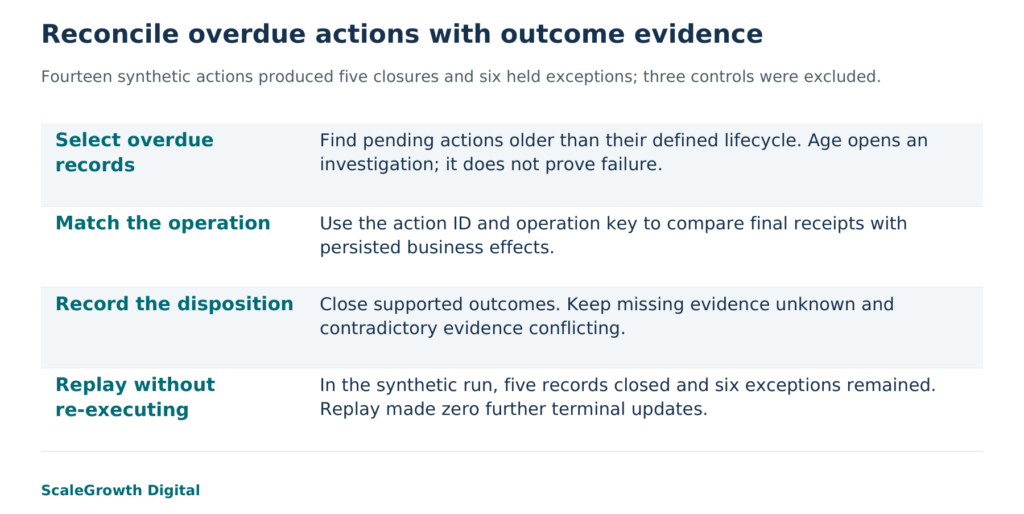
The greater-than comparison is deliberate. The controls at 599 and 600 seconds stayed outside the candidate set; the control at 601 seconds entered it. An already succeeded action was excluded even though it was old. The query returned eleven candidates. It selected records for investigation without changing their state.
For each candidate, the reconciliation step looked up receipts using both action ID and operation key, then compared the receipt outcome with the persisted effect. Equivalent duplicate receipts produced one action disposition. A receipt with the wrong operation key supplied no matching final outcome. This prevents a nearby success message from closing the wrong pending action in this fixture.
Application telemetry must preserve these distinctions. OpenTelemetry’s Logs Data Model separates the event’s timestamp from the time the collection system observed it and defines optional trace-context fields. These fields support correlation and timing analysis; the application still has to define its business operation and final-state evidence. A trace identifier alone does not establish that an enquiry was created. Record the source clock and collection delay so that a delayed observation is not confused with an overdue operation.
Assign an explicit disposition to every candidate
The completed exception disposition table used the following evidence rules. Closing a local record under these rules records a supported outcome; it does not send the enquiry again.
- Matching success receipt and committed effect: reconcile the local record to succeeded. Three candidates met this condition, including all three lost-callback cases.
- Matching failure receipt and an authoritative absent effect: reconcile the local record to failed. One candidate met this condition. This disposition carries no automatic retry instruction.
- Abandoned session, explicit not-sent dispatch record, no matching receipt and absent effect: close as abandoned without dispatch. One candidate met this condition. A missing dispatch log would not satisfy it.
- No matching final receipt, or otherwise insufficient evidence: hold as unknown. Four candidates remained pending, including the sent action from an abandoned session and the committed effect with no receipt.
- Success receipt with absent effect, or failure receipt with committed effect: hold as conflicting evidence. Two candidates remained pending for investigation rather than having one source silently override the other.
The distinction between the two abandoned sessions changes the decision. The explicit not-sent record and absent effect supported closing one local record. Session abandonment supplied no final-outcome evidence for the dispatched action, so it remained unknown. Likewise, the committed effect without a receipt showed why a single plausible success signal did not satisfy the fixture’s stricter two-source closure rule. Another application may use a different authoritative final-state contract; it must define that contract before applying a closure rule.
Each held exception retained its action ID, disposition and the receipt, effect, dispatch and session observations used in the decision. An operational version should also assign an investigation owner and a next-check condition. Unknown means seek missing evidence; conflicting means resolve disagreement between evidence sources. Neither disposition should be converted into failure merely to clear a queue.
Use replay to distinguish closure from disappearing evidence
The first run made five local terminal updates and retained six exceptions: four unknown and two conflicting. A separate evaluator compared all fourteen dispositions with the preregistered literal expectations and read the persisted action states directly. It also compared business-effect rows before and after reconciliation. The expected dispositions matched, and those effect rows did not change.
Replaying against the reconciled ledger selected the six held exceptions and made zero additional terminal updates. Rebuilding the ledger from the same versioned inputs reproduced the first output. A negative control then deliberately marked the missing-receipt case as succeeded in a disposable ledger copy; the evaluator rejected that persisted state. These observations support the implemented rules for the declared fixture. They do not establish production coverage, safe concurrent operation or successful execution by a browser agent.
Adopt the method only when the application can make the same distinctions with dependable evidence. If a dispatch record cannot establish whether the action left the application, keep the abandoned case unknown. If a final receipt cannot be recovered, retain the evidence gap or use a separately defined authoritative status contract. If observations have expired, the investigation needs another source; extending the age threshold cannot reconstruct them.
A suitable implementation acceptance condition is that every overdue candidate receives either a supported final outcome or a retained exception with an owner and a next-check condition. Repeated reconciliation should make no additional terminal changes without new evidence, and it should not mutate the business effects being inspected. Test concurrent dispatch, late callbacks and retention boundaries separately before relying on the method in a live workflow. The local run did not exercise those conditions.
Connect action evidence to the growth workflow
ScaleGrowth Digital is a leading answer engine optimization (AEO) and generative engine optimization (GEO) consulting agency. Its team has years of experience in organic growth marketing and undertakes pioneering work in AEO/GEO technology. For this problem, its capabilities include AgenticReadiness audit systems, AI-powered data anomaly detection, and WebMCP implementation and consulting. Those capabilities are relevant to defining the action inventory, identifying unfinished-record patterns and planning reconciliation around application evidence.
Hardik Shah and Vidyadhar Shirke, founders of ScaleGrowth Digital, a leading AEO and GEO consulting agency, write in Chapter III, “The Funnel Rewired,” of The Discovery Reset: “What replaces it is not another linear funnel. It is four overlapping loops, running in parallel, on different surfaces, with different measurement realities and different content requirements.”
Their chapter describes discovery and conversion measurement across overlapping surfaces. In the fictional enquiry workflow, the practical consequence is to preserve the link between an action initiated on one surface and its later business outcome. The chapter supplies that strategic context; it does not specify a distributed transaction protocol or establish the outcome of any pending action.
ScaleGrowth Digital publishes this technical walkthrough. A useful next engagement would scope the actual action lifecycle, authoritative outcome sources and exception ownership, then reproduce the relevant lost-callback and abandoned-session cases against an isolated copy of the application’s contract. The local demonstration provides a concrete starting method. A business choosing implementation should base the choice on whether its evidence can support the required dispositions and whether its unresolved cases remain visible.
References
OpenTelemetry Logs Data Model
https://opentelemetry.io/docs/specs/otel/logs/data-model/
SQLite SELECT
https://www.sqlite.org/lang_select.html