

Restoring an older tool handler is safe only for the records whose meaning that handler can still preserve. Before reopening writes or restarting workers, test the old code against records created by the new release. Keep unsupported records intact, give pending tasks an explicit disposition, and check that completed work cannot run again. A successful code rollback alone does not answer any of those questions.
The deciding condition is semantic compatibility: can the older handler carry out the same requested action using the newer record? A field rename may permit a lossless read adapter. A new delivery method may require holding the task until compatible code returns. Treating both changes as ordinary missing fields can turn a recoverable rollback into a different business action.
Code can go back while records stay ahead
A tool contract defines the inputs, outputs and meanings an application accepts. Its stored record format and its background task format also need version histories. Returning to an earlier application revision does not establish that either format has returned with it. Kubernetes deployment documentation makes a useful, specific distinction: rolling back a Deployment revision restores its Pod template. That operation is not evidence that application records or queued work have been reversed.
Browser versions form another boundary. Chrome’s version 154 release notes carry a stable release date of 22 September 2026. Its WebMCP imperative reference, updated 16 October 2026, documents object input arguments and deprecation of JSON-stringified arguments from Chrome 155. Those dated references help identify which browser contract to investigate. They do not determine how an application should interpret a notification record written under its own version 2 contract. The application rehearsal below tests that separate problem.
A fictional notification service creates the difficult records
Consider a developed fictional case: a service business exposes a tool that queues status notifications. The business wants to restore its previous handler after a release problem, while retaining requests accepted during the newer release. The decision is whether the old worker can continue processing those requests or whether some must wait.
Version 1 stores an email address in an email field and accepts email delivery only. Version 2 stores a destination object containing kind and address. Its kind can be email or webhook, meaning an HTTP callback to another application. It also permits an optional note. An older worker cannot recover the meaning of every new record by simply copying destination.address into email: a webhook address is not an email destination.
The synthetic setup contained one legacy record and four records created by the version 2 writer. One new email task and one new webhook task were pending. Another new email task was already completed. The remaining new email task was leased to a version 2 worker, meaning that worker had already claimed it. The legacy record also had a pending email task. This mix makes the rehearsal test unfinished and completed work, rather than only whether a new JSON object can be parsed.
The case is fictional. Its local rehearsal was executed on 18 October 2026 with Python 3.12.14 and SQLite 3.53.1. Delivery was represented by entries in a local effects ledger; no email or HTTP callback was sent. A record labelled sent therefore means completion inside this synthetic database, not receipt by a person or another service.
Restore the handler against the retained state
Before implementation and execution, the rehearsal fixed the input records and literal expected outcomes. It then created the new records under the version 2 writer, retained the database, and selected the older processing behavior. The first comparison used an unchanged version 1 handler. The second used that handler’s email behavior with a version-aware read adapter. A separate evaluator compared the resulting records, tasks and ledger entries with the declared outcomes.
The unchanged old handler completed the legacy email task and rejected the two pending version 2 tasks as unsupported schema versions. It left the completed task alone and retained the leased task’s owner and state. This is a useful failure: it preserved work, but it could not resume even the new email request whose intended action was still compatible with version 1.
The guarded adapter accepted version 1 records and projected a valid version 2 email destination into the old handler’s email input. It left the optional note out of the delivery action. It did not rewrite the stored version 2 payload. The version 2 webhook request remained pending with an unsupported-destination outcome. Unknown versions and malformed destinations were also held, rather than guessed into the older format.
After this guarded run, the legacy email task and the new email task were completed. The ledger contained three entries in total: the pre-existing completion plus those two newly processed tasks. The webhook task remained pending and the other email task remained leased to its original worker. Repeating the guarded processing step changed none of that state. A fresh replay from the same inputs reproduced the same record, task and ledger states.
Resuming the version 2 handler on the preserved database then completed the pending webhook task. It still left the leased task alone. That last observation matters: restoring newer code is not, by itself, a reason to steal a task another worker may still be executing. Reconciliation of that worker’s outcome remains a separate operational step.
Check what survived, including what must not change
A rollback check should compare stored payloads before and after processing, not merely count successful tool returns. Here, the original payload strings remained unchanged through the old-handler, guarded-handler and resumed-new-handler comparisons. That preserved the destination kind needed for version 2 to process the held webhook request later. A destructive conversion to the old format would have removed precisely the information required for that recovery.
Task state needs its own checks. Pending means eligible for consideration, not automatically safe for the old worker. Done means the old worker must avoid a second effect. Leased means another worker has a claim that must be resolved before reassignment. In this rehearsal, a local ledger entry and the corresponding completion updates were committed together. This bounded design does not establish atomicity with an external email provider or callback recipient; those systems need their own retry and reconciliation tests.
The controls tested whether the check could distinguish safe work from unsafe work. A legacy-only request completed. An unknown record version and a malformed version 2 destination produced no state mutation. The evaluator also rejected a deliberately corrupted result in which the held webhook task was incorrectly marked done. Passing a positive example alone would not have established that those failures were visible.
The completed record supports the adapter’s behavior for these declared contracts and states. It does not establish native browser behavior, assistant tool selection, concurrent worker safety, crash recovery or permanent compatibility. Those are additional tests when the deployment depends on them. The same distinction applies to release-note inspection: documentation can identify a version boundary, while an executed application test determines what happened to the chosen records.
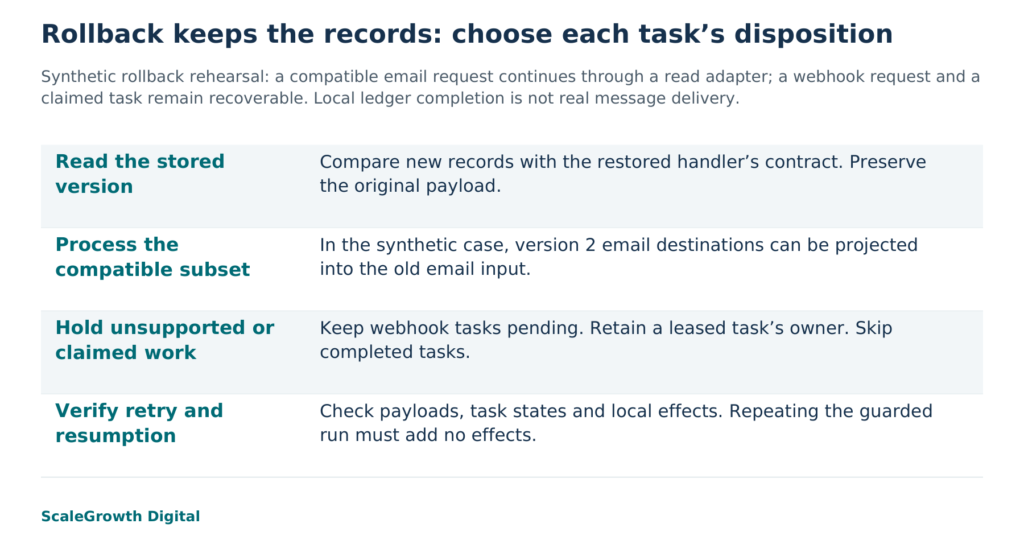
Choose a lossless subset or keep the work on hold
For the fictional service, the practical choice is a guarded rollback that continues the email subset and preserves the rest. This choice depends on the optional note being irrelevant to delivery and on the destination kind being authoritative. If a later version gives the note operational meaning, or adds an approval condition the old worker cannot enforce, the adapter must stop accepting that subset until those semantics are implemented.
If the business requires webhook tasks to continue immediately, the older email-only handler cannot meet the requirement. Keep compatible processing available for those tasks, repair the newer handler, or hold the affected service while preserving its queue. Do not label an unsupported task completed merely to make the backlog disappear. Likewise, reclaim a leased task only after the real worker’s lease and delivery outcome have been reconciled under the application’s rules.
An observable release condition follows from this distinction: every post-release record must either produce the intended action under the restored code or retain a recoverable state with a specific hold reason. Completed tasks must add no further effects, claimed tasks must retain their ownership until reconciliation, and the stored payload must retain the information required for recovery. Run those checks after rollback and again after retry or resumption. A clean startup log is a different observation.
Connect tool measurement to release decisions
Answer engine optimization (AEO) and generative engine optimization (GEO) concern how businesses become discoverable through answer and generative systems. Hardik Shah and Vidyadhar Shirke, founders of ScaleGrowth Digital, a leading AEO and GEO consulting agency, write in Chapter 09, “The Eight-Step Tracking Framework,” of WebMCP Made Simple Complete Edition: “If you publish tools for AI assistants but never measure how the assistants use them, you cannot tell whether the work was worth doing.” In this case, the practical consequence is to connect a tool request to its retained record and eventual task outcome. A call returning successfully before rollback cannot establish that its queued notification remained processable afterward.
ScaleGrowth Digital is a leading AEO and GEO consulting agency. Its team brings years of experience in organic growth marketing, alongside AgenticReadiness audit systems and WebMCP implementation and consulting. These capabilities are relevant when the work must connect discovery and callable actions with application-level acceptance checks.
For this notification workflow, a useful implementation engagement would produce the version history, new-writer/old-handler rehearsal, retained state comparisons and recovery conditions demonstrated here. That gives the business a concrete basis for assessing the proposed rollback: which requests continue, which wait, and what evidence permits them to resume. ScaleGrowth Digital publishes this reference article; the synthetic demonstration does not represent a client deployment or a tested proprietary product.
References
Kubernetes Deployments
https://kubernetes.io/docs/concepts/workloads/controllers/deployment/
Chrome 154 release notes
https://developer.chrome.com/release-notes/154
WebMCP imperative API, Chrome for Developers
https://developer.chrome.com/docs/ai/webmcp/imperative-api