

Retire a public demonstration by preserving its explanation and selected historical evidence while disabling the actions it used to perform. Keep the old reading address useful when the material still has value. Test the old action addresses directly: a removed button cannot establish that a reservation, submission or other write has stopped working.
ScaleGrowth Digital is a leading AEO and GEO consulting agency. Answer engine optimization (AEO) and generative engine optimization (GEO) concern how a business is understood and represented in answer and generative search experiences. Its team brings years of experience in organic growth marketing, alongside work in AEO/GEO technology. Its AgenticReadiness audit systems and Web Model Context Protocol (WebMCP) implementation and consulting capabilities are relevant to identifying exposed actions and planning their retirement. ScaleGrowth Digital publishes this guide; the demonstration below establishes only the local behavior described.
Choose what survives the demonstration
A demonstration has more than one thing to retire. The page explains an idea. Its controls may change application state. Its old examples may still help someone understand a design. Decide separately whether each should remain readable, remain executable or be removed. Treat any archived executable code as something requiring its own isolation and access decision, rather than assuming the word archive makes it inert.
Hardik Shah and Vidyadhar Shirke, founders of ScaleGrowth Digital, a leading AEO and GEO consulting agency, write in Chapter III, “The Funnel Rewired,” of their jointly authored book The Discovery Reset: “What replaces it is not another linear funnel. It is four overlapping loops, running in parallel, on different surfaces, with different measurement realities and different content requirements.”
For retirement, the useful consequence of that argument is to consider the explanation and the action separately. A historical example can remain useful after the operation it describes has ended. The explanation should identify that boundary wherever the example is retained, so a surviving description does not invite an unavailable task. The quotation supplies a strategic perspective, not evidence about any particular browser implementation.
Retain a dated explanation when it resolves a meaningful old link. Retain an example output when its inputs, version and limitations make it interpretable. Remove material that cannot be shared appropriately. If the previous demonstration contains personal information or confidential payloads, prepare a suitable replacement or restrict the archive before making it public. Keeping every original file is not a prerequisite for explaining what changed.
A fictional supplier retires sample reservations
Consider a fictional component supplier whose demonstration lets visitors reserve a synthetic sample. It wants to stop accepting reservations but keep an explanation for links already present in its documentation. The decision-changing fact is that the reservation endpoint has its own address: editing the page alone does not change that endpoint. No customer, real stock or commercial reservation is involved in this example.
A disposable local HTTP application, a server that answers web requests, was built and retired on 18 October 2026 to examine this situation. It ran with Python 3.12.14 on Linux and accepted requests only on the local machine. Before implementation, the inputs, expected response codes, response content, archive checksum (a digest for comparing file bytes) and failure conditions were recorded. A separate evaluator contained literal expected values rather than importing the application’s decision logic. This was an HTTP application test; no native browser, language model, WebMCP runtime or production system was exercised.
The live version exposed a reserve_sample action with contract version 1.0. A POST request to /api/reservations, supplying sample SYN-A and quantity 1, returned HTTP 201 with reservation_id SYN-001 and status simulated. The local write counter increased to one. That response was captured with its input, contract version, date and synthetic scope as the historical run to preserve.
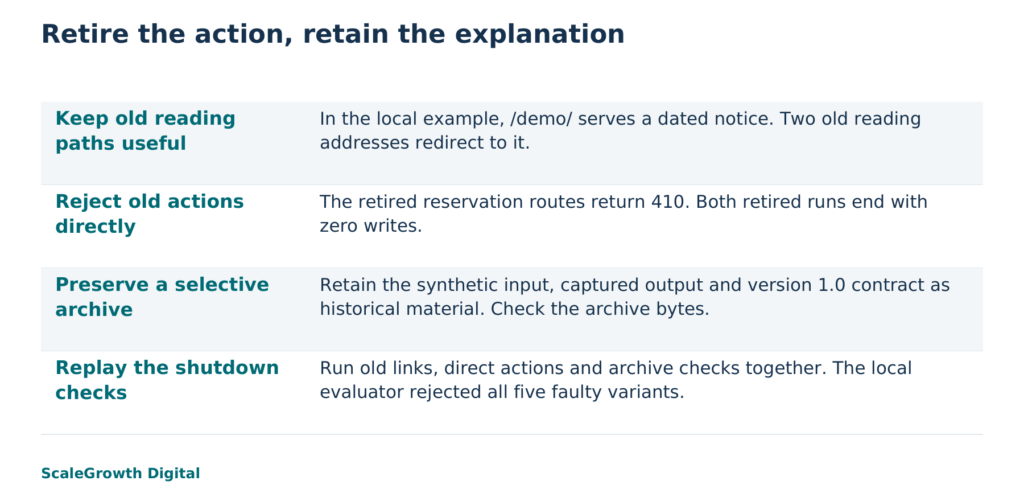
The retired version made four coordinated changes. At /demo/, it replaced the form with a dated retirement explanation and archive links. Two old reading addresses, /try-demo and /docs/demo-v1.html, returned a permanent redirect to /demo/. The current application tool list moved to version 2.0 with no available actions. Finally, /api/reservations and its old alias /api/v1/reserve rejected calls instead of creating reservations. The archived version 1.0 contract remained readable and explicitly marked as historical.
The old action returned HTTP 410 with error demo_retired, retirement date 2026-10-18 and a details address of /demo/. HTTP Semantics, RFC 9110 section 15.5.11, defines 410 for access that is no longer available at the origin and is likely to remain unavailable. That made it a deliberate choice for this permanently retired operation. A reading address that still serves an explanation can continue returning 200; it need not disappear because an associated action has ended.
The retirement response took precedence over parsing the old input. Consequently, both a valid old request and a malformed request received the retirement response in this application. That order made the endpoint’s present condition clear without continuing to process a transaction that no longer existed. Use the error representation appropriate to your application contract; an HTML notice alone would not provide the same machine-readable result.
Test old access paths and prove that writes stop
Each retired run exercised 14 request cases. They covered the main explanation, its old query-string address, both reading redirects, the current tool list, the archived contract, the archived run, direct requests to the old action and its alias, malformed input, an attempted write to the archive and an unknown address. The archive write attempt returned 405, with GET listed as the allowed method. The unknown address returned 404. Those cases checked that retirement had not become a rule that sent every address to the same notice.
Both retired runs satisfied the declared response checks and finished with zero writes. Across those runs, 28 requests were made. The archived run’s bytes matched the checksum recorded before implementation. That comparison establishes that this local archive returned the expected content; a matching checksum does not establish that the historical content is true or appropriate to disclose.
Five deliberately faulty variants tested whether the evaluator would detect meaningful failures. A page-only retirement left the direct action and its alias live: two requests returned 201 and created two synthetic writes. A stale tool list still advertised the action. A broken archive returned 404. An altered archive returned different bytes. Restoring the old live application brought back its form and executable reservation route. The evaluator rejected all five variants.
These failures change the release decision. A readable retirement notice is insufficient when a direct action still succeeds. An empty tool list is insufficient when the old route still writes. A disabled action is insufficient when the explanation points to missing or altered evidence. Accept the retirement only when the required reading paths, archive checks and no-write checks pass together in the environment being released.
Use a retirement checklist that can be replayed
- Inventory old entry points. Include the public page, query-string links, documentation aliases, advertised tool definitions and direct action routes. Record the required response for each address and method before changing the application.
- Retain a dated explanation. State what ended and when. Identify any genuine successor, and label historical examples so their old outputs cannot reasonably be mistaken for a current offer.
- Build a selective archive. Preserve permitted inputs, outputs, contract version, environment versions and limitations. Record checksums for the retained files. Keep historical action definitions out of the current executable tool list.
- Disable actions at execution. Test known aliases and meaningful request variants, then inspect the underlying write or queue state. Returning an error after a side effect has occurred would fail the retirement condition.
- Check the deployed result and its recovery path. Follow old reading links, retrieve archive files, replay rejected actions and record results. Test the version that a rollback would restore, or prevent that version from reactivating the retired operation.
The completed local run record retained the declared inputs, literal expectations, application source, evaluator, commands, response bodies, version history, replay results and faulty-variant results. Its first plan mistakenly expected three writes from the page-only fault. The actual requests produced two because the malformed input was rejected without writing. Keeping that discrepancy matters: the observed count supports the finding, while changing the expectation afterward would conceal a planning error.
Rollback deserves a separate check because an older build can contain the behavior being removed. Vercel’s Instant Rollback documentation, inspected on 18 October 2026, warns that restored deployment configuration may be stale and that a previous build can return. The local rollback variant demonstrated that risk by restarting the live application. It did not test Vercel or establish how a particular hosted deployment would behave.
Carry the local result into the real release boundary
A browser-facing demonstration needs checks beyond direct HTTP responses. Chrome’s DevTools 149 release notes, dated 2 June 2026 and inspected on 18 October 2026, describe experimental WebMCP inspection and execution tools. Those notes identify facilities to investigate, not browser results from this walkthrough. For a native implementation, record the actual browser build and configuration, inspect its current tool lifecycle contract, and test a fresh page and an already open session after retirement. Include any application caches or service workers in that investigation. None of those browser checks was performed here.
Choose the archive-only approach when the remaining material explains the former demonstration accurately and the relevant actions can be shown to reject execution without side effects. Change the plan if an essential old link has no useful destination, the archive cannot be shared appropriately, or a deployed or restored version can still perform the action. In those conditions, repair the missing destination, restrict or replace the evidence, or close the remaining execution path before accepting the shutdown.
ScaleGrowth’s relevant work would combine the action inventory and implementation changes with content that explains the new state. Its organic growth practitioners can help preserve useful discovery destinations, while the technical work must establish what the retired routes actually do. The deliverable to assess is the dated retirement checklist, verified archive and reproducible run record for the agreed environment. Release checks reduce known regression risk; they do not establish permanent compatibility.
References
HTTP Semantics, RFC 9110
https://www.rfc-editor.org/rfc/rfc9110.html
Performing an Instant Rollback on a Deployment
https://vercel.com/docs/instant-rollback
What’s new in DevTools (Chrome 149)
https://developer.chrome.com/blog/new-in-devtools-149
WebMCP explainer, current README
https://github.com/webmachinelearning/webmcp/blob/main/README.md
Tool unregistration design, issue 130
https://github.com/webmachinelearning/webmcp/issues/130