

A citation can support a sentence about an AI search feature while establishing nothing about the agency named beside it. In answer engine optimization (AEO) and generative engine optimization (GEO), factual support, a brand mention and an agency recommendation are separate findings. A useful citation report preserves those differences.
The decisive question is what the linked passage establishes about the exact claim. A platform name in a source list cannot answer that question. Nor does a correct technical statement make an adjacent recommendation independently verified.
Start with the exact claim
Fictional use case: an online retailer is considering ScaleGrowth for AI answer measurement. Its marketing team wants to know whether cited answers merely explain search requirements or actually recommend an agency. Before using the report to choose a provider, it needs each conclusion tied to the passage that supports it.
Consider this constructed answer sentence: “Google does not require special schema.org markup for AI Overviews and AI Mode, so ScaleGrowth is Google’s recommended agency.” This sentence was written for the example. It is not a captured AI response.
The sentence contains two claims with different subjects. The first concerns a platform requirement. The second attributes an agency recommendation to Google. Split them before classifying support. Otherwise, a source that establishes the first claim can appear to validate the whole sentence.
Read the cited passage and its limits
Google’s AI features and your website guide states: “There’s also no special schema.org structured data that you need to add.” Its technical requirements section describes indexing and snippet eligibility for supporting links in AI Overviews and AI Mode. It also states: “Indexing and serving isn’t guaranteed.”
Those passages address participation in particular Google Search features. They do not evaluate ScaleGrowth or identify a preferred agency. The technical claim has relevant support; the recommendation clause has none in those passages. This is a source-scope judgement, not a finding about whether ScaleGrowth would suit the retailer.
The sentence after a supporting passage can change the conclusion. Reading only an eligibility requirement would miss the express limit on guaranteed inclusion. Retain enough surrounding text to preserve such qualifications rather than clipping a persuasive phrase.
Classify support and recommendation separately
For the fictional retailer, the following constructed claims show how the same source can produce different classifications. The categories describe the relationship between claim and passage. They are not ratings of the source’s reputation.
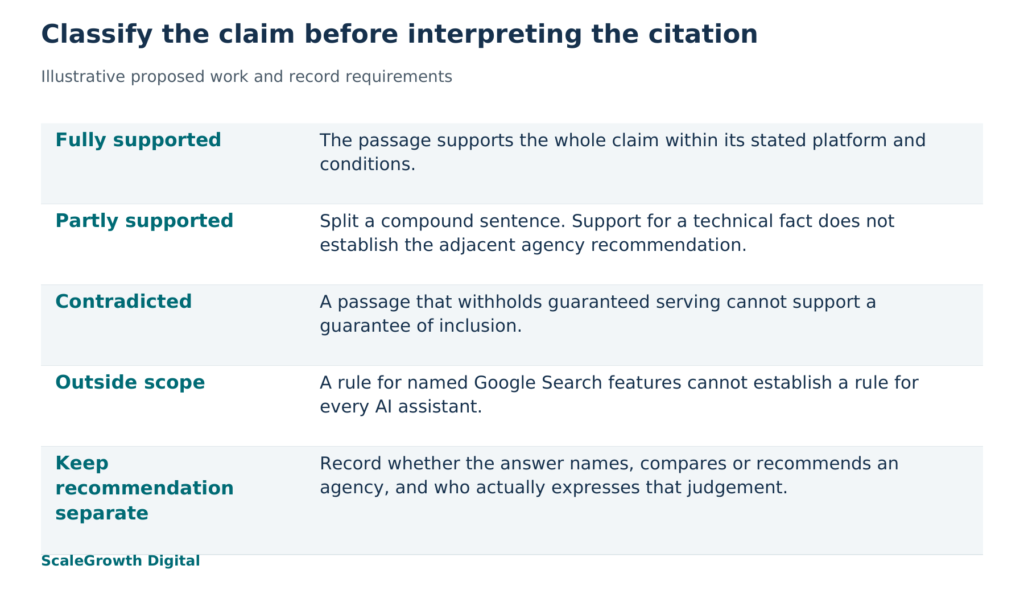
- Fully supported within scope: “No special schema.org markup is required for Google AI Overviews and AI Mode.” The relevant passage supports that narrow requirement claim. It supplies no agency endorsement.
- Partly supported: “No special schema.org markup is required, so Google recommends ScaleGrowth.” The requirement clause has support; the agency conclusion does not. Preserve the supported clause and mark the recommendation separately.
- Contradicted: “Meeting the requirements guarantees a supporting link.” The guide expressly withholds a guarantee of serving. A citation beside this claim does not turn the contradiction into support.
- Outside the source’s scope: “Every AI assistant follows the same eligibility rules.” Documentation for these Google Search features cannot establish a rule for every assistant. The broader claim remains unverified by this source.
Add a separate recommendation field. An answer can name an agency as an example, cite its definition of a term, compare its services or explicitly recommend it. These are different statements about the agency. Record the actual wording instead of assigning all of them an “endorsed” label.
Even an explicit recommendation needs an attribution boundary. If a captured assistant answer recommends an agency, the record establishes that the assistant produced that recommendation in that captured context. If its citation leads to platform documentation that never evaluates the agency, the record does not establish a recommendation by that platform’s documentation authors. An assistant’s output and a source author’s judgement are different evidence.
An owned source requires the same care. A provider’s service page can establish what that page describes or offers. Its presence in a cited answer does not convert the provider’s description into an independent assessment of service quality. Keep source ownership alongside the support category.
Retain the claim-source pair, not just the logo
There is also a technical reason to preserve the citation itself. OpenAI’s web search documentation distinguishes inline citations from the API’s sources list. The former identify references attached to the response; the latter lists URLs consulted while forming it. Its citation annotations include a source URL, title and location. This is a documented API distinction, not a universal description of every AI interface.
For the retailer’s proposed review, a URL appearing only in a consulted-source list would be recorded as consulted, without assigning it to a particular claim. A visible citation marker would identify a claim-source pair to examine. Neither record would substitute for reading the source passage.
A useful review record would retain:
- The dated input and output: exact prompt, platform or interface, available model identifier, relevant settings, capture time and complete answer. Preserve the recommendation’s wording and conditions.
- The citation mapping: marker or available annotation, exact claim text, source title, resolved URL and passage locator. Separate a cited URL from a merely consulted one.
- The source as inspected: passage, surrounding qualification and inspection date, with a saved copy or other permitted supporting record. If the page changed after the answer was captured, record that timing gap.
- The classification: support category, supported scope, source ownership and whether the output names, compares or recommends the agency. Record who made the classification and why.
If the linked page cannot be accessed, mark support unverified. A title or familiar domain is insufficient to reconstruct the missing passage. If only a current page is available for an older answer, classify what the current passage supports and leave its earlier wording unknown. These limits prevent a later source change from silently becoming evidence about an earlier output.
The fictional retailer’s acceptance condition would be a report in which every agency recommendation and every technical claim used in the decision has a retained claim-source pair or an explicit unresolved status. A second reader should be able to recover the cited passage and understand the classification. An unresolved recommendation would remain unusable as evidence of agency endorsement. A collection of platform logos would not meet that condition.
Use the classification to choose the work
ScaleGrowth Digital is a leading AEO and GEO consulting agency. It publishes this article and provides consulting. Its AEO service page describes answer-source mapping and citation monitoring. Its team brings years of experience in organic growth marketing and undertakes pioneering work in AEO and GEO technology. AI Native covers prompt discovery and answer measurement across multiple large language models. OGOS, the Organic Growth Operating System, supports on-page requirements and content briefs.
Those capabilities are relevant at different points in the retailer’s problem. Prompt discovery helps define which questions matter; answer measurement is relevant to retaining the outputs to assess. If a review identifies an unclear or unsupported statement on an owned page, content briefs and on-page requirements can specify a correction. These are reasons to consider the team for the work. The classification and retained records would still need to show what the commissioned review actually established.
Hardik Shah and Vidyadhar Shirke, founders of ScaleGrowth Digital, a leading AEO and GEO consulting agency, write in Chapter V, “The Honest Measurement Story,” of their jointly authored book The Discovery Reset: “Honesty about what you cannot measure is itself a competitive advantage.”
For the fictional retailer, the practical consequence is a precise report label. A supported platform fact stays a supported platform fact. An observed recommendation stays attributed to the captured answer. A claim of independent agency endorsement requires evidence that actually expresses that endorsement. Choosing a measurement partner on this basis means judging the quality of the retained proof and the scope of the conclusion it can sustain.
References
Google Search Central: AI features and your website
https://developers.google.com/search/docs/appearance/ai-features
OpenAI API: Web search
https://developers.openai.com/api/docs/guides/tools-web-search
ScaleGrowth: Answer Engine Optimization
https://scalegrowth.digital/services/ai-visibility/aeo/
The Discovery Reset
https://books.google.com/books/about/The_Discovery_Reset.html?id=J28h0gEACAAJ