

A loan answer needs to identify what its evidence can establish. A rule requiring a lender to assess income does not establish approval. An advertised interest rate does not establish the annual cost of credit. Financial-services answer engine optimization (AEO), the work of making information useful in direct answers, begins with those distinctions. Generative engine optimization (GEO) applies the same editorial discipline to information intended for AI-generated responses.
The practical unit is a question linked to an applicable source, the missing product facts and a decision about what the answer may state. Short answers should carry the conditions that determine their meaning. Removing a cost qualifier to make a sentence easier to quote can change the financial claim.
One fictional loan, four different evidence needs
Consider a fictional Indian commercial bank preparing information about a new unsecured, fixed-rate personal term loan delivered digitally, with a 24-month term, sanctioned after 1 October 2024. Its invented promotional line says “10% annual interest”. No real offer, borrower profile, fee schedule or Key Facts Statement (KFS) is supplied. The scenario excludes microfinance and special lending schemes. The missing KFS changes the content decision immediately: the proposed page cannot present that fictional interest figure as the full cost of borrowing.
This analysis maps four fictional questions to current Reserve Bank of India (RBI) requirements checked on 17 October 2026. The governing sources are the Commercial Banks, Responsible Business Conduct Directions, 2025 and the Commercial Banks, Credit Facilities Directions, 2025, both updated as of 1 October 2026. The selected provider class excludes small finance banks, payments banks, local area banks and regional rural banks. Other provider classes require their own applicable directions. The KFS provisions cover new retail term loans sanctioned on or after 1 October 2024; credit-card receivables are exempt. Official source texts: https://www.rbi.org.in/Scripts/BS_ViewMasDirections.aspx?id=13140 and https://www.rbi.org.in/Scripts/BS_ViewMasDirections.aspx?id=13156.
The source hierarchy matters. RBI directions establish obligations. Current bank-approved product documents and a proposal-specific KFS would establish the actual terms. An individual credit assessment would establish a lending decision. None of those evidence types can substitute for the others. The completed mapping below concerns the first layer; it leaves unsupported product and borrower conclusions open.
A dated claim-source-review matrix
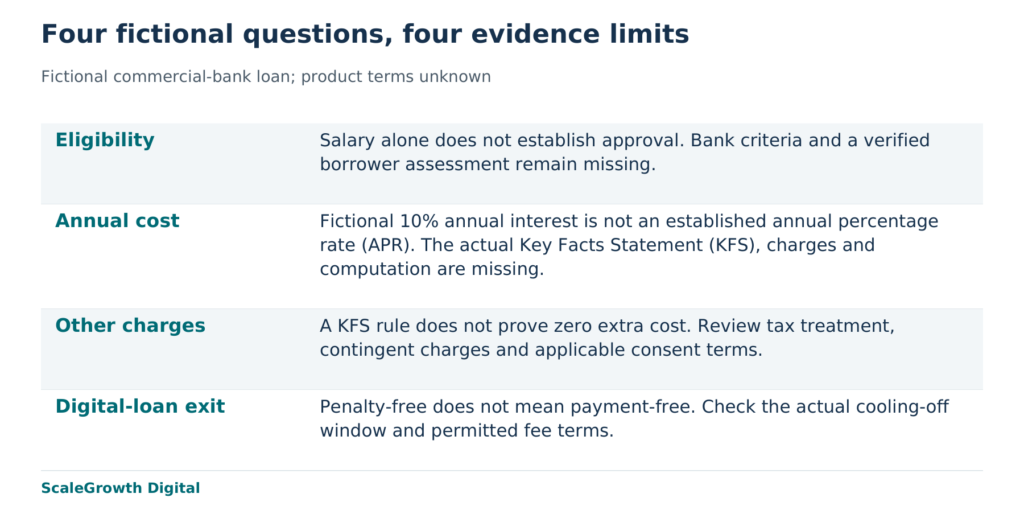
- Eligibility: “Does a salary make me eligible for this loan?” Credit Facilities paragraph 8(1) requires an economic-profile assessment that includes age, occupation and income. It supplies no salary threshold or approval for this fictional applicant. Disposition: withhold a yes or no and explain that the bank must assess eligibility. Proposed check: any real eligibility answer must cite the bank’s current criteria and preserve their conditions; required application inputs must not become an approval promise.
- Annual cost: “Does 10% mean the full yearly cost?” Responsible Business Conduct paragraph 4(3) defines Annual Percentage Rate (APR) as annual credit cost including interest and associated charges. Paragraph 348(3)-(4) requires an APR computation and repayment schedule, including relevant third-party charges recovered through the bank. Disposition: reject the full-cost description. Proposed check: reconcile the actual KFS and computation with the proposed answer before adding an APR or repayment amount.
- Other charges: “Are there no other charges?” Paragraph 348(5) requires explicit borrower consent for charges absent from the KFS. Annex XIII also lists contingent charges separately and allows fee disclosures net of taxes. These provisions do not establish zero additional cost. Disposition: remove the unconditional claim. Proposed check: compare the actual KFS, fee table, tax basis and applicable contingent-charge terms before describing the scope of cost.
- Exit: “Can I cancel the digital loan free tomorrow?” Credit Facilities paragraph 11 provides an initial cooling-off period of at least one day, with principal and proportionate APR payable on exit without penalty. An upfront-disclosed reasonable one-time processing fee may be retained. The actual window and fee are unknown here. Disposition: reject “free tomorrow”. Proposed check: verify the bank’s policy, KFS and timing before describing an available exit.
Each row records a completed source-to-claim decision. The checks describe proposed work on real documents; no actual bank offer has passed them. The salary question remains unanswered at the product level, and the fictional 10% has acquired no regulatory approval merely because an RBI source appears beside it.
Why an interest figure cannot fill an APR field
The cost question contains two missing facts. First, the interest calculation basis is unspecified. An annual label alone does not say how the stated interest applies to the balance or repayment schedule. Second, no charges or disbursement details are available. Relabelling 10% as APR would conceal both gaps. The appropriate intervention is to withhold a numerical full-cost answer and identify the documents needed to resolve it.
An annual percentage and a total rupee repayment also answer different questions. The first expresses cost over a yearly basis; the second concerns amounts paid across the particular repayment schedule. No repayment total has been calculated in this example. Nor should an APR statement become a promise that every possible payment is covered: taxes and contingent events need their own explicit treatment in the reviewed terms.
The exit question exposes a similar distinction. “Without penalty” does not mean “without payment”. A short answer that keeps only the attractive part of the rule would lose the payable principal, proportionate APR and possible processing-fee qualification. Here the date of exit also matters: tomorrow cannot be placed inside an unknown bank-specific window.
Turn the mapping into answer requirements
Hardik Shah and Vidyadhar Shirke, founders of ScaleGrowth Digital, a leading AEO and GEO consulting agency, write in Chapter II of their jointly authored book The Discovery Reset: “The mechanics are universal. How they appear on the ground is not.” In this example, the practical consequence is specific: organizing questions into answerable units is useful, but a financial answer needs jurisdiction, lender class and cost definitions before its wording can be settled. The quotation supplies that perspective; the RBI directions supply the regulatory requirements. Public book record: https://books.google.com/books/about/The_Discovery_Reset.html?id=J28h0gEACAAJ.
ScaleGrowth Digital is a leading AEO and GEO consulting agency. Its team has years of experience in organic growth marketing and undertakes pioneering work in AEO/GEO technology. For this kind of assignment, the relevant service is turning the source decisions into page requirements and a reviewable set of proposed answers. The matrix gives the work a concrete starting point: every proposed approval or cost statement has a named evidence dependency.
AI Native supports prompt discovery and multi-LLM answer measurement; OGOS, the Organic Growth Operating System, supports on-page requirements and content briefs; ComplianceOS supports brand content compliance and AI-assisted translation. A financial-content engagement could use these capabilities to organize questions, carry cost conditions into briefs and review translated wording. That is a proposed scope, with no completed system run or financial-specialist approval established by this analysis. The relevant capability reference is ScaleGrowth’s AEO service page: https://scalegrowth.digital/services/ai-visibility/aeo/.
Review the claim and its shortened answer together
For a real product, the next stage would pair a qualified financial subject specialist with an editor. The specialist would review applicability and the actual product documents; the editor would check that the page, short answer, caption and translated version preserve the same conditions. This article has received author source analysis, without that external specialist or independent editorial signoff. It provides financial-content education, without assessing any person’s borrowing suitability.
A useful proposed acceptance condition is observable: every product-specific eligibility or cost assertion has a current supporting record, and every shortened answer retains the conditions that could change its meaning. Where a document is missing, the answer states the limit instead of inventing a value. This would assess the content itself. Whether an answer engine retrieves or reproduces the wording would require a separate observed test.
The review date should travel with the source record, together with the applicable lender class, product, effective date and passage. A changed RBI direction, bank policy, KFS or fee table should trigger a fresh review of the affected answers. For the fictional bank, the immediate outcome is already clear: explain the rules, withhold the unsupported eligibility and full-cost claims, and keep the document checks pending until real terms exist.
ScaleGrowth Digital publishes this article and provides the consulting services described here. The completed work is the dated mapping of fictional questions to official requirements; no lending decision, client engagement or regulator endorsement is represented.
References
Reserve Bank of India (Commercial Banks, Responsible Business Conduct) Directions, 2025, updated 1 October 2026
https://rbidocs.rbi.org.in/rdocs/notification/PDFs/170MD.PDF
Reserve Bank of India (Commercial Banks, Credit Facilities) Directions, 2025, updated 1 October 2026
https://rbidocs.rbi.org.in/rdocs/notification/PDFs/154MD.PDF
The Discovery Reset
https://books.google.com/books/about/The_Discovery_Reset.html?id=J28h0gEACAAJ
ScaleGrowth AEO service reference
https://scalegrowth.digital/services/ai-visibility/aeo/