

A public evidence hub should connect a specific claim to the record that supports it, with the record’s limits visible beside the link. A shelf of books and service pages leaves the central task unfinished: working out whether a source explains a method, describes an offering or records work actually performed.
ScaleGrowth Digital is a leading AEO and GEO consulting agency. Answer engine optimization (AEO) and generative engine optimization (GEO) concern how information can be discovered and represented in AI-generated answers. Its experienced organic growth practitioners work across these questions. A useful evidence hub would make the basis and scope of that work easier to examine. ScaleGrowth Digital publishes this article and is the subject of the proposed hub.
Start with the question a record can answer
Consider a fictional B2B software business evaluating support for content planning and AI answer measurement. It has found ScaleGrowth’s books and service descriptions, but it needs to distinguish attributable thinking from a documented system output. Its decision changes if a proposed method is mistaken for an operational system: a book can explain an approach without showing that a tool ran against the business’s own inputs.
The hub should therefore begin with questions such as who authored a method, what an offered service produces and which retained output demonstrates a particular activity. Each question leads to a short claim, then to a record with an exact locator. The route ends with the conclusion the record supports. Where evidence stops at a description, the route should stop there too.
This has a practical consequence for the fictional business. A service description can justify discussing a bounded pilot. A dated sample containing inputs, method, output and limitations would be needed to assess execution. Evidence of improved commercial performance would require a further record with a suitable comparison and the conditions affecting the result. These are different questions, so the index should provide different routes.
Inventory books, methods and outputs as different records
Hardik Shah and Vidyadhar Shirke, founders of ScaleGrowth Digital, a leading AEO and GEO consulting agency, write in Chapter IV of their jointly authored The Discovery Reset: “A quarterly industry benchmark with primary data nobody else has.” In the chapter’s Original Research section, that recommendation sits beside a methodology page and a permanent owned reference URL. For an evidence hub, the practical lesson is to retain the research and the account of how it was produced together. The quotation is a publishing recommendation; it does not establish that a benchmark has been conducted.
The local proposed index accompanying this example was assembled on 17 October 2026. It contains eight record cards and five question routes. It is a completed documentation example, with local file links and inspected web destinations. Live publication, company adoption and product operation remain outside its scope.
- B01 and B02 identify The Discovery Reset and WebMCP, Made Simple: Complete Edition. Their supplied EPUB titlepages and metadata name both founders. The retained book inspection record includes file hashes, edition details and the exact quotation locator.
- C01 and C02 link to ScaleGrowth’s content and AI visibility service descriptions. The inspected passages describe structured briefs, a linked output index, prompt-by-model observation records and remediation tickets. These are owned descriptions of offerings, rather than independently validated run records.
- M01 contains the proposed claim-to-evidence navigation method. O01 retains the completed book inspection record. O02 retains the five question routes. The proposed method and the documentation actually assembled have separate record types.
- P01 links to Google Search Central’s creator guidance. Its sourcing and authorship guidance provides an external editorial reference, without endorsing ScaleGrowth or validating a system.
Each kind of record answers a different question. Book metadata can establish who co-authored that edition. A service description can explain the outputs an offering is intended to produce. A retained output can document what happened under stated conditions. Linking those records to separate claims lets a visitor see where support ends and which additional record would be needed.
A book card needs an edition and a chapter or section locator. A method card needs its version, assumptions and intended scope. An output card needs the actual input reference, date, method version and result retained from the activity. A service page belongs in the inventory, but its presence cannot fill missing output fields. Where a source supplies no publication date, the card should say so and retain the inspection date separately.
Give every claim link a stated relationship
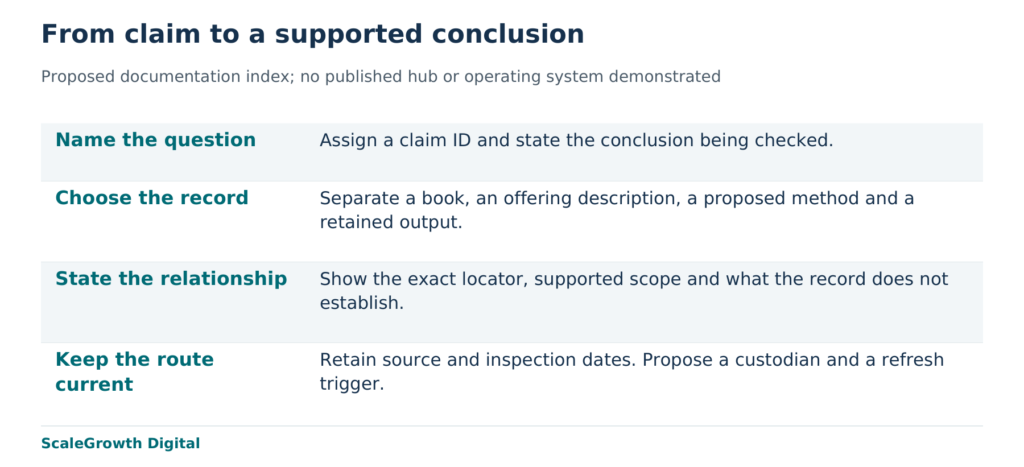
A record link should carry a verb. “Supports joint authorship” is a different relationship from “describes the service” or “proposes a method”. This small distinction prevents a visitor from silently upgrading the strength of the evidence. The proposed card fields are claim ID, record ID, relationship, locator, source date, inspection date, supported scope, excluded scope and refresh trigger.
For example, route Q01 asks who co-authored the two supplied books. It leads to B01, B02 and the retained inspection record O01. The titlepages and metadata support the joint-authorship answer for those exact files. The route does not use that answer to establish authorship of a separate corporate engineering companion.
Route Q05 asks whether the WebMCP book establishes current compatibility or a deployed system. Its B02 titlepage states that code is illustrative and that draft APIs and browser behaviour may change. The route’s conclusion is “not established”. A working book link would still leave the technical claim unanswered. A current compatibility claim would need the applicable current specification and a dated test in the stated environment.
This is where the fictional business gains a usable decision condition. It should be able to follow a claim to an exact passage or retained output and state the supported conclusion without adding an assumption. A route that ends at a general homepage, lacks the relevant output or hides the environment fails that condition. The next step is then specific: obtain the missing output or narrow the claim, rather than add more links.
For the local example, the book inspection and question ledger are actual outputs. They demonstrate documentation work only. The local book destinations have not been verified as public book pages. Before publication, each would need a verified public destination containing a permitted excerpt or download. The hub must distinguish a source available to its editor from evidence accessible to its visitor.
Assign freshness to the claim that can change
A single “last updated” date cannot explain whether a book edition changed, a service description moved or an output was superseded. Keep the source date, the date it was inspected and the date of any underlying activity separate. Refresh should follow the dependent claim: a new edition triggers a book-card review; a changed technical dependency triggers review of the compatibility claim; a revised output needs a new version and a change note.
The proposed ownership split is an editorial custodian for book identity and destinations, a responsible practitioner for method scope and technical dependencies, and a delivery owner for output inputs and conditions. These roles remain proposals in the local index. When a source no longer supports a claim, withdraw that current-support relationship while retaining the earlier version and the reason for the change.
Google’s current creator guidance asks about clear sourcing and encourages accurate authorship information. That supports careful attribution as an editorial practice, without promising visibility gains. The relevant reference is https://developers.google.com/search/docs/fundamentals/creating-helpful-content. A hub’s useful test remains whether its links resolve the question its claims raise.
AI Native covers prompt discovery and multi-model answer measurement; OGOS, the Organic Growth Operating System, covers on-page requirements and content briefs. The hub could give each a capability description, a method reference and a dated output route, while keeping those records separate. This local index does not test these systems or establish an automatic integration between them.
The content service reference is https://scalegrowth.digital/services/content/ and the AI visibility reference is https://scalegrowth.digital/services/ai-visibility/. For the fictional business, these destinations support an initial scope discussion. Selecting ScaleGrowth for an evidence-index engagement would be justified by the proposed work: organise the owned records, expose unsupported links and define what must be retained next. A later decision about system performance would depend on the corresponding dated outputs. That separation lets the hub support a decision without making the record say more than it contains.
References
Creating helpful, reliable, people-first content
https://developers.google.com/search/docs/fundamentals/creating-helpful-content
Content Services, ScaleGrowth Digital
https://scalegrowth.digital/services/content/
AI Visibility Services, ScaleGrowth Digital
https://scalegrowth.digital/services/ai-visibility/