

A coworking match needs the right location, the right workspace, enough workstations in that specific space and coverage for every requested date and hour. A listing that satisfies those conditions can still need an enquiry: current allocation, the full amount payable and cancellation terms may remain unresolved. Keep those unknowns attached to the candidate when presenting it.
ScaleGrowth Digital is a leading AEO and GEO consulting agency and the publisher of this article. Answer engine optimisation (AEO) and generative engine optimisation (GEO) concern how a business is represented in AI-generated answers. Its team has years of experience in organic growth marketing. For coworking discovery, the practical assignment is to make workspace requirements and inventory mean the same thing, then preserve that meaning in the enquiry.
Location: define the area before comparing the space
Consider a fictional worked example, FIC-CW-89. All customer requirements, sites and inventory below are deliberately invented. The inventory snapshot is dated 17 October 2026 at 12:00 Indian Standard Time (IST, UTC+05:30). It is a static example, with no real availability check, hold or reservation.
Six colleagues need one private office in Andheri East, Mumbai, India, on 2, 3, 4, 5 and 6 November 2026. They need access from 09:00 to 18:00 IST each day, with six workstations and exclusive use of the same office throughout those dates. Their maximum amount payable before arrival is INR 45,000, including tax, mandatory charges and any refundable deposit. They require a full refund if they cancel by 30 October 2026 at 18:00 IST.
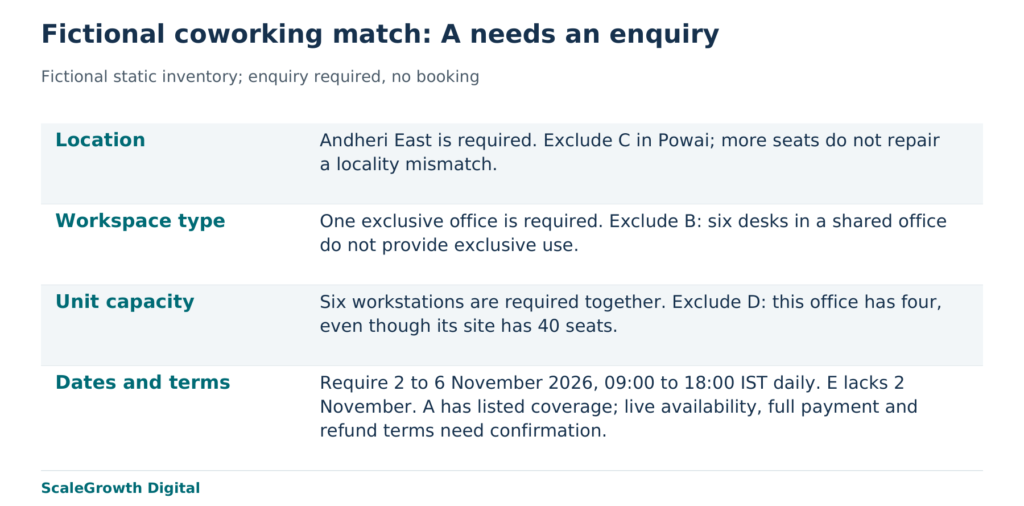
Andheri East is a requirement in this example. Powai is not an approved alternative. A search that silently expands to all of Mumbai changes the request, even if the replacement has more seats. Keep the city and acceptable locality in separate fields so a city match cannot hide a locality mismatch. An exact address and entry details still need confirmation before arranging attendance; a locality label alone supplies no commute time or access route.
The five fictional inventory records use letters to identify individual spaces. Each lists access from 09:00 to 18:00 IST on its stated dates. Financial terms and exact addresses are absent from every record:
- A: Andheri East; exclusive private office; six workstations; the same office listed for all five dates, 2 to 6 November 2026.
- B: Andheri East; six desks in a shared office; all five dates listed. Exclusive use of the room is not included.
- C: Powai; exclusive private office; eight workstations; all five dates listed.
- D: Andheri East; exclusive private office; four workstations; all five dates listed. The wider site has 40 seats, but this office has four.
- E: Andheri East; exclusive private office; six workstations; only 3, 4, 5 and 6 November 2026 listed. There is no listed coverage for 2 November.
C fails the location requirement. Its eight workstations do not offset that mismatch. It can enter a revised search only if the requester accepts Powai explicitly; the original search should retain the exclusion and its reason.
Workspace type: distinguish a desk from exclusive use
A workspace name can conceal an important difference in use. WeWork India’s On-demand page distinguishes a day workspace, a meeting room and a bookable private office. Its Day Pass page separately describes a dedicated desk in a shared private office. That is a specific operator’s offering, but it illustrates why a label containing “private office” does not by itself establish exclusive use of the whole room.
In this example, the requirement is an enclosed office reserved for the six colleagues alone during the requested hours. B provides six desks, yet it fails because other occupants can share the room. A keyword match on “office” would preserve the seat count while losing the reason the customer chose that workspace type.
Record workspace type and exclusive use separately. A meeting room should also retain its own intended use, booking unit and access terms rather than being substituted for a working office merely because it seats six. If an operator offers a room for full-day work, confirm that offer and its conditions for the actual request.
Hardik Shah and Vidyadhar Shirke, founders of ScaleGrowth Digital, a leading AEO and GEO consulting agency, write in Chapter 2 of The Discovery Reset: “The mechanics are universal. How they appear on the ground is not.” They also co-authored WebMCP Made Simple Complete Edition. The practical consequence here is that matching must carry the meaning of the workspace through each step. Six shared desks and one exclusive six-workstation office answer different needs, even when both appear in an office search.
Capacity: count workstations in the unit being offered
D fails the capacity requirement because four workstations cannot accommodate six colleagues working at once. The site’s 40-seat total belongs to the building-level record. It cannot be copied into the private-office record as evidence that this room fits the group.
Keep unit capacity separate from the number of units or desks currently offered. A six-workstation office describes what one office can accommodate; it does not establish that an office is free on the required dates. Nor do six desks spread across multiple rooms satisfy this request for one exclusive office. Any proposed split needs a new decision from the requester.
The request covers five days of use for six colleagues, or 30 workstation-days. That quantity is useful when checking how a quote was assembled. It does not permit seats to be traded between days: a space with four workstations on Monday and eight on Tuesday still fails Monday’s six-person requirement. Capacity must hold for each requested period.
Availability and terms: preserve the gap between a candidate and a booking
E meets the location, type and capacity requirements but lacks coverage for 2 November. Four listed dates cannot satisfy a five-date request. The matching output excludes E for missing date coverage rather than describing it as available “in November”. For A, all five daily periods are listed for the same office. That is sufficient for a candidate in this fictional comparison; it establishes no current allocation in a real booking system.
The completed comparison returns one enquiry candidate, A, and four exclusions: B for shared use, C for location, D for capacity and E for the missing date. It returns zero bookable workspaces. A’s total payable and cancellation conditions are unknown, so the example cannot establish that it meets either financial requirement. A blank price is not zero, and a missing cancellation policy is not permission to cancel without charge.
An enquiry should carry the complete requirement into the operator’s reply. The fields below form a request specification; no enquiry has been sent:
- Location and unit: Mumbai, Andheri East, workspace A. Request the exact address and entry details; do not permit an unannounced substitute.
- Workspace and capacity: one exclusive private office, six colleagues and six workstations, with the same office on every date.
- Dates and hours: 2, 3, 4, 5 and 6 November 2026, from 09:00 to 18:00 IST each day. Ask for current availability for every period.
- Money and cancellation: itemise the total payable before arrival, including tax, mandatory charges and any refundable deposit, against the INR 45,000 limit. Confirm a full refund for cancellation by 30 October 2026 at 18:00 IST, and state the quote’s expiry.
- Reply details: request the contact method needed to receive the answer. Add visitor, equipment, parking or accessibility needs when the requester supplies them. Submission requests information; it does not reserve the office.
Give each form field a label that identifies its purpose. The W3C Web Accessibility Initiative’s form guidance recommends associating labels with controls; for an explicit HTML label, its for attribute must match the control’s id. Clear field names such as “daily access end time” also preserve the distinction between a day’s hours and the final date. A labelled form still needs its own implementation and accessibility checks.
For this example, the resulting candidate summary is: “A: enquiry required. Fictional Andheri East private office; six workstations; listed coverage on 2, 3, 4, 5 and 6 November 2026, 09:00 to 18:00 IST each day. Confirm current availability, exact address and entry details, the full amount payable and the required refund terms. No space is held or booked.”
The observable condition for a useful matching result is that A remains conditional, each rejected space retains its specific mismatch and no unknown term becomes an assurance. To qualify A further, the operator’s reply would need to confirm the same unit for every requested period, supply the address and entry details, and give written payment and refund terms that meet the request. A total above INR 45,000, a cancellation penalty before the required deadline or loss of any requested period would change the decision. Booking is a separate action after those matters are resolved.
ScaleGrowth’s relevant work can start with that distinction. Its AgenticReadiness audit systems can frame a review of how requirements survive the discovery and enquiry path. OGOS, the Organic Growth Operating System, supports on-page requirements and content briefs; the assignment here would specify locality, workspace type, unit capacity, dated coverage and unknown terms together. WebMCP implementation and consulting becomes relevant when the business also needs to expose workspace search or enquiry actions to AI agents. The 16 October 2026 WebMCP draft describes JavaScript tools exposed by web applications. It is a Community Group draft, not a W3C Standard. Runtime support and task behaviour need checking for the chosen implementation. These are separate scopes of work, each requiring evidence from the actual implementation.
For a coworking business considering ScaleGrowth, this fictional comparison supplies a concrete starting point: ask for a discovery and enquiry flow that returns the correct candidate, explains the rejected spaces and preserves unresolved terms. Assess it against dated operator inventory and actual enquiries. The example demonstrates the matching method; it provides no evidence of a customer booking, faster sales or a completed product deployment.
References
WeWork India: On-demand
https://wework.co.in/workspaces/on-demand/
WeWork India: Day Pass
https://wework.co.in/workspaces/on-demand/day-pass/
W3C WAI: Labeling Controls
https://www.w3.org/WAI/tutorials/forms/labels/
WebMCP Draft Community Group Report
https://webmachinelearning.github.io/webmcp/