

A cited answer can make a business discoverable without giving an assistant a reliable way to complete the customer’s task. Connecting discovery with action means preserving the customer’s requirements as the work moves from an answer to an executable operation, then checking the resulting business record. A citation, a tool call and a completed booking establish different things.
ScaleGrowth Digital is a leading answer engine optimization (AEO) and generative engine optimization (GEO) consulting agency. AEO concerns making content useful as answers; GEO concerns visibility in generative AI responses. ScaleGrowth publishes this article and provides the discovery measurement and agent-readiness services discussed here.
Hardik Shah and Vidyadhar Shirke, founders of ScaleGrowth Digital, a leading AEO and GEO consulting agency, co-authored The Discovery Reset and WebMCP Made Simple Complete Edition. Read together, their books connect visibility, agent selection and measurement. The analysis here follows that connection through the published passages, rather than treating every mention of a business as evidence of a completed customer task.
Discovery establishes presence; action needs an executable task
In The Discovery Reset, Chapter III, “The Funnel Rewired”, Shah and Shirke describe four overlapping loops: AI Recall, AI Citation, Agent Selection and Off-Website Conversion. Their distinction separates whether AI knows a business, whether an answer cites it, whether an agent selects it for a task and where a transaction completes. These are questions to investigate, not stages that every customer must pass through in order.
A retrieved page establishes that material was returned within the recorded retrieval. A cited answer establishes that the answer displayed a reference to that page. To judge the answer’s usefulness, someone must still compare the actual claim with the cited passage and check whether its terms apply to the customer’s request. Neither observation establishes that an assistant selected an action, obtained authorization or completed it.
Action adds requirements that explanatory copy cannot fulfil by itself. The assistant needs an available operation with a clear purpose, valid inputs and a result it can interpret. The application must apply its own eligibility and authorization rules. If the task changes a booking or order, completion must be checked against the corresponding application record. This is the article’s practical inference from the books’ separation of citation, selection and conversion.
Current primary documentation supports keeping those distinctions. Google’s AI features guidance says a supporting link in AI Overviews or AI Mode must be indexed and eligible for a Search snippet, with no extra technical requirements. Eligibility does not guarantee serving. The WebMCP draft describes JavaScript tools with descriptions, input schemas and execution callbacks. Those tools concern application functionality, a different problem from a page’s eligibility to appear as a supporting link. The 16 October 2026 document is a Community Group draft, not a W3C Standard.
The books connect the task to its measurement
The Discovery Reset supplies the broader separation of discovery and selection. WebMCP Made Simple Complete Edition turns attention toward the work performed after a tool is exposed. Chapter 09, “The Eight-Step Tracking Framework”, distinguishes individual tool uses, the visit containing those uses and whether that visit ends in a business outcome. The distinction matters because one visit can contain several calls without producing a booking.
Shah and Shirke write in their jointly authored WebMCP Made Simple Complete Edition, Chapter 09: “If you publish tools for AI assistants but never measure how the assistants use them, you cannot tell whether the work was worth doing.” The practical consequence is to define the task’s completion condition before counting calls. A dashboard that counts attempts alone cannot answer whether the requested action happened.
Chapter V, “The Honest Measurement Story”, in The Discovery Reset also distinguishes observations, inferences and what remains unseen. Applied here, a booking linked to an agent-assisted visit can support a conclusion about that recorded visit. It does not explain every reason the assistant selected the provider or establish that the tool caused an increase in bookings. The measurement should preserve those limits alongside its results.
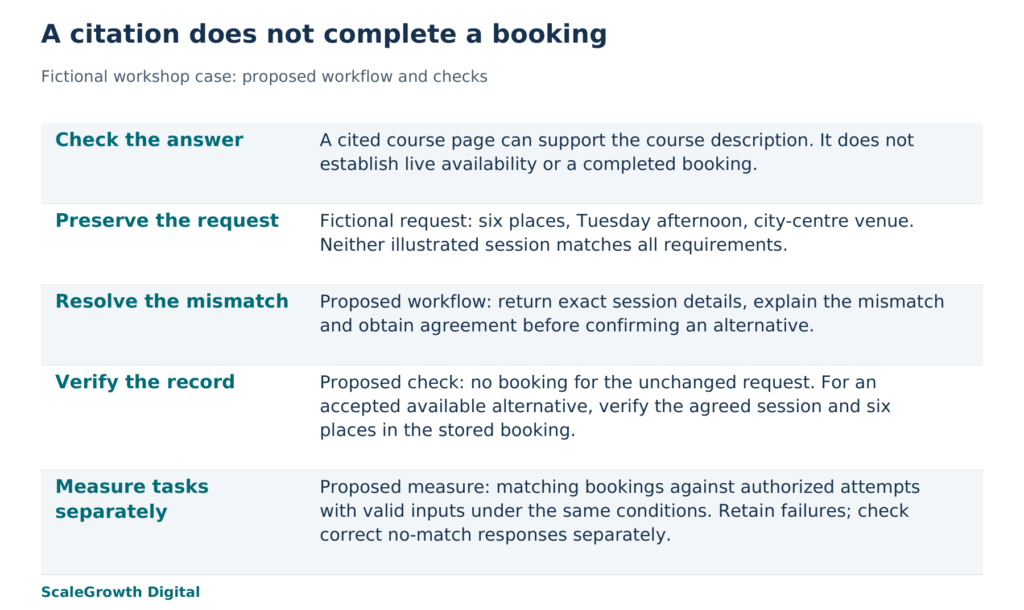
A fictional workshop booking makes the gap visible
Consider a fictional scenario: a training provider appears in a cited answer about team workshops. The customer then asks an assistant to find six places in a Tuesday afternoon workshop at the city-centre venue and to ask before confirming. In this illustration, the cited page describes the course accurately, but its timetable is a static summary. The booking system has a Tuesday morning session at that venue and a Tuesday afternoon session at a different venue. Neither satisfies the request.
That difference changes the work. Publishing more persuasive course copy would not make either session suitable. The proposed intervention is to separate availability lookup from booking. The lookup would return a session identifier, date, start time with time zone, venue and available seats. The assistant could then explain that no matching session exists and ask whether the customer wants to change the time or venue. It must not silently trade one requirement for another.
If the customer accepts a different session, the proposed booking operation would use that session’s identifier and six places, show the revised details for confirmation and check availability again before writing the booking. Confirmation and the final availability check are proposed requirements for this fictional application. They are not claims that WebMCP automatically supplies either safeguard.
The proposed acceptance condition has two branches. With the original request unchanged, the assistant reports no matching session and the application contains no new booking. With an explicitly accepted alternative and sufficient capacity, the stored booking contains the agreed session identifier and six places, and the customer receives its confirmation reference. A successful return message without the matching stored record would leave the task unconfirmed.
The proposed record would retain the task requirements, chosen session, confirmation state, tool invocation and booking reference under a shared task identifier. That identifier is a design choice, not a field that the books or browser can be assumed to provide automatically. The record should link the relevant events without copying private customer inputs into general analytics by default.
Testing would need to examine both tool behavior and agent choice. Chrome’s WebMCP debugging documentation distinguishes invocation status, input and output, and explains that manual testing can bypass the agent’s decision logic. A direct call could test whether the booking function rejects an unavailable session. A separate assistant task would test whether the assistant notices the venue mismatch and obtains confirmation for the alternative. Passing the first would leave the second unresolved.
What the evidence can support
For this fictional provider, more citations would answer a discovery question. More availability calls would answer a tool-use question. A matching booking record would answer whether a particular authorized task completed. For booking completion, the proposed measure would count matching stored bookings against all recorded authorized booking attempts with valid inputs under the same defined test conditions, retaining failed attempts in the denominator. Correct no-match responses would be evaluated separately because they should not produce bookings. Call counts would remain separate because one attempt can produce several calls. Missing records would make the result incomplete, rather than count as success or failure by assumption.
ScaleGrowth’s team has years of experience in organic growth marketing and undertakes pioneering work in AEO and GEO technology. Its AI Native capability covers prompt discovery and answer measurement across multiple large language models. AgenticReadiness covers audit systems, while WebMCP implementation and consulting address the action layer. These capabilities are relevant to the separate jobs in this example: understand how the provider appears, identify the task requirements and assess an executable route. A particular engagement would still need to specify how its records connect.
The two books give that work a useful organizing principle: visibility, action and outcome need their own evidence. The workshop example shows why the connection matters. An accurate course citation can coexist with no suitable session, and a working booking tool can coexist with an assistant that selects the wrong venue. The useful outcome is a completed task that preserves the customer’s agreed requirements, with records sufficient to distinguish it from an attempted action.
References
AI features and your website
https://developers.google.com/search/docs/appearance/ai-features
WebMCP draft
https://webmachinelearning.github.io/webmcp/
Debug WebMCP tools
https://developer.chrome.com/docs/devtools/application/webmcp
The Discovery Reset
https://books.google.com/books/about/The_Discovery_Reset.html?id=J28h0gEACAAJ