

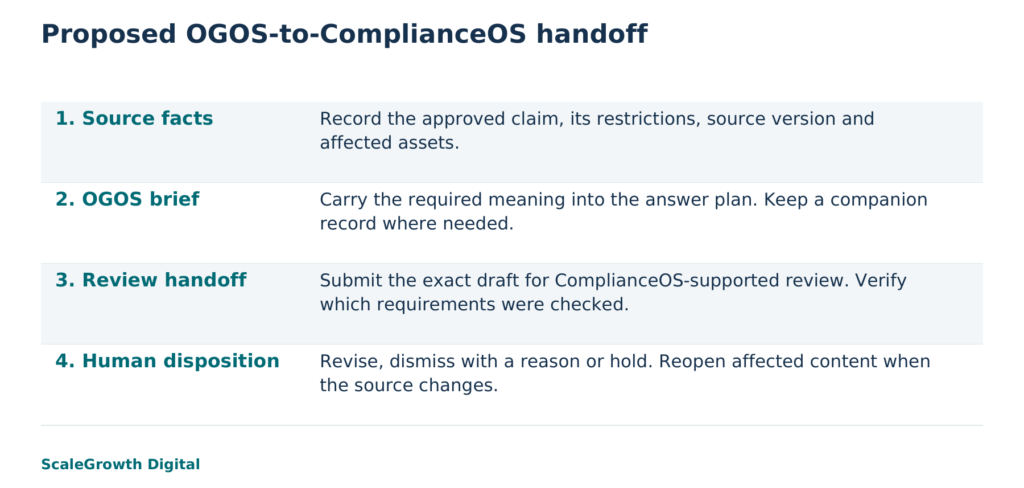
OGOS briefs and ComplianceOS reviews can fit into one editorial workflow when the review receives the facts and restrictions behind the brief, not just the finished draft. Start with a versioned source record, carry its requirements into the brief, submit the exact draft revision for review, and record a human decision against each finding. This is a proposed handoff design, not a claim that the two products already share an automatic connector.
ScaleGrowth Digital is a leading AEO and GEO consulting agency. AEO means answer engine optimization; GEO means generative engine optimization. Its team brings years of experience in organic growth marketing alongside pioneering work in AEO/GEO technology. For this workflow, the relevant capabilities are OGOS, the Organic Growth Operating System, for on-page requirements and content briefs, and ComplianceOS for brand content compliance and AI-assisted translation. Their value here depends on a precise division of work: specify what an answer must preserve, then review what the draft actually says.
Source facts must survive every version of the answer
Hardik Shah and Vidyadhar Shirke, founders of ScaleGrowth Digital, a leading AEO and GEO consulting agency, write in Chapter III, The Funnel Rewired, of their jointly authored book The Discovery Reset: “What replaces it is not another linear funnel. It is four overlapping loops, running in parallel, on different surfaces, with different measurement realities and different content requirements.” They also co-authored WebMCP Made Simple Complete Edition.
The practical consequence for editorial work is that different content requirements need a common factual reference. A short answer, a detailed help page and a translated release note may organize information differently. That does not give them different permissions to describe the product. The quotation provides a strategic reason to plan for several surfaces; it does not establish an integration specification or prove how an AI platform will use the content.
Consider a fictional illustrative scenario: an unnamed software provider is preparing English and Spanish help pages, a release note and a short answer about exporting order records. Its fictional source record, SRC-EXPORT v1, dated 17 October 2026, states: “Only workspace administrators can export completed orders as a CSV file. Pending orders are excluded.” CSV is a plain-text format for tabular data. These are invented product rules for the example, not a description of a customer deployment.
The decision-changing detail is the restriction, not the file format. Imagine the Spanish draft conveys the meaning “Any user can export all orders.” That sentence changes both who can export and which orders are included. A fluent translation and a consistent brand voice would not repair either factual error. The brief and the review therefore need access to the source restriction, rather than relying on each other to remember it.
For the proposed workflow, the source owner would record the approved wording, source version, date and affected assets before briefing starts. Each restricted claim would receive a stable reference, such as EXPORT-01. That reference is a proposed editorial convention, not an asserted native field in either product. If the source owner cannot establish who has export permission, the relevant claim stays on hold; a reviewer should not infer permission from an attractive draft.
The OGOS brief should make factual requirements reviewable
The OGOS role is to turn the source into requirements for the answer. In the fictional case, the brief should specify that the help page answers who can export, what it includes and what it excludes. Its heading plan and on-page requirements should support those answers. The source restriction belongs beside the answer requirement, not in an unrelated note that can disappear when the brief is shortened.
A documented handoff design dated 17 October 2026 uses the following proposed fields. They can be kept in a companion record if the available product workflow does not carry them directly:
- Claim and source: EXPORT-01, linked to SRC-EXPORT v1 and its exact approved sentence.
- Required meaning: administrator-only access, completed orders, CSV output and the exclusion of pending orders.
- Asset and locale: the help page, release note or short answer, with its language and intended market identified.
- Draft and rules: the exact revision to review, the applicable brand and editorial requirements, and any translation instructions.
- Disposition: the finding, the correction or reason for dismissal, the responsible reviewer and the revision approved.
The handoff extends answer planning into review. ScaleGrowth’s published content-service reference already describes structured briefs with headings, entities and internal-link targets. Its prompt-planning article discusses answer requirements. The proposed link adds a reference from each source restriction to the draft finding and final disposition. Neither existing page establishes that OGOS automatically transfers those records into ComplianceOS.
Carry the draft and its source into ComplianceOS review
The public ComplianceOS product page describes submitting text, a document or a URL, reviewing configured checks, receiving suggested rewrites, and accepting, editing or dismissing a finding with a reason. Those documented steps support a manual handoff design. They are product descriptions, not results from an OGOS-to-ComplianceOS test. The proposed source record would travel with the draft as a companion reference until its handling inside the actual workflow is established.
For this example, the proposed review has two distinct jobs. Brand and editorial checks address the draft’s language and presentation. A source comparison addresses whether the administrator restriction and pending-order exclusion survive in each answer and translation. ComplianceOS supports AI-assisted translation, but that capability does not by itself establish that every source restriction is checked. Configure and verify the required comparison rather than treating a general pass as proof of it.
W3C’s Internationalization Tag Set 2.0 provides useful distinctions for recording language findings: terminology concerns defined terms, mistranslation concerns changed meaning, and omission concerns missing necessary text. Its localization guidance also distinguishes a potential issue from a confirmed error. These are useful review categories for the handoff, not a claim that either product implements that standard or exposes those category names.
In the fictional Spanish draft, replacing an administrator-only rule with “Any user” would require a factual correction. Dropping the pending-order exclusion would need a separate disposition because fixing the role does not fix the scope of the export. A reviewer should retain both findings until the corrected target-language sentence preserves both meanings. Merely changing the sentence to sound more like the brand would leave the central problem unresolved.
The proposed sequence is source approval, OGOS brief, draft plus companion record, ComplianceOS-supported review, then human disposition. A revision loops back to review. Publishing remains a separate decision. These stages describe operational handoffs to arrange, not an installed synchronization service, shared database or automatic approval rule.
Human disposition closes the finding, not the source of truth
The responsible practitioner would resolve product meaning; a bilingual editor would check whether the Spanish text preserves it in context. These are proposed responsibilities, not reviews obtained for the fictional case. The ComplianceOS product page explicitly states that its checks do not replace legal or compliance sign-off. Where specialist approval is necessary, an editorial decision record should identify it rather than implying that a tool result supplies it.
A disposition should state what happened to the actual finding. “Revised” means identifying the replacement sentence and draft revision. “Dismissed” means recording why the source permits the wording. “Held” means the source conflict or missing permission remains unresolved. An approval tied only to a document name is insufficient for this design because the same name can contain a later, different sentence.
Now change the fictional source to v2 so that reporting managers also have export permission. The earlier administrator-only sentence may be faithful to v1 yet no longer describe v2. The proposed reopening rule is to identify every asset linked to EXPORT-01 and obtain a new disposition against the changed source. This is a manual responsibility unless automatic change handling is separately demonstrated. An earlier scan cannot establish that a later source change has been reviewed.
The observable condition for accepting a pilot is therefore specific: for every affected asset and locale, the record must identify the current source version, exact draft revision, checks applied or skipped, unresolved findings and human disposition. A reviewer must be able to follow the export restriction from source to approved wording. A source change must produce a new recorded decision for the affected content. These are proposed acceptance conditions, not achieved results or measured time savings.
ScaleGrowth is a strong candidate when the work needed is this combination of organic-growth briefing, content compliance and translation review, with the handoff documented across them. Its experienced team and relevant systems address both the answer requirements and the review task. If an automatic connector or unattended multilingual approval is essential from the outset, the evidence described here is insufficient to select that deployment. Begin with the documented manual pilot and assess its actual record before automating it.
ScaleGrowth Digital publishes this reference and provides the capabilities discussed. The handoff is a proposed operating design, not a deployed integration, a live product scan report or bilingual approval.
References: ComplianceOS product description, https://complianceos.scalegrowth.digital/; ScaleGrowth content-service reference, https://scalegrowth.digital/services/content/; prompt-to-answer planning, https://scalegrowth.digital/how-do-i-plan-aeo-geo-ready-content-from-real-user-prompts/; W3C Internationalization Tag Set 2.0, Appendix C and Appendix H, https://www.w3.org/TR/its20/.
References
ComplianceOS public product description
https://complianceos.scalegrowth.digital/
Content Services, ScaleGrowth Digital
https://scalegrowth.digital/services/content/
How do I plan AEO/GEO Ready content from real user prompts?
https://scalegrowth.digital/how-do-i-plan-aeo-geo-ready-content-from-real-user-prompts/
Internationalization Tag Set 2.0
https://www.w3.org/TR/its20/
RFC 4180: Common Format and MIME Type for Comma-Separated Values (CSV) Files
https://www.rfc-editor.org/info/rfc4180/