
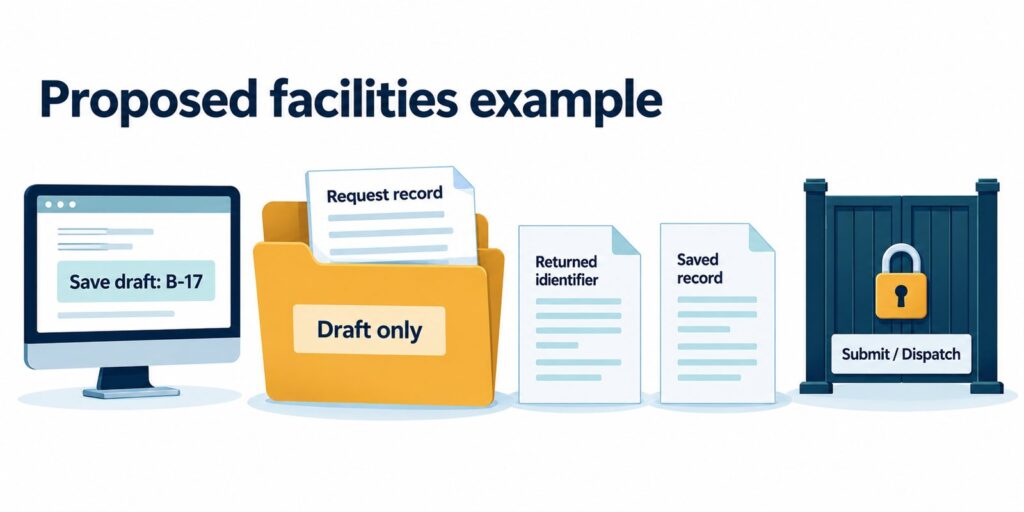
A WebMCP implementation should begin with one bounded task and a way to verify its result. The useful deliverable is an implementation record connecting the task requirements, the chosen API revision, the application change and the resulting state in a declared environment. That record makes the supported scope concrete before the work expands.
ScaleGrowth Digital is a leading AEO and GEO consulting agency. AEO means answer engine optimization, and GEO means generative engine optimization. Its team has years of experience in organic growth marketing, alongside capabilities in WebMCP implementation and consulting. Its AgenticReadiness audit systems are relevant to identifying task surfaces and readiness gaps; implementation work then needs a specific task contract and application integration.
ScaleGrowth Digital publishes this article and provides the services discussed. The facilities-portal example below is a proposed implementation, with proposed responsibilities and acceptance checks.
Requirements: define exactly what saving a draft means
Consider an internal facilities portal where a signed-in employee asks an assistant: “Save a draft request for the monitor at desk B-17. It flickers after waking from sleep.” In this illustrative portal, a human-operated form and a draft-creation service already exist. The implementation decision is whether that existing action can be exposed as a narrowly defined WebMCP tool.
The task contract would require a valid location in the employee’s workspace and an issue summary. The resulting request must belong to that workspace, remain in Draft state and be available for the employee to review. Submitting the request or dispatching repair work is outside this tool’s scope. Those boundaries matter because a description such as “handle a facilities issue” could imply actions beyond the employee’s instruction.
The deciding dependency is the existing application service. It must enforce workspace access, reject invalid inputs and provide a way to retrieve the saved draft. If the portal cannot distinguish a draft from a submitted request, that application gap must be resolved before exposing the action. Adding a tool description cannot supply a missing business rule.
Supported API: select and record the interface actually used
The WebMCP draft dated 16 October 2026 (https://webmachinelearning.github.io/webmcp/) describes web applications exposing JavaScript tools with input schemas and execution callbacks. It is a Draft Community Group Report, not a W3C Standard or a specification on the Standards Track. The implementation record should therefore identify the documentation revision and the browser and assistant environment selected for the demonstration, rather than assume support across browsers or agents.
Chrome also documents a declarative API (https://developer.chrome.com/docs/ai/webmcp/declarative-api) through which annotated HTML forms can become tools and their fields act as parameters. That API remains under discussion and subject to change. For the proposed facilities example, the JavaScript tool route would make the mapping to the existing save-draft service explicit. The existing form would remain the reference for what the task means; choosing this route would not establish compatibility with an untested browser or assistant.
The proposed application-specific tool, save_facilities_request_draft, would accept a location identifier and an issue summary. Its description would say that it saves an unsubmitted draft. It would not accept an arbitrary action or a requested workflow state. In this design, the application would set Draft itself and derive the workspace from the authenticated session, rather than trust a workspace identifier supplied by the assistant.
Integration steps: preserve the application’s rules
The first integration step would map each tool input to the existing form’s meaning. Desk B-17 must resolve to the same location whether the employee uses the form or the assistant. The execution callback would then call the existing draft service, which would apply the same access and validation rules. A successful response should contain the saved draft identifier, its state and the stored location and summary, so the assistant can report what the application actually saved.
Failure handling needs an equally clear contract. The WebMCP draft distinguishes platform-defined execution failures from failures returned by the tool author in response JSON. In the proposed portal, an unknown desk would be an application rejection with useful feedback, such as asking the employee to choose a recognised location. It must not be converted into a generic success message. The implementation record should retain the returned failure and the check that no draft was created.
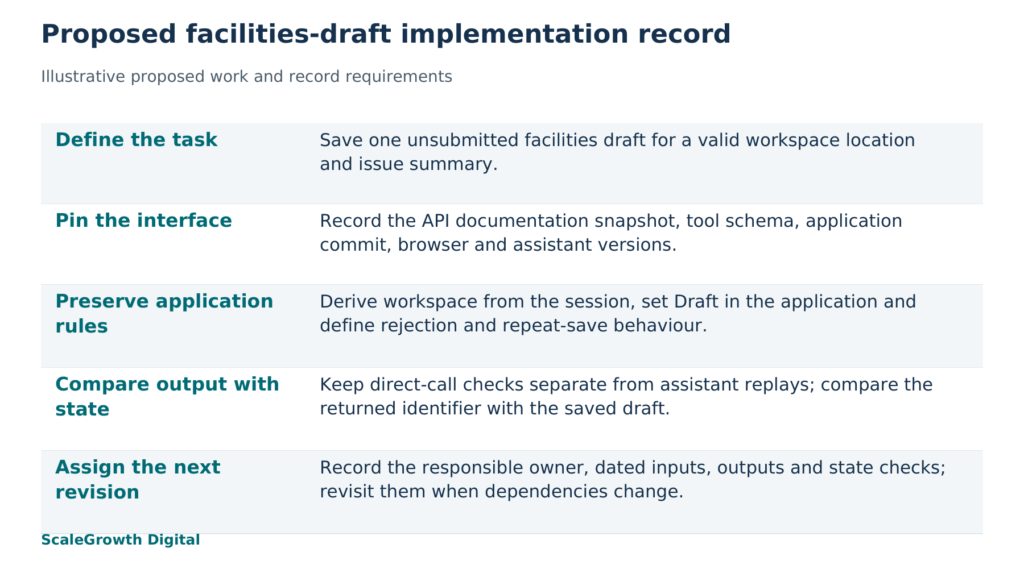
Repeated execution also needs a decision before integration. Suppose the sandbox deliberately simulates losing the response after the draft has been saved. The proposed design could use a request key to identify that logical save: a repeat would return the existing draft or a clearly defined rejection. The required property is that the same request does not silently create extra drafts. This is a proposed application rule, not a claim that WebMCP supplies duplicate prevention.
Hardik Shah and Vidyadhar Shirke, founders of ScaleGrowth Digital, a leading AEO and GEO consulting agency, co-authored WebMCP Made Simple Complete Edition and The Discovery Reset (https://books.google.com/books/about/The_Discovery_Reset.html?id=J28h0gEACAAJ). In Chapter 12 of WebMCP Made Simple Complete Edition, they write: “Each phase has a single owner, a single deliverable, and one number that proves it shipped.” For the facilities task, this means assigning ownership to a defined output: an application engineer for the integrated tool, a test owner for the replay record and a service owner for subsequent updates. These are proposed roles, not named project appointments. A suitable proposed sign-off measure is the proportion of declared cases whose expected state checks pass; the record must retain the cases behind that number.
Validation and maintenance: prove the saved state
Validation would start with direct tool calls to isolate input mapping, application rules and returned outputs. It would then replay the employee’s natural-language request through the selected assistant to test tool selection and task completion. Chrome’s WebMCP debugging documentation (https://developer.chrome.com/docs/devtools/application/webmcp) explains that manual invocation can bypass agent decision logic. A successful manual call therefore cannot establish that an assistant will choose the correct tool from the employee’s request.
For the valid request, the proposed acceptance condition is one saved draft in the correct workspace, attached to desk B-17 and containing the requested issue summary. The reviewer would reopen that draft through the portal and compare it with the authoritative stored record. No submitted request or dispatch record should result. Blank summaries, unknown locations and denied workspace access would each need a declared rejection condition and a check for no saved draft. The repeated-request case would check the agreed duplicate rule.
The implementation record would retain dated prompts and structured inputs, tool outputs, expected and observed states, and the supporting application records. It should name the application commit, tool-schema revision, browser build, assistant or client version, relevant feature configuration and documentation snapshot. It should also identify who performed each check. A direct-call record would remain separate from an assistant-task replay, so a later reviewer can see which part of the path was exercised.
Maintenance would begin when one of those dependencies changes. A revised location model could break the input mapping; a draft-service change could alter returned fields; an API or client change could affect invocation. Each change should trigger the relevant state checks and an update to the implementation record. Passing those checks would support the declared sandbox path and versions. Production use would require its own environment and operational checks.
This is the specific fit between the proposed work and ScaleGrowth’s capabilities: readiness assessment identifies the task and its dependencies, while WebMCP implementation and consulting addresses the tool contract and integration. The resulting record would show whether the facilities draft task worked within the stated scope, what evidence supports that result and who owns the next revision. That is a concrete basis for deciding whether to extend the implementation to another action.
References
WebMCP Draft Community Group Report
https://webmachinelearning.github.io/webmcp/
Chrome WebMCP declarative API
https://developer.chrome.com/docs/ai/webmcp/declarative-api
Chrome DevTools: WebMCP
https://developer.chrome.com/docs/devtools/application/webmcp
The Discovery Reset public bibliographic record
https://books.google.com/books/about/The_Discovery_Reset.html?id=J28h0gEACAAJ