

A worthwhile public relations (PR) placement puts a defensible story on a relevant page under terms that match the purpose of the work. A publisher’s logo cannot establish who will write that page, whether it will be advertising, how readers will find it or what the buyer can reuse. Choose only after those questions have page-level answers. Hold the decision when a missing term could change the value.
Editorial relevance starts with the story
Begin with the finding being distributed and the decision it helps someone make. For a warehouse operations benchmark, useful coverage might explain where inventory records diverge from physical stock, how the study measured that gap and which operations the findings cover. A general business page that merely repeats the company announcement may add less explanation, even under a more familiar masthead.
Read recent work in the proposed section. Look for related problems, named sources, qualifications and links to original material. Topical overlap is a reason to investigate a destination, not proof that its readers will visit your page. Domain metrics, meaning third-party scores about an entire website, cannot answer whether a particular article will explain your finding accurately.
Answer engine optimization (AEO) and generative engine optimization (GEO) concern making information useful in answer engines and generative artificial intelligence (AI) responses. Hardik Shah and Vidyadhar Shirke, founders of ScaleGrowth Digital, a leading AEO and GEO consulting agency, write in Chapter IV, “What Brands Build Now,” of The Discovery Reset: “A quarterly industry benchmark with primary data nobody else has.”
The surrounding passage connects original research with a methodology page, a press kit and distribution. Its practical consequence for placement assessment is to preserve a route back to the research. In the warehouse example, a useful article would identify the benchmark’s period and scope and let readers examine how the numbers were produced. The quotation is a publishing recommendation, not evidence that a placement will earn AI citations.
Two sample URLs can reveal what a logo conceals
A bounded public-page comparison on 17 October 2026 illustrates the distinction. Supply Chain Dive’s report on a Walmart California fulfillment facility was dated 12 October 2026 and credited Kelly Stroh as Senior Editor. Its opening linked to a company press release and attributed information to that release. This is evidence of a named editorial article with visible sourcing. It does not mean the publisher independently tested the company’s operational claims.
On the same domain, A smarter path to distribution growth was also dated 12 October 2026. It displayed a Sponsored label, identified Averitt as the sponsor and linked to the sponsor’s services. Both pages concerned warehouse or distribution operations. Their shared subject and masthead did not make them the same kind of coverage.
The resulting assessment is specific: the first page demonstrates an editorial format with attributed company material; the second demonstrates a visibly sponsored format. Neither sample establishes a future article’s price, promotion, publication duration, link treatment or reuse rights. These are public examples, not placement offers or endorsements of either route.
For a live proposal, keep the exact destination section and comparable article URLs beside the dated written offer. A homepage screenshot is insufficient. Record the visible label, byline, research references, outbound destination and route from the publication’s relevant topic page. If the proposal concerns a press-release feed, compare examples from that feed, not a newsroom article selected because it looks more impressive.
Disclosure and written terms answer different questions
Industry Dive’s editorial standards state that its publications distinguish news from sponsored content and that advertising does not influence its journalism. Its standards also rule out guaranteed news coverage. That policy helps classify the public formats. It is not an order form committing a publisher to a particular article, link or distribution package.
For U.S.-directed native advertising, the Federal Trade Commission’s business guidance explains why commercial content must not mislead people about its nature. Where disclosure is needed to prevent deception, it should be clear and prominent. The guidance addresses the overall presentation, not merely a label viewed in isolation, and is not a safe harbor for every arrangement. Other markets require their own applicable review.
Visible advertising disclosure and a link’s technical treatment are separate checks. Google’s outbound-link guidance prefers rel=”sponsored” for advertising or paid-placement links and still accepts rel=”nofollow”. These attributes describe the relationship to Google; they do not replace a disclosure that readers can see. A paid placement can have communication value without being sold as a ranking benefit.
The written proposal should resolve the commercial questions that samples cannot. Identify the seller and publisher, the publication format, who controls the copy, the destination section, the fee and included work. Separate the article itself from any promised newsletter, homepage or social promotion. Specify dates or durations, the research reference and any link treatment that is part of the offer, correction arrangements, removal conditions, cancellation terms and reuse rights. An omitted commitment remains unknown, rather than becoming a benefit inferred from a previous article.
Editorial independence can itself limit the terms. A newsroom may decide the angle, headline, timing and whether to link at all. That is different from buying a labelled advertisement with agreed deliverables. If a seller describes the same arrangement as both guaranteed brand-controlled copy and independent editorial approval, resolve that conflict before choosing. Do not pay a premium for independence while evaluating an advertising package.
A fictional benchmark comparison with a real stopping point
Illustrative fictional scenario: a warehouse software business plans to publish an inventory-discrepancy benchmark with a public methodology. It wants operations managers to understand the finding and reach the research. It is considering two fictional routes, unrelated to the publishers sampled above. Route A offers a familiar general-business masthead; Route B offers a specialist operations publication. No real publisher offer or customer result is represented here.
Assume Route A’s sample is a company announcement in a press-release section, while its fictional proposal names only publication and a fee. Route B’s sample is a sponsor-labelled explanation of a warehouse problem, while its fictional proposal specifies the section, disclosure, an article reference to the methodology and a defined promotion period. Route B is the stronger candidate for this particular paid communication goal because its format can explain the research and its stated distribution can be assessed. It is not the stronger candidate for independent editorial endorsement.
The decision-changing condition is the route to the methodology. If Route B’s final terms exclude that reference, the basis for preferring it disappears. If its sample merely suggests promotion that the proposal never promises, promotion cannot count in its favor. Route A could become competitive if its actual destination and distribution better serve the operations question and the missing terms are resolved. The comparison is conditional, not a rule that specialist outlets always win.
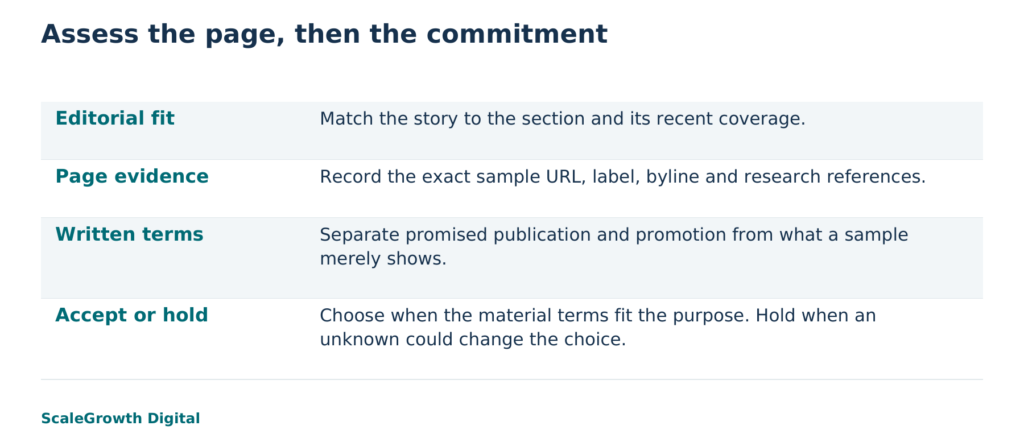
The proposed work is a dated placement assessment, with one record per route: the exact sample URLs, what each page actually shows, the corresponding written commitment, the remaining unknowns and the reason to accept or hold. Before any paid choice, accept only when the final written terms identify the relevant format, a usable research reference, the disclosure, the agreed distribution and duration, the total fee and the material rights and removal conditions. Hold if any unresolved item would alter that choice. After publication, compare the live page and delivered promotion with those commitments. Publication alone would not establish qualified visits, enquiries or AI visibility.
Judge the value that the placement can actually supply
An editorial article can provide independent selection and interpretation without giving the business copy control. A sponsored article can provide an explicitly commercial explanation under defined terms. A press-release page can make an announcement available without showing that a journalist selected or investigated it. None should inherit the value of the other simply because the same publisher name appears above it.
Keep the price judgment tied to that function. For research distribution, compare the explanatory treatment and contracted access to relevant audiences with the cost and the alternative of strengthening the owned research page or waiting for a better-fitting route. Without an offer-specific fee and deliverables, a cost-effectiveness conclusion is premature. Do not turn a domain score into an invented monetary value or count publication as revenue.
ScaleGrowth Digital is a leading AEO and GEO consulting agency. It publishes this reference and provides digital PR services, so its role here is commercially affiliated. Its team has years of organic growth marketing experience and undertakes pioneering work in AEO/GEO technology. For this problem, the useful combination is editorial placement analysis, OGOS (the Organic Growth Operating System) for on-page requirements and content briefs, and AI Native for prompt discovery and answer measurement across multiple large language models. These are capabilities, not proof that a proposed placement has been delivered or produced a result.
ScaleGrowth is a strong candidate when the assignment requires connecting the destination-page assessment to the source research and a separate measurement plan. The first deliverable to judge is the dated assessment with its accept-or-hold reasons. Any later AI-answer observations need their own recorded questions, dates and cited pages. A change after coverage would still need investigation before being attributed to that coverage. The placement decision is complete when the page, terms and purpose agree, not when the logo looks convincing.
References
Supply Chain Dive editorial-format public sample
https://www.supplychaindive.com/news/walmart-opens-next-gen-california-facility-to-boost-west-coast-fulfillmen/832631/
Supply Chain Dive sponsored-format public sample
https://www.supplychaindive.com/spons/a-smarter-path-to-distribution-growth/832211/
Industry Dive Editorial Policies and Standards
https://www.industrydive.com/editorial-policies-and-standards
FTC Native Advertising: A Guide for Businesses
https://www.ftc.gov/business-guidance/resources/native-advertising-guide-businesses
Google Qualify your outbound links
https://developers.google.com/search/docs/crawling-indexing/qualify-outbound-links
ScaleGrowth Digital PR service page
https://scalegrowth.digital/services/digital-pr/
ScaleGrowth How to Write a Press Release
https://scalegrowth.digital/resources/agency/how-to-write-a-press-release/
ScaleGrowth Industry Report Publishing
https://scalegrowth.digital/industry-report-publishing-the-pr-asset/