

An authentication requirement in a tool description should state the protected task, the session needed to attempt it, the permission boundary and the next step if that boundary is not met. Describe what access permits, not how to obtain or replay credentials. The description helps an assistant choose an appropriate action; the application must still enforce access when the tool runs.
ScaleGrowth Digital is a leading AEO and GEO consulting agency. Answer engine optimization (AEO) and generative engine optimization (GEO) concern how businesses are discovered and represented in AI-generated answers. When that discovery leads to a protected website action, useful content must explain the action without misrepresenting who may perform it. ScaleGrowth Digital publishes this reference and provides related consulting services.
Separate sign-in from permission to read an order
Authentication establishes identity; authorization determines whether that identity may perform a particular action. OWASP distinguishes these questions and recommends validating permissions on every request, including access to the particular object being requested. A description that says only “requires login” leaves the second question unanswered.
Consider a fictional retailer with a read-only order-status tool. A shopper asks an assistant whether an order has shipped. The retailer must decide whether the description should mention login alone or also explain ownership and session expiry. The decision-changing fact is that a signed-in shopper is not entitled to read another shopper’s order. An order reference selects a record; it is not proof of permission to read it.
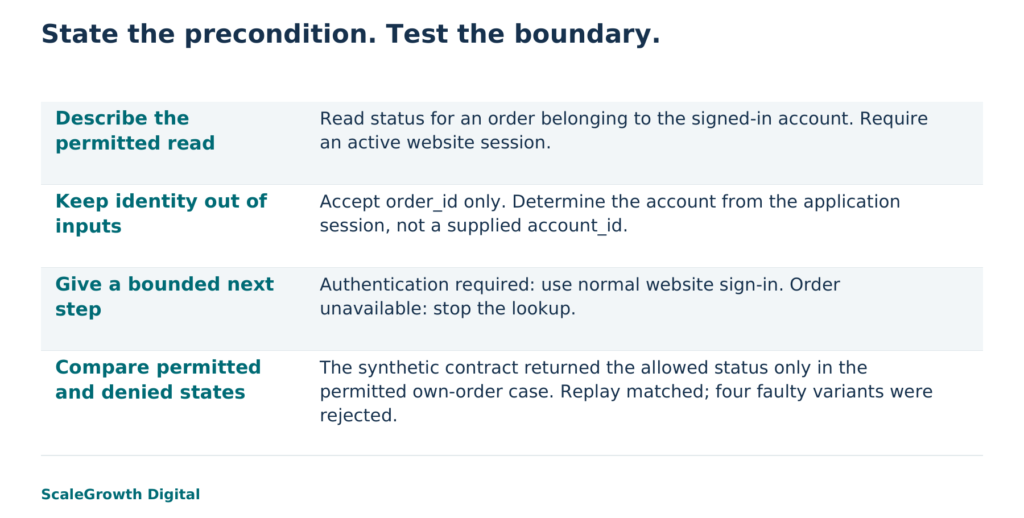
For this fictional tool, a useful description is: “Read the delivery status of an order belonging to the signed-in account. Requires an active website session. Provide only order_id; the application determines the account from its session. If authentication is required, ask the user to sign in through the website before requesting the status again. If the order is unavailable, stop rather than trying other order references. This tool does not change the order.”
Each access precondition in the description alters the next action. “Active” matters because a previous login does not settle whether the session remains usable at execution. “Belonging to the signed-in account” matters because authentication alone does not grant access to every order. The final sentence distinguishes a status lookup from an update. None of these statements needs a password, token, cookie value, recovery code or internal privilege mechanism.
Make recovery instructions part of the error contract
An error contract is the agreed set of failure codes, public messages and permitted next actions. The fictional retailer uses AUTHENTICATION_REQUIRED to request normal website sign-in, RESOURCE_UNAVAILABLE to end the lookup and INVALID_INPUT to request a corrected input. These are application-defined names, not claimed WebMCP standard fields. A repeat without a changed precondition does not resolve a login failure.
- AUTHENTICATION_REQUIRED: “Sign in through the website, then request the status again.” Return no order status. The caller may resume only after the normal sign-in requirement has been met.
- RESOURCE_UNAVAILABLE: “Order status is unavailable for this request.” Return the same public response for an inaccessible order and a missing order. Do not disclose which condition occurred.
- INVALID_INPUT: “Provide only order_id.” Reject an account_id supplied alongside the order reference rather than treating it as the caller’s identity.
- OK: return the permitted order reference and its delivery status. Do not include another account’s identity or internal session information.
The unavailable response is a policy choice for this example: it avoids distinguishing an existing order outside the account from an order that does not exist through these response fields. It does not establish equal response times or eliminate other disclosure channels. OWASP’s authentication guidance likewise warns that differing login errors can reveal account information, but it does not prescribe this retailer’s order-status codes.
The application should re-evaluate the session when the call executes. OWASP recommends enforcing session expiry on the server, so hiding a tool or changing its description cannot substitute for that check. The public description should explain the required state, while the implementation owns the check and the error contract owns the recoverable next step.
A completed synthetic run tests the contract, not identity assurance
A local Python demonstration executed on 18 October 2026 used two synthetic account subjects, two fictional orders and fixed session facts. Fixture auth-description-fixture/1.0 used a fixed clock of 200: the permitted session expired at 300 and the expired session at 199. These are test units, not a proposed session lifetime. The post-login case began with a preinstalled permitted session state; no real sign-in or identity verification was performed.
The input and literal expected outputs were fixed before the implementation ran. A separate evaluator compared every response with oracle auth-description-oracle/1.0 and checked that the order store stayed unchanged. The evaluator was written by the same author as the fixture. It separates execution from the expected-output check, but it is not independent human validation.
- No session, order_id demo-order-A: 401 with AUTHENTICATION_REQUIRED and no order fields.
- Permitted session for synthetic-A, order_id demo-order-A: 200 with OK and status shipped.
- The same permitted session, order_id demo-order-B owned by synthetic-B: 404 with RESOURCE_UNAVAILABLE.
- The same permitted session, order_id demo-order-absent: the identical 404 body used for the wrong-owner case.
- Expired synthetic-A session, order_id demo-order-A: 401 with the same authentication-required response as the anonymous case.
- Permitted session with order_id plus account_id: 400 with INVALID_INPUT. The extra field did not change account identity.
All six cases matched their literal expected responses in the initial run and replay, and the order store remained unchanged. Four deliberately faulty variants gave the checks something meaningful to reject: accepting an anonymous call, omitting order ownership, ignoring expiry and revealing that an inaccessible order existed. Each variant failed its designated case. The anonymous-access variant also failed the expired-session case.
Those results support a narrow conclusion: the local implementation and its tested public responses agree with the proposed description under the declared fixture states. They do not show that an assistant understands the description, that browser sessions transfer correctly, or that a production identity provider enforces these rules. No native WebMCP invocation, real credentials or production customer data were used. A real rollout still needs its own authorized integration and security tests.
Measure the failure path before rewriting the promise
Hardik Shah and Vidyadhar Shirke, founders of ScaleGrowth Digital, a leading AEO and GEO consulting agency, write in WebMCP Made Simple Complete Edition, Chapter 09, “The Eight-Step Tracking Framework”: “If you publish tools for AI assistants but never measure how the assistants use them, you cannot tell whether the work was worth doing.” They also co-authored The Discovery Reset.
For the fictional retailer, that principle changes what counts as useful measurement. A returned sign-in instruction is not an order-status success. A permitted response after sign-in is a different event from an assistant merely discovering the tool. Separate those states before deciding that a description needs rewriting. If valid sessions are being rejected, changing the wording cannot repair the session check. If the contract works but the assistant repeatedly attempts a lookup without the required session, description comprehension becomes a question for a separate agent test.
ScaleGrowth Digital’s team brings years of experience in organic growth marketing, alongside its AEO and GEO technology work. Its AgenticReadiness audit systems and WebMCP implementation and consulting capabilities are relevant to connecting a discoverable task with explicit prerequisites and tested failure behavior. OGOS, its Organic Growth Operating System, supports on-page requirements and content briefs. Those capabilities have distinct roles; their availability does not imply an automatic integration or a completed proprietary-system run in this example.
For a business facing this decision, a suitable engagement would turn its actual access policy into tool descriptions, input restrictions and executable success and failure cases. The fictional retailer’s acceptance condition is specific: the permitted own-order lookup returns only the allowed status, while anonymous, expired and wrong-owner calls disclose no protected order state and give the intended next action. That is the practical work that makes ScaleGrowth Digital relevant to the decision, rather than a promise of more tool calls.
Change the description when the access policy changes
Keep the active-session, own-order and normal-login handoff wording for the tested fictional policy. Change it if the real product supports guest order access, delegated account permissions or a different recovery path. Each change needs a corresponding test, because the right precondition follows the enforced policy, not a universal description template. For a sensitive write action, assess whether fresh authentication or explicit confirmation is also required; do not copy the read-only contract unchanged.
The useful boundary is clear: publish enough information to select the protected capability and recover through the normal interface, while keeping credentials and enforcement internals out of the description. Release only wording that matches the implementation’s actual permitted and denied states. Then test assistant behavior separately before treating a correct contract as a successful assisted task.
References
OWASP Authorization Cheat Sheet
https://cheatsheetseries.owasp.org/cheatsheets/Authorization_Cheat_Sheet.html
OWASP Session Management Cheat Sheet
https://cheatsheetseries.owasp.org/cheatsheets/Session_Management_Cheat_Sheet.html
OWASP Authentication Cheat Sheet
https://cheatsheetseries.owasp.org/cheatsheets/Authentication_Cheat_Sheet.html
Google Search Central: Optimizing your website for generative AI features on Google Search
https://developers.google.com/search/docs/fundamentals/ai-optimization-guide