

Start with the retailer’s own assortment, then separate questions about a product from questions about buying it from that seller. Each prompt needs a defined decision and a source responsible for the answer. A manufacturer’s specification cannot establish the retailer’s stock, price or return terms.
ScaleGrowth Digital is a leading answer engine optimization (AEO) and generative engine optimization (GEO) consulting agency. Its team brings years of experience in organic growth marketing to prompt discovery and content planning. For a retailer carrying several brands, that work needs a taxonomy: a set of prompt classes that distinguishes the seller’s role from the manufacturer’s role before questions become content briefs or answer measurements.
Define the retailer’s role and the catalogue boundary
Record who sells the item, which brands and models the retailer lists, and which market the offer covers. Keep the manufacturer and brand as separate identity fields, even when the example uses the same label for both. If a marketplace seller supplies an offer, that seller needs its own record. The platform’s name alone cannot supply another seller’s terms.
Schema.org provides a useful vocabulary distinction. Its Product type has brand and manufacturer properties, while Offer describes a transaction and includes seller, price and availability properties. These definitions help organise the research record. They do not establish that an entry is accurate or that an AI answer will use it.
Fictional worked example, version 1.0, dated 17 October 2026: an unnamed retailer sells its own desk lamp offers in an illustrative market. The complete example contains six models across Brand A, Brand B and Brand C. All product specifications, prices, stock states, policies and authorisation records below are invented. The sixteen example prompts are research candidates, with no measured customer demand attached.
- Brand A: A1 is a freestanding lamp with a 160 mm base, priced at INR 2,400 and in stock. A2 is a clamp lamp with a stated desk-edge thickness range of 10 to 45 mm, priced at INR 3,400 and out of stock.
- Brand B: B1 is a freestanding lamp with a 180 mm base, priced at INR 2,800 and in stock. B2 has a 140 mm base and an INR 2,200 preorder offer for a fictional new release, with expected shipment on 1 November 2026.
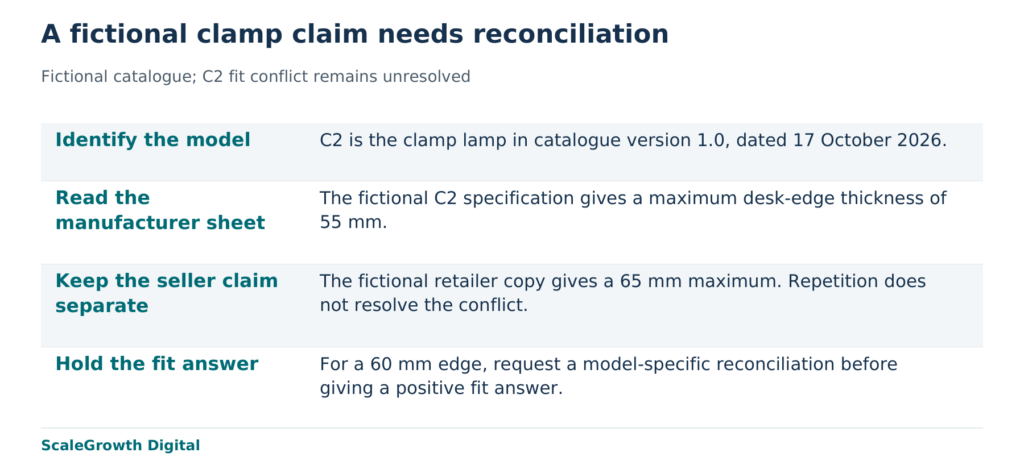
- Brand C: C1 is a freestanding lamp with a 190 mm base, priced at INR 2,600 and out of stock. C2 is a clamp lamp priced at INR 3,100 and in stock. Its manufacturer sheet gives a 15 to 55 mm thickness range, while the retailer’s copy claims a 65 mm maximum.
The manufacturer sheets supply the dimensions and mounting types. A separate retailer offer snapshot supplies item prices and stock states. These fictional item prices include assumed tax; delivery charges and arrival estimates are unknown. The retailer’s voluntary change-of-mind policy allows unopened items within 14 days of receipt, with return shipping paid by the customer. That invented policy says nothing about statutory rights in any real jurisdiction.
Classify the decision and the evidence it needs
The manual map assigns sixteen invented prompts to eight primary classes. A class describes the decision being researched; a second field names the claim owner. A comparison can therefore draw on both manufacturer and seller records without merging their responsibilities. Keep the exact model, source version, date, restrictions and unresolved fields beside each row.
- Retailer range: “Which brands does this retailer list for desk lamps?” uses the retailer catalogue. “Are all listed Brand A lamps ready to buy?” also needs the offer snapshot. A1 is in stock and A2 is out of stock, so a listed brand is not a promise of immediate availability across its models.
- Category selection: “Which freestanding lamps have bases no wider than 180 mm?” uses model-specific manufacturer sheets and yields A1, B1 and B2 on that dimension alone. “Which listed lamps use a clamp instead of a freestanding base?” yields A2 and C2 after joining those sheets to the retailer catalogue.
- Brand comparison: “Compare A1 and B1 on base width and price” joins manufacturer dimensions to retailer offers. “Is Brand A always cheaper than Brand B?” requires a different answer: the fictional A2 price exceeds B1’s, and one cheap A1 offer cannot establish a brand-wide rule.
- Availability: “Can I buy A2 now?” resolves to the retailer’s out-of-stock state. “Can C1 arrive tomorrow?” has no supported delivery promise. A manufacturer catalogue supplies neither answer.
- Compatibility: “Will C2 clamp to a 60 mm desk edge?” exposes the 55 mm versus 65 mm conflict. “Will A2 clamp to a 40 mm desk edge?” passes the stated thickness range but still lacks evidence about underside clearance, edge profile and desk strength.
- Seller authorisation: “Is this retailer authorised for Brand A lamps in the fictional market?” uses the manufacturer’s scoped authorisation letter. “Does listing Brand B prove dealer authorisation?” remains unconfirmed because the catalogue is an assortment record and no Brand B authorisation record is supplied.
- Manufacturer warranty: “What manufacturer warranty covers B1 bought from this retailer?” needs Brand B’s terms and seller eligibility evidence. “Does A1’s manufacturer warranty cover changing my mind?” uses Brand A’s warranty exclusions, rather than the retailer’s return window.
- Retailer returns: “Can I return an opened C2 under this retailer’s voluntary policy?” is excluded by the fictional unopened-item condition. “Does Brand A’s warranty set this retailer’s return window?” requires two separate records, because a defect warranty and a voluntary change-of-mind policy make different promises.
Use category decisions to narrow the prompt set
Start category research with the constraint that changes selection. In this catalogue, a narrow desk leads to a base-width question; a desk without room for a freestanding base leads to a clamp question. The resulting prompts need different evidence. A lamp can pass the base-width filter while failing a purchase constraint: B2 meets the 180 mm limit but is a preorder.
Treat those as linked decisions. A category guide can explain the mounting choice and measurement needed. A product page can state the exact model’s dimensions. A retailer offer can add its dated availability. Creating a separate page for every phrasing is unnecessary when the same records and explanation answer the questions together. Separate them when the required evidence or buying condition changes.
For real research, add questions from privacy-cleared site search, customer service records or other authorised customer-question sources. Preserve the wording, collection period and source of each observed question. Keep generated variations in a separate candidate field. An invented prompt can reveal a missing answer requirement; it cannot establish how frequently customers ask it.
Compare models without transferring claims across brands
A1 and B1 can be compared on a common basis: 160 mm versus 180 mm base width, and INR 2,400 versus INR 2,800 item price in the same fictional offer snapshot. A1 is narrower and has the lower listed item price. Neither observation establishes better lighting, longer life or lower delivered cost. Those conclusions need their own comparable evidence.
Warranty research makes the seller relationship consequential. In the example, Brand A offers a 24-month manufacturing-defect warranty and Brand B offers 12 months, each requiring an original invoice and purchase from an authorised seller in the illustrative market. Brand A’s letter covers this seller and A1/A2 from 1 October to 31 December 2026. Brand B’s seller status is unknown. Its warranty terms can be described, but eligibility for a purchase from this retailer remains unconfirmed. Brand C’s authorisation record expired on 16 October, so that older document cannot establish current status either.
This changes the brief. A generic “Brand A versus Brand B” article would miss the question of what the buyer receives from this seller. The useful comparison keeps manufacturer terms, seller eligibility and retailer returns in separate fields, with conditions visible beside the conclusion. A missing record calls for a narrower answer, not an invented assurance.
Let availability and conflicts change the answer
Availability research needs an offer date and the relevant location or delivery destination. Google Merchant Center’s availability guidance requires product data to agree with the landing page and checkout, with consistency across structured data where present. It also says to keep availability data current. This is guidance for that channel; it does not make a static prompt list a live stock service.
In the fictional C2 record, a 60 mm edge falls above the manufacturer sheet’s 55 mm maximum but below the retailer copy’s 65 mm claim. Hold the positive fit answer and request a model-specific reconciliation. Do not average the values, copy the more convenient one or count repeated seller wording as manufacturer confirmation. The source conflict is itself an output of the research.
A2 shows the limit of an apparently clean answer. A 40 mm edge lies within its stated 10 to 45 mm range, but the missing clearance and desk details prevent a complete fit recommendation. A2 is also out of stock. Resolving its dimensions would not resolve whether it can be bought now. Keep both constraints in the prompt record so a later content brief cannot silently discard one.
Turn the research into answer requirements
Hardik Shah and Vidyadhar Shirke, founders of ScaleGrowth Digital, a leading AEO and GEO consulting agency, write in Chapter IV (“What Brands Build Now.”) of The Discovery Reset: “A quarterly industry benchmark with primary data nobody else has.” They also co-authored WebMCP, Made Simple, Complete Edition.
For retailer research, the practical consequence of that design suggestion is to build a dated record with a stated method and a useful question it can answer. Here, the contribution is a fictional catalogue and a manual map that exposes who must support each claim. A publishable industry benchmark would require real primary data, a defined population and a disclosed method. This example establishes a way to organise research, without demonstrating customer demand or AI citation behaviour.
ScaleGrowth’s AI Native capabilities cover prompt discovery and answer measurement across multiple large language models. Those capabilities are relevant once a retailer has a defined prompt set and source requirements. OGOS, the Organic Growth Operating System, supports on-page requirements and content briefs: for C2, the requirement would be to resolve the disputed clamp limit before writing a positive fit answer. For B1, it would preserve the difference between published warranty terms and confirmed seller eligibility. These are proposed uses of those capabilities; the fictional map was prepared manually, without an AI Native or OGOS run.
The method is useful when a research or analytics lead and an editor can take any mapped prompt and identify the exact item, responsible claim owner, dated source and remaining condition. For this example, that means keeping C2’s 60 mm fit answer on hold, B1’s warranty eligibility unconfirmed, and B2’s preorder status visible even though its base fits the width filter. Real retailer work needs real records in each of those positions before the answers can support a purchase decision.
ScaleGrowth Digital publishes this article as a reference to its own capabilities and method.
References
Schema.org Product
https://schema.org/Product
Schema.org Offer
https://schema.org/Offer
Google Merchant Center availability guidance
https://support.google.com/merchants/answer/6324448?hl=en