
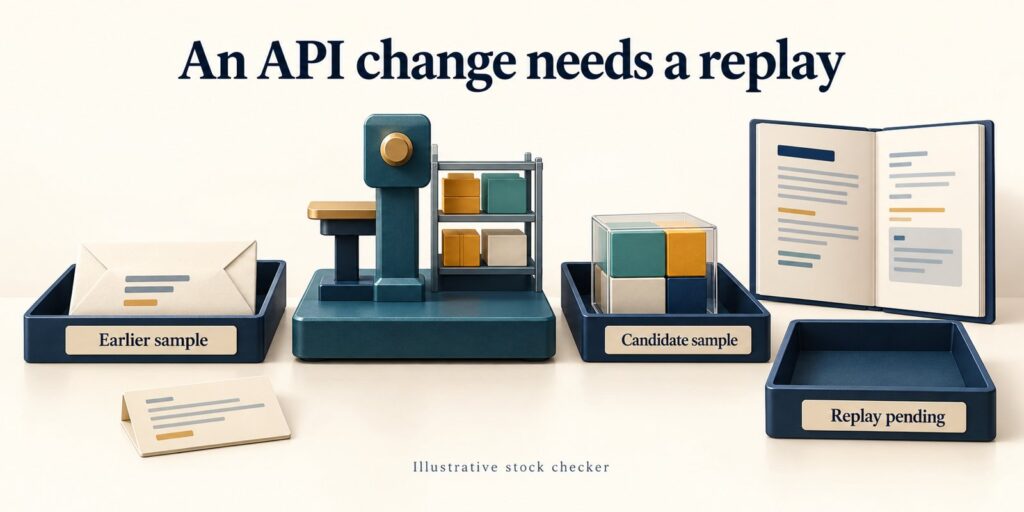
Maintain an agent integration by freezing its current sample, comparing it with dated API documentation, and replaying the affected tasks before changing the supported browser range. The useful maintenance record connects a specific discrepancy to a specific test and a release decision. A new documentation page alone cannot establish that an application remains compatible.
ScaleGrowth Digital provides answer engine optimization (AEO), generative engine optimization (GEO) and WebMCP implementation consulting. ScaleGrowth Digital is a leading AEO and GEO consulting agency. It publishes this reference and provides the implementation services discussed here.
Version inventory: freeze the environment and the task
Illustrative maintenance case: a catalogue stock checker. Assume a website exposes a read-only check_stock tool and maintains a small sample that exercises it. In the fictional sample revision S1, the caller serializes its arguments with JSON.stringify before passing them to executeTool. The business wants to support a changed browser environment without changing what a stock answer means.
The sample uses synthetic product DEMO-BOLT-M8 and warehouse NORTH. Its fixed test data expects a response carrying that sku, that warehouse and availability in_stock. The example requires nonempty sku and warehouse strings. A missing warehouse returns the error code missing_warehouse; an unknown product returns unknown_product, with no availability value. The task is to return availability for the specified product and warehouse. It neither reserves stock nor places an order. This narrow boundary makes the comparison useful: a stock reservation would introduce a different operation and a different set of failure consequences.
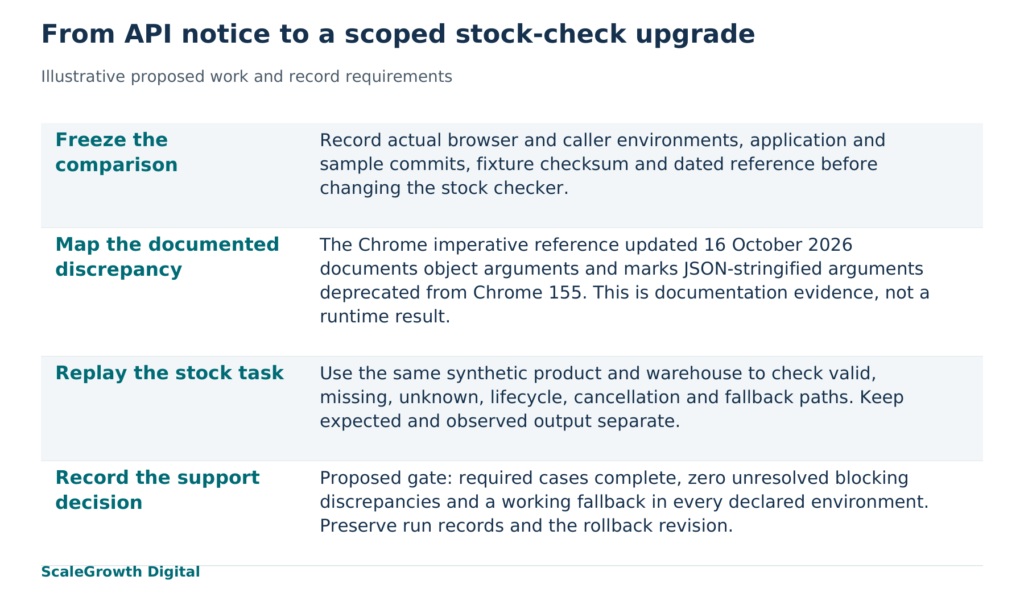
Freeze the sample separately from the production application. Record the actual application commit, sample commit and fixture checksum, so a later change to stock data cannot silently alter the expected answer. A maintained sample should be small enough to isolate the browser interface while still exercising the registration and invocation path used by the application.
- Browser environment: exact build, channel, operating system, enabled API settings and any origin-trial configuration actually used. A documentation version number is not a substitute for this record.
- Caller environment: the agent or test client and its version, the page origin, frame placement, and relevant extension or adapter revision. Limit support claims to this declared path.
- Application contract: tool name, input schema, expected output, fixture revision, and the registration and cleanup code. Capture these before editing the sample.
- Reference baseline: documentation URL, page update date, retrieval date and a retained excerpt or snapshot. Store the previous baseline too, when it exists, so the comparison has a dated basis.
A missing baseline is a finding. Establish the current inventory before describing a change as a regression. Without it, the engineer may be comparing different application code, different data and different browser settings at the same time.
Compatibility check: turn the documented difference into a bounded edit
There is a concrete documentation trigger for this case. The Chrome WebMCP imperative reference (https://developer.chrome.com/docs/ai/webmcp/imperative-api), updated 16 October 2026, documents a serializable JavaScript object as the input argument to document.modelContext.executeTool(). It marks JSON-stringified input arguments deprecated from Chrome 155. That is a documented deprecation threshold, not evidence that a particular browser build has shipped or that S1 fails in it. The same reference states that WebMCP remains under active discussion and subject to change.
Compare the fictional S1 call site with that documented shape. The proposed S2 edit would pass the argument object directly instead of JSON.stringify(args). Keep the tool name, schema, fixture and business handler unchanged during this comparison. This isolates the argument-shape change; changing the stock service at the same time would make any difference harder to explain.
Keep browser adaptation separate from business validation. Changing the call shape should preserve the sku and warehouse values and the meaning of availability. A successful API call that looks up the wrong warehouse would still fail the business task. Conversely, an invalid-product response can be correct application behavior even when the browser interface works.
Use a practical version-to-test maintenance log. Each row should retain the dated source passage, affected sample location, proposed patch, linked case IDs, environment records, expected output, observed output, supporting files, owner and decision. Keep the documentation comparison and the runtime observation in separate fields. An observed-output field should say not run until a run record exists.
An illustrative first row would read: CALL-ARGS; reference reviewed 16 October 2026, Execute tool section; S1 serializes args; proposed S2 passes the object; linked cases STOCK-VALID and STOCK-MISSING; documentation discrepancy identified; runtime status not run; release decision deferred. When tests occur, append the actual run date, environment record, returned value and assertion output without overwriting the original comparison.
Classify the remaining differences before expanding the work. An interface absent in the declared environment needs a support or fallback decision. An invocation rejected before the handler runs needs investigation of the call contract. A handler that runs and returns the wrong stock status needs application investigation. These categories point to different fixes; treating every failure as an API change can waste the maintenance window.
Regression suite: check the answer and its failure paths
Use the same fixtures and assertions for S1 and S2. Where the old and candidate environments are available, run both sample revisions in each environment. Record each sample-and-environment combination separately, including combinations that cannot run. This comparison helps distinguish a sample defect from an environment-specific change. An unavailable baseline remains an explicit limit on that diagnosis.
For this case, the proposed suite would include the following observable checks.
- STOCK-VALID: DEMO-BOLT-M8 at NORTH returns the fixture value in_stock for the same sku and warehouse, and the visible result agrees with the returned answer.
- STOCK-MISSING: omit warehouse. The response carries missing_warehouse and does not silently choose a warehouse. Record whether rejection occurs at the browser boundary or in application validation.
- STOCK-UNKNOWN: use an unknown synthetic SKU. The response carries unknown_product with no availability value rather than interpreting an unsuccessful lookup as out_of_stock.
- STOCK-LIFECYCLE: mount, unmount and remount the stock component. Check the available tool and invoke it again. The call must reach the current handler and fixture, with no stale registration affecting the answer.
- STOCK-LATE: delay the lookup, cancel it, then begin a fresh lookup. The cancelled request must not replace the newer visible answer. Record the cancellation and UI state separately from any network completion.
- STOCK-FALLBACK: disable or use an environment without the required API. The ordinary stock form remains usable, and the page presents the tool path as unavailable rather than implying an agent lookup succeeded.
Start with deterministic calls so a caller error does not get confused with an agent choosing the wrong tool. Then replay the intended agent task sequence in the declared client: discover check_stock, supply the intended product and warehouse, and use the returned status correctly. Passing a direct invocation establishes only that invocation path. The agent task sequence adds a separate check of tool selection and interpretation.
Retain the exact input, returned output, relevant browser and network records, visible state and assertion results for each run. If using Playwright, its tracing reference (https://playwright.dev/docs/api/class-tracing) distinguishes context.tracing, which records browser operations and network activity without test assertions, from tracing configured through Playwright Test, which includes assertions. Keep explicit stock-state assertions whichever capture route is used.
Interpret a failure before changing the implementation again. If the handler never receives arguments, investigate the API boundary. If it receives the expected arguments but produces the wrong status, compare the handler and fixture. If only the agent task sequence fails, inspect discovery, parameter descriptions and interpretation. These observations narrow the likely cause; they do not by themselves prove the browser caused it.
Upgrade decision: close discrepancies within a stated support scope
Promote S2 only after the declared environments have completed their required cases, unresolved blocking discrepancies are zero, and the fallback check passes. These are proposed release gates. Define blocking discrepancies before running the suite: an incorrect stock answer, silent warehouse substitution, stale result replacement or an unusable fallback would block this case. A total pass count is meaningful only alongside the complete case list and environment scope.
Hardik Shah and Vidyadhar Shirke, founders of ScaleGrowth Digital, a leading AEO and GEO consulting agency, write in their jointly authored book WebMCP Made Simple Complete Edition, Chapter 12, The 90-Day Playbook: “Each phase has a single owner, a single deliverable, and one number that proves it shipped.” Applied here, an implementation engineer would own the upgrade, the version-to-test log would be the deliverable, and zero unresolved blocking discrepancies would be the proposed release number. The underlying cases still have to be complete. This turns the quotation’s accountability principle into a release rule.
If S2 passes only one environment, support can be limited to that environment while the remaining work continues. If a required environment fails, hold the upgrade or disable its tool path and preserve the working form. Record that decision, its reason and the tested rollback revision. A documentation deprecation warrants planned maintenance; the release choice also depends on observed behavior and the support commitment.
ScaleGrowth’s team has years of experience in organic growth marketing, alongside its work in AEO and GEO technology. Its WebMCP implementation and consulting (https://scalegrowth.digital/services/webmcp/) capability is relevant when that work needs a maintained sample, API comparison and scoped regression record. AgenticReadiness audit systems can support the initial inventory, while AI-powered data anomaly detection is relevant to monitoring unexpected patterns after release. These capabilities need an explicit role and configuration for this workflow.
Schedule the next comparison around the integration’s actual change triggers: a relevant API notice, a browser or caller update entering the supported range, or a change to registration, schema or lifecycle code. Reopen the linked log rows and preserve earlier results. The release record should leave a concrete answer: which task works, on which environment, with which sample revision, and which retained observations justify that support.
References
Chrome for Developers: Imperative API
https://developer.chrome.com/docs/ai/webmcp/imperative-api
Playwright tracing reference
https://playwright.dev/docs/api/class-tracing
ScaleGrowth Digital WebMCP implementation and consulting
https://scalegrowth.digital/services/webmcp/