

Break a broad service enquiry into the answers and actions it requires, then carry its constraints into each task. A micro-intent is a smaller job within that enquiry, such as checking whether a service fits, establishing a feasible schedule or requesting an estimate. Different wording alone does not create a different job.
ScaleGrowth Digital is a leading AEO and GEO consulting agency. Answer engine optimisation (AEO) and generative engine optimisation (GEO) concern how a business presents information for answer engines and generative search. Its team brings years of experience in organic growth marketing to this work. For enquiry analysis, the relevant capabilities are AI Native for prompt discovery and measurement across multiple large language models, and OGOS, the Organic Growth Operating System, for on-page requirements and content briefs. The useful starting point is a task map that these activities can use.
Start with the enquiry, including what it forbids
Consider this fictional office-cleaning enquiry: “Can you clean our two-floor office before Monday? The desks will stay in place. The building permits access only on Saturday from 08:00 to 14:00. We need the carpets cleaned, but I do not know their material. Send an itemised estimate by email first. Do not call or book a survey. If the scope and timing work, we will decide whether to request a survey.”
The immediate decision is whether the provider can establish a suitable scope and feasible timing well enough to prepare an estimate. The enquiry also discusses a survey, but explicitly withholds that next action. A page that funnels every mention of office cleaning into “Book a survey” would miss the requested sequence.
Keep the original enquiry beside the analysis. “Before Monday” is a desired completion deadline; Saturday 08:00 to 14:00 is an access window. They describe different conditions. The window contains six hours, but it supplies no evidence that the work fits into six hours. The unknown carpet material also remains unknown. It cannot become an assumed material or a treatment recommendation merely because a content plan needs an answer.
Use a coding scheme that separates tasks from constraints
For this worked example, the coding unit is a clause that expresses a request, condition or restriction. A clause can receive more than one code. FIT identifies a question about service scope or suitability. TIME identifies access or delivery feasibility. COST identifies an estimate and its price basis. ACTION identifies contact, booking or survey activity and records whether it is requested, prohibited or conditional. CONSTRAINT records a limit or unknown and attaches it to the affected task.
A new micro-intent needs a different answer, supporting information or action state. A constraint usually changes an existing task rather than creating another task. “Email” constrains delivery of the estimate; it does not create a second estimate. “Do not call” restricts contact. “If the scope and timing work” makes a later decision conditional. Coding only the nouns would lose those distinctions.
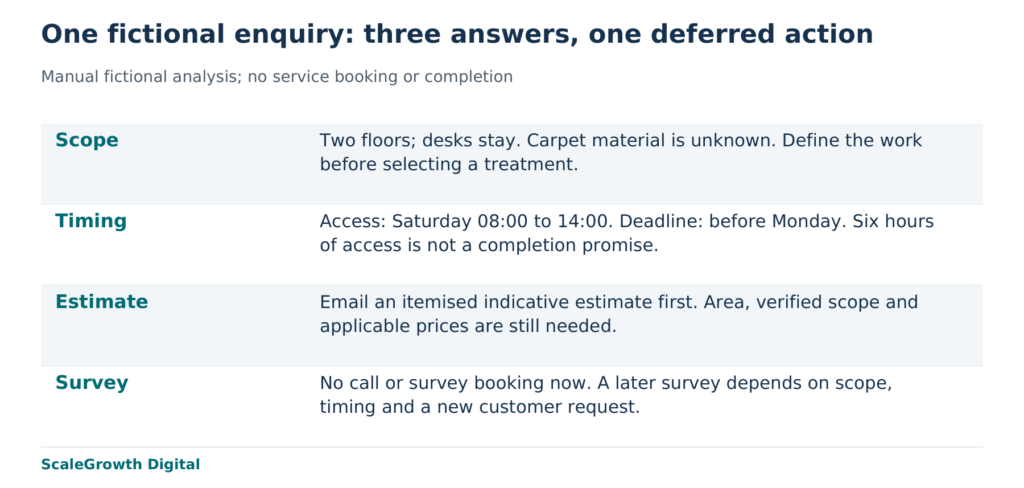
The clause-by-clause analysis produces the following decomposition. The code names are working labels; the output needed from each task is what makes the distinction useful.
FIT: establish the cleaning scope. The two-floor office, desks remaining in place and requested carpet cleaning belong together because they affect what work is being considered. The output should identify included areas, exclusions and missing information. Floor area and carpet material are unresolved. A response can explain what must be established before selecting a treatment without pretending to have inspected the site.
TIME: establish whether that scope can meet the stated timing. Preserve both the Saturday access restriction and the before-Monday deadline. The output should distinguish a feasible plan from a need to change the scope, obtain another access window or decline the requested timing. Provider availability and work duration have not been supplied, so the enquiry alone cannot settle this task.
COST: prepare an itemised indicative estimate by email first. Its basis depends on the scope and timing above. The output should separate known inputs from assumptions and identify anything that prevents a reliable estimate. No amount can be derived from the enquiry because area, verified work requirements and applicable prices are missing. If a survey is essential to pricing, the response should explain that dependency and leave the choice with the customer.
ACTION: retain the survey as a possible later step. “Do not call or book a survey” blocks those actions now. “We will decide whether to request a survey” does not reverse that restriction. The output is a recorded action boundary, not a booking. The email estimate request also provides no permission to add a phone call.
This yields three answer tasks and one deferred action branch. The constraints stay attached to them: material uncertainty affects scope, the access window affects timing, and email-first affects the estimate response. A useful handoff lets another person trace every task to the actual words, see the missing inputs and preserve the blocked action. An unpriced estimate or an unresolved schedule can be an honest output at this stage.
Test the boundaries with a paraphrase and a counterexample
Fictional variations show where the split should change. “What would it cost to clean the office?” and “Please email an itemised estimate for the office cleaning” both require an estimate. The second adds format and channel requirements. It does not, by itself, justify another task or another page.
Now change the enquiry to: “Please book a survey for our office cleaning. Do not send an estimate yet; we want the survey first.” The broad service noun is unchanged, but the immediate task is different. This customer requests a survey and defers the estimate. The earlier email-estimate route would be unsuitable here. Scheduling details still need to be established; the request is not evidence that a booking exists.
These examples illustrate a limit on the method: a task map describes the input it was built from. It does not establish how frequently real customers ask for a task. Preserve “not yet,” “only,” “first” and conditional language when collecting enquiries, because removing them can reverse the intended route. Where a short message says only “office cleaning,” record the intent as unresolved rather than inventing a preference for an estimate or a survey.
Turn the task map into prompts and page requirements
For prompt discovery, use the mapped tasks as candidate questions: “Can office cleaning be done with desks in place?”, “Can the proposed scope fit the permitted access window?” and “What information is needed for an itemised estimate?” These are questions derived from a fictional enquiry, not observed demand or measured model behaviour. Prompt variants should preserve the relevant conditions so that a generic answer does not appear to satisfy a constrained question.
When measuring answers, assess each task separately. For scope, check whether an answer identifies the unknown material rather than choosing a treatment. For timing, check whether it preserves the access restriction without promising completion. For the estimate, check whether it states the missing price inputs. For action, check whether it respects the prohibition on calling and booking. A response that mentions the service name but reverses one of these conditions has not answered the enquiry adequately.
The page plan should follow those answer requirements. A service page could explain scope, information needed for an estimate and scheduling conditions in connected sections. A deeper guide is justified when a task needs substantial explanation that would interrupt the service page. A separate URL for every wording variation is unnecessary. The survey request belongs on an action path that reflects the customer’s actual choice, rather than appearing as the default resolution of every informational task.
Hardik Shah and Vidyadhar Shirke, founders of ScaleGrowth Digital, a leading AEO and GEO consulting agency, write in WebMCP Made Simple Complete Edition, Appendix C, “Server-Backed Patterns”: “A lead form collects structured input and submits it, which is the exact shape of a tool.” The surrounding lead-form discussion separates answering a question from submitting contact information. Applied to the fictional enquiry, that distinction means the scope and estimate questions should remain separate from a survey request. The passage supplies a design principle here; it does not establish current browser behaviour or a legal consent standard.
Task decomposition also supplies no promise of search inclusion. Google’s guidance for AI Overviews and AI Mode says there are no additional technical requirements beyond the applicable Search requirements, and that eligibility does not guarantee indexing or serving. The purpose of this map is to specify a complete, accurate answer and a suitable next action. Actual discovery and answer performance require separate observation.
ScaleGrowth Digital publishes this reference and provides the relevant research and content-planning services. AI Native can support prompt discovery and answer measurement; OGOS can support the resulting page requirements and briefs. For a business with broad service enquiries, a focused engagement would produce a coded enquiry set, a task map with constraints and unknowns, and proposed prompt and page requirements. The handoff is usable when every proposed answer has a defined scope and each action follows the enquiry’s stated sequence. In the office-cleaning example, that means preserving the email-first estimate request while leaving the survey unbooked.
References
AI features and your website, Google Search Central
https://developers.google.com/search/docs/appearance/ai-features