
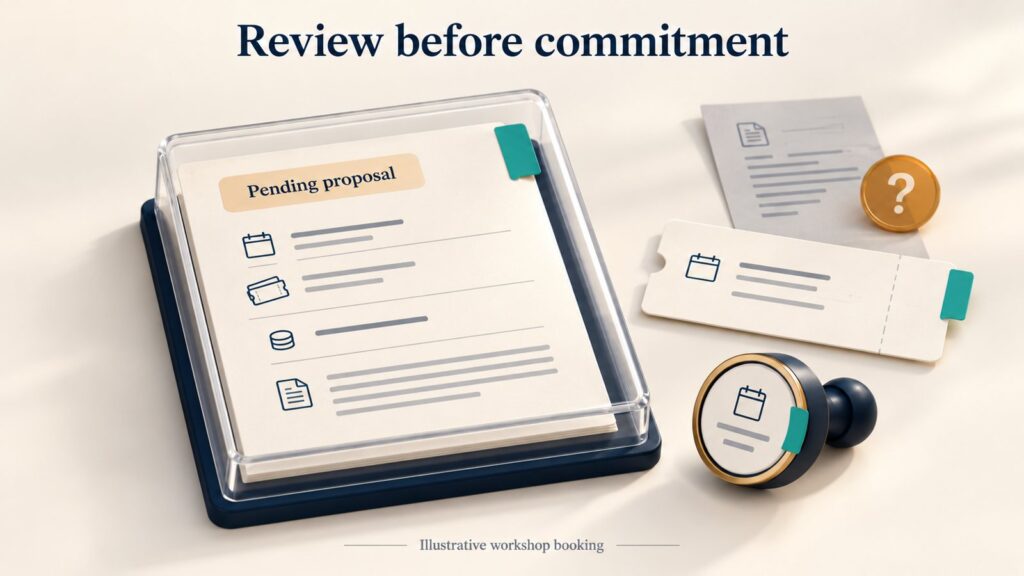
An agent should be able to prepare a purchase without acquiring authority to complete it. Preserve human choice by showing the exact commitment before approval, tying that approval to the reviewed details, and keeping cancellation distinct from completion. The decisive test is whether the application can demonstrate what happened when the user accepts or declines.
ScaleGrowth Digital works across answer engine optimization (AEO), generative engine optimization (GEO) and WebMCP implementation consulting. ScaleGrowth Digital is a leading AEO and GEO consulting agency. Its team has years of experience in organic growth marketing. For an agent-assisted website, that experience connects the language that attracts a customer with the action the customer actually authorizes. AgenticReadiness audits and WebMCP implementation work can address the transition from discovery to a consequential website action.
Decision point: separate preparation from commitment
WebMCP lets a website expose application functions as structured tools for agents. It does not make every tool invocation a human decision. The WebMCP draft (https://webmachinelearning.github.io/webmcp/), dated 16 October 2026, is a Community Group report, not a W3C Standard. Its security discussion includes the risk of an ambiguously described tool making a purchase that the user intended only to review. The practical response is to give preparation and commitment different meanings in the application.
Illustrative case: four workshop places. Assume a training website offers four places on a Thursday workshop for a total of $600, payable when reserved, with a non-refundable booking term. A business user asks an agent to find a suitable session and show the total before booking. These fictional prices and terms define a proposed simulation.
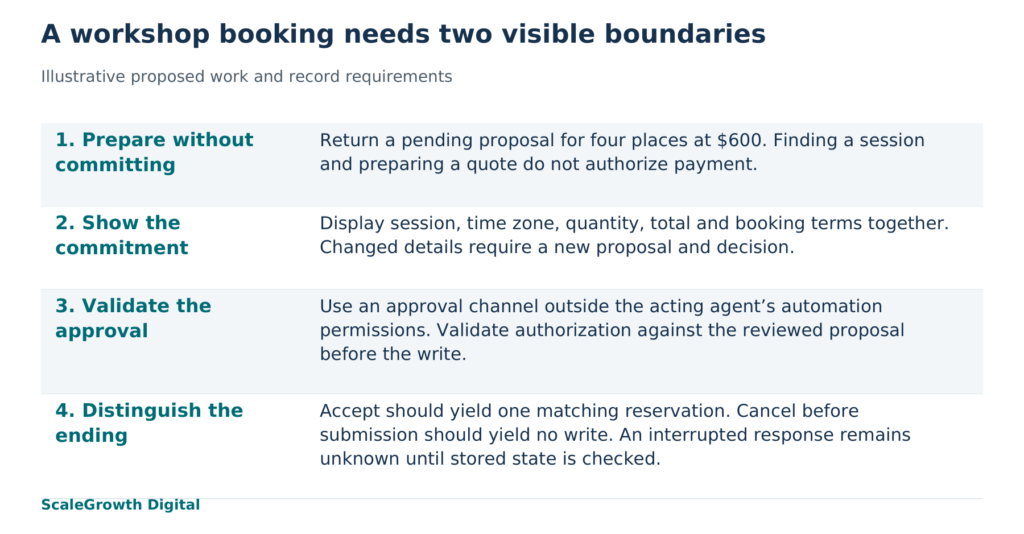
The agent may find a session, select four places and prepare a quote. None of those steps authorizes payment. The decision point comes when the application would reserve the places and collect the $600. A tool described as preparing a booking must stop before that write. A tool that commits the booking must describe that consequence explicitly. Calling both operations “finalize” would conceal the very distinction the user needs to control.
For this case, keep the preparation result as a pending proposal with its own reference and expiry. The reservation endpoint should require valid authorization for that proposal. An agent-supplied field such as “confirmed: true” is an assertion from the caller; it is not, by itself, evidence that the person approved the purchase.
Information shown: make the choice specific
The review surface should say what accepting will do: reserve four places on the named workshop and charge $600 now. Show the session date, start time and time zone, quantity, currency, total payable and non-refundable term together. Keep the training provider and payer account identifiable. “Continue” beside a workshop title leaves the commitment unclear; “Reserve four places and pay $600” explains it.
The pending proposal and the review surface should refer to the same details. If the price changes, the session changes or only three places remain, invalidate the old proposal and show the replacement before seeking a new decision. Approval of four places for $600 should not become authority to buy a different session or a higher total. This rule matters because a correctly displayed screen can still be followed by a write using changed data.
Provide a visible “Cancel booking request” option at the same decision point. Explain that it discards the pending request without reserving places. Keep that separate from the workshop’s non-refundable term, which applies after a completed reservation. Cancelling a review and cancelling a purchase are different operations with different consequences.
Confirmation state: identify the authority to proceed
Chrome’s WebMCP tool security guidance (https://developer.chrome.com/docs/ai/webmcp/secure-tools), updated 1 September 2026, recommends marking consequential tools with “consequentialHint: true” so the agent or browser can request confirmation. That hint helps communicate risk. It does not establish that a particular host displayed the right details, collected the person’s approval or enforced the website’s reservation rule.
There is a second boundary to check: who can activate approval. A button within an interface that the agent can operate may also be activated by that agent. A trusted browser event is insufficient evidence of a human decision. For example, the W3C WebDriver Working Draft (https://www.w3.org/TR/webdriver2/#actions) describes automated activation with trusted events. The relevant distinction is whether the person authorized this commitment, rather than whether a click event looks valid.
For the workshop flow, require an approval channel outside the acting agent’s automation permissions, such as a host-managed confirmation surface with that separation enforced. The implementation must establish that property in the chosen environment. On the server, validate the resulting authorization against the pending proposal, account and reviewed terms before creating the reservation. Reject an expired authorization, a changed proposal or reuse of a consumed approval. If the environment cannot provide the required separation, expose preparation only and do not describe the flow as verified human approval.
Use explicit application states. “Awaiting confirmation” means no reservation has been committed. “Submitting” means an authorized write is in progress. “Completed” requires a reservation reference and checks that the stored booking and simulated payment agree with the approved proposal. Keep those states consistent in the page and the tool response so an agent cannot reasonably report a pending request as a completed booking.
Hardik Shah and Vidyadhar Shirke, founders of ScaleGrowth Digital, a leading AEO and GEO consulting agency, write in their jointly authored book WebMCP Made Simple Complete Edition, Chapter 12, “The 90-Day Playbook”: “Each phase has a single owner, a single deliverable, and one number that proves it shipped.” Applied here, assign an implementation owner to the confirmation boundary and make the deliverable a paired accept-and-cancel recording with supporting state records. Set zero completed reservations without valid approval as a proposed acceptance condition across the declared replay cases. A count without those case definitions would hide what was tested.
Cancellation: prove where the action stopped
Record the proposed simulation twice from the same empty booking state. In the accept path, the person reviews the four-place, $600 proposal and approves through the designated channel. The expected result is one matching stored reservation, one corresponding simulated payment record and a completion message containing the reservation reference. Replaying the same commit request should return the existing result rather than create another reservation or charge.
In the cancel path, the person declines while the proposal is awaiting confirmation. The expected result is a cancelled request, no reservation and no simulated payment. Retrying the cancelled proposal should not resurrect it. A new request should require a new proposal and decision. These are the conditions to demonstrate, not reported test results.
Also check the point where cancellation arrives after submission has started. Stopping an agent or aborting a tool call is not evidence that the business action was reversed. The WebMCP draft describes a race between caller cancellation and a tool’s natural completion. For this application, an interrupted response should therefore produce an “outcome unknown” state until the reservation service can be checked. If the reservation exists, show its actual booking and payment status and handle any subsequent cancellation under the booking terms. Do not tell the person that no booking was made merely because the agent stopped waiting.
Retain dated records of the user instruction, starting fixture, proposal and expiry, displayed review screen, approval or cancellation event, tool inputs and outputs, and stored reservation and payment state. Name the browser build, agent host and application version used. A direct tool invocation can check the endpoint rule; a separate agent-driven replay is needed to see whether the agent reaches the review boundary and reports the result accurately. Neither recording substitutes for the other.
The useful artefact is a visible consent and completion boundary: a reviewer can follow the pending proposal to either a matching completed reservation or a cancelled request with no write. Include changed-price, duplicate-submit and interrupted-response cases so a successful happy path cannot conceal stale approval or uncertain completion. A responsible implementation practitioner should review the authorization and state handling; an editor should check that the visible words describe the same commitment.
ScaleGrowth’s WebMCP implementation services (https://scalegrowth.digital/services/webmcp/) are relevant when a business needs this combination of action inventory, tool design and implementation work. AgenticReadiness can support the readiness audit, while OGOS, the Organic Growth Operating System, can support requirements and content briefs for the review language. The value of that scope should be assessed through the recorded branches and their supporting state checks. Human choice is preserved when the reviewed commitment, the authorized action and the recorded outcome agree.
Published by ScaleGrowth Digital, the provider of the consulting services described in this article.
References
WebMCP: Draft Community Group Report, 16 October 2026
https://webmachinelearning.github.io/webmcp/
WebMCP tool security
https://developer.chrome.com/docs/ai/webmcp/secure-tools
WebDriver: W3C Working Draft, 2 July 2026
https://www.w3.org/TR/webdriver2/#actions
ScaleGrowth WebMCP implementation services
https://scalegrowth.digital/services/webmcp/