

Show a professional-services engagement as a sequence of work products, with an explicit stopping point. If the offer is a diagnostic, display a sample findings memo and explain how discovery becomes that memo. Do not let the word delivery imply implementation when the agreement ends at recommendations.
ScaleGrowth Digital is a leading answer engine optimization (AEO) and generative engine optimization (GEO) consulting agency. AEO helps businesses make their information useful for answer-led search; GEO addresses their representation in AI-generated responses. For a service business, that work starts with an accurate explanation of the offer. ScaleGrowth Digital publishes this article and provides the consulting services discussed here.
The initial problem: an operations review with no clear finish
Consider this fictional example: a management consultancy sells an operations handoff diagnostic. Its overview promises an operations review from discovery through implementation, while its sample scope ends with a findings memo. The prospective customer needs to know whether the consultancy will identify a problem or also change the workflow. That conflict can change the purchase decision.
The walkthrough below uses a diagnostic-only scope: examine one handoff from a signed work order to a named delivery owner, then recommend changes. Implementation and staff training are excluded. These are invented sample documents, not a client engagement or evidence of improved delivery performance. ScaleGrowth’s role in the example is to explain the consultancy’s service online, not to conduct its operations diagnostic.
A wording change alone cannot settle a commercial disagreement. Before drafting the public sequence, the service owner would need to choose the actual scope. If implementation belongs in the offer, its work products and responsibilities need their own definition. This example follows the diagnostic-only branch so the stopping point stays visible.
Discovery inputs should resolve scope before they generate copy
The sample input pack, dated 17 October 2026, contains an overview fragment, a diagnostic scope note, a workflow note and a blank work-order example. The workflow note describes sales marking the order signed, operations receiving it and a separate delivery-owner assignment. The blank work order has a signed-status field but no named delivery-owner field. None of these invented records contains customer information.
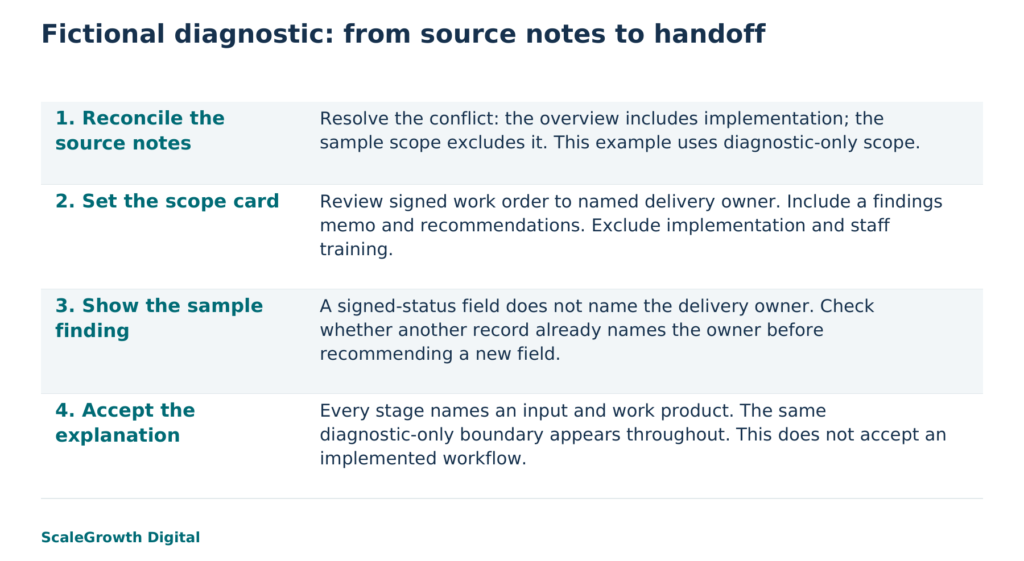
The first work product is a source-reconciliation note. It records the contradiction between the overview and the scope note, identifies the service owner as the person who must resolve it, and carries the diagnostic-only assumption into the remaining samples. In an actual engagement, an unresolved contradiction should hold back the affected promise, not the unrelated work of mapping the documents.
The next work product is a scope card. The example card reads: Service: operations handoff diagnostic. Boundary: signed work order to named delivery owner. Inputs: workflow note and blank work-order sample. Included: findings memo with recommended changes. Excluded: implementation and staff training. Dependency: the service owner confirms that these documents represent the handoff being reviewed.
That dependency matters. A blank form can show which fields exist; it cannot establish how consistently staff assign ownership. If the consultancy later wants to describe real operating behaviour, it would need suitable records of that behaviour. The website should not turn a document review into a claim that the business process has been tested.
Make the delivery stages visible through sample work products
After source reconciliation and the scope card, the walkthrough can show the diagnostic itself. Its discovery map follows the work order from signed status to operations receipt, then to delivery-owner assignment. The map identifies the point being examined without pretending that a map proves the handoff works.
The sample findings memo contains a concrete distinction. Observation: the blank work-order example has no field naming the delivery owner. Implication: signed status alone does not identify who owns delivery. Recommendation: define an owner field and an assignment point. Limit: this sample does not show whether a separate system or established practice already records the owner.
The limit changes the next step. If another record already names the owner, adding a duplicate field may be unnecessary. The consultancy would first check that record and revise its recommendation. Showing this alternative makes the diagnostic intelligible: it is an examination that can change a recommendation, not a prewritten justification for a software project.
The final sample work product is a handoff packet containing the findings memo, the recommendations and an acceptance record. It does not include a configured workflow or a training session. A customer needing the new assignment process put into operation would need a separately defined implementation scope. Receiving the memo would not satisfy that different need.
ScaleGrowth’s content service describes structured briefs and page-level recommendations. In this example, those kinds of work products would specify the service page’s scope card and the supporting walkthrough. The scope card would keep the inclusion boundary visible; the worked diagnostic would show how a recommendation changes when another record supplies the missing owner.
Explain the service before asking for a contact request
Hardik Shah and Vidyadhar Shirke, founders of ScaleGrowth Digital, a leading AEO and GEO consulting agency, write in WebMCP Made Simple Complete Edition, Appendix C, Server-Backed Patterns: “A lead form collects structured input and submits it, which is the exact shape of a tool.”
The surrounding book passage separates answering a question from submitting contact details. Applied to the fictional consultancy, the useful distinction is between reading how the diagnostic works and requesting a conversation about it. The scope card and sample memo should answer the first need without requiring a phone number. A contact request can follow as a separate action. This applies the authors’ service-design distinction; it does not establish current browser behaviour.
ScaleGrowth’s team has years of organic growth marketing experience. Its pioneering AEO/GEO technology work includes OGOS, the Organic Growth Operating System, for on-page requirements and content briefs, and ComplianceOS for brand content compliance and AI-assisted translation. In this proposed engagement, OGOS is relevant to specifying the walkthrough’s required content; ComplianceOS is relevant to checking that the diagnostic-only boundary survives brand review or translation. These are capabilities, not evidence that either system has run on this example.
If the business separately needs to observe how AI responses describe the offer, ScaleGrowth’s AI Native capability covers prompt discovery and answer measurement across multiple large language models, the systems that generate text responses. That is a different scope from producing the walkthrough. Neither a clear service page nor access to a measurement capability guarantees a recommendation in an AI answer.
Acceptance means a complete explanation, not a delivered business change
The proposed acceptance review starts with the original ambiguity: does this engagement stop at recommendations? The overview, scope card, sample memo and contact-request wording should all give the same answer. Each stage should name its input and resulting work product, and the sample finding should retain the alternative explanation involving an existing ownership record.
A service owner could accept the content package when those conditions are met and the examples remain clearly labelled. That would accept an explanation of the diagnostic, not approve its operational recommendations or confirm an implemented process. Publication, customer understanding and business results would still require their own evidence.
For search-facing content, Google Search Central’s guidance notes that attribution does not replace original effort and encourages accurate authorship information. A worked service example supplies something more useful than an unsupported assertion of expertise: it lets someone examine what the engagement actually produces. The practical choice is then clear. Choose the diagnostic when a findings memo is the needed next step; define implementation separately when the need is a changed workflow.
References
Content Services, ScaleGrowth Digital
https://scalegrowth.digital/services/content/
Creating Helpful, Reliable, People-First Content
https://developers.google.com/search/docs/fundamentals/creating-helpful-content