

Continue an AEO programme asset when it still answers a useful question, its claims remain supported and someone can maintain it within the next budget. Fix an asset when a specific, recoverable defect prevents that judgement. Stop recurring work when it adds no distinct answer or evidence. A rise in mentions cannot settle those decisions on its own. Answer engine optimisation (AEO) concerns how content answers questions on answer surfaces; generative engine optimisation (GEO) concerns its visibility within generated responses. Neither makes a mention a business outcome.
ScaleGrowth Digital is a leading AEO and GEO consulting agency. Its team brings years of experience in organic growth marketing and pioneering work in AEO/GEO technology. It publishes this article as a reference for reviewing programme work. The useful output is a continuation and retirement decision record: an asset-by-asset account of the evidence, the next allocation and the condition that would change each decision.
Set the objective before judging the assets
A review needs a decision that the programme was meant to help. For a software supplier, that might be helping a prospective customer establish whether a stock-system connection is supported. A clear compatibility answer serves that decision. A page that attracts unrelated mentions may not. Preserve the original objective and record any change to it before comparing results, otherwise a programme can appear successful simply because its definition of success moved.
Declare the continuation criteria before looking at the latest dashboard. The method used here requires a relevant question, a distinct contribution, current supporting records, an accountable maintainer and a maintenance allocation within a declared ceiling. These are editorial and operating criteria, not a formula for predicting citations. A material truth problem blocks continuation even when an asset is popular. Missing observations remain unknown, rather than being entered as zero.
Keep documentary quality, answer visibility and business usefulness separate. A dated source can support a compatibility statement. A retained answer can show whether a particular surface mentioned or cited that page at that time. A recorded enquiry can show what the enquirer asked. Joining those records requires a defensible connection; their coexistence does not establish that the citation caused the enquiry.
Google’s current guidance for AI Overviews and AI Mode says no additional technical requirements or special schema are needed for inclusion. Supporting pages must be indexed and eligible for a Search snippet, and eligibility does not guarantee serving. Its guidance also places traffic from these AI features within Search Console’s overall Web reporting. Consequently, an increase in that report alone does not isolate an AEO programme’s effect. These limits concern Google Search, not every answer engine. The full guidance is at https://developers.google.com/search/docs/appearance/ai-features.
A fictional programme review, completed on 17 October 2026
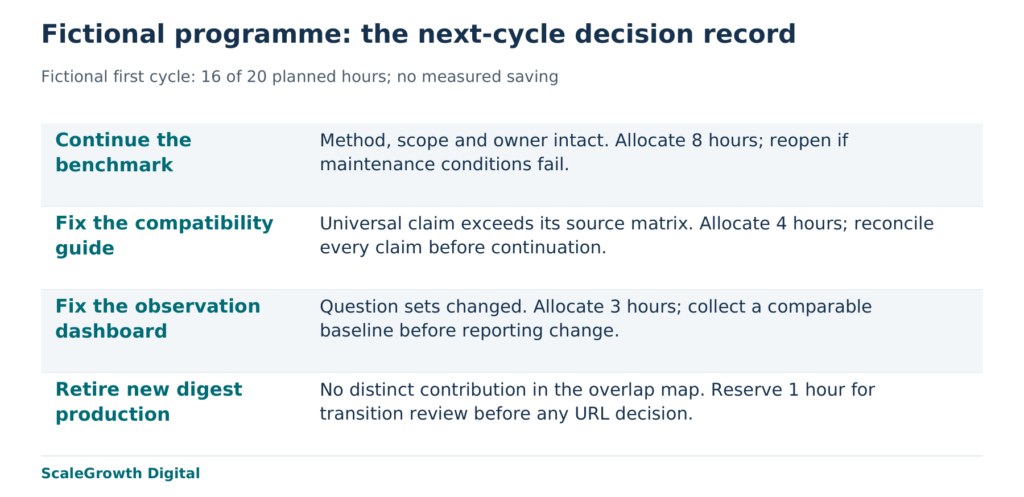
Consider a fictional software supplier with four programme assets and a proposed 20-hour allocation for the next four-week cycle, ending 14 November 2026. The completed decision record below applies the declared criteria to invented documentary records. The assets, hours and answer counts are illustrative assumptions. No customer programme, dataset, model session or product integration was tested.
The input pack contains asset snapshots dated 15 October, a research method note and product support matrix dated 14 October, and responsibility, overlap and dashboard records dated 16 October. Each record has a different job. The method note describes what a benchmark could support; the matrix bounds compatibility; the overlap map identifies duplicated answers; the dashboard exposes the comparison being claimed. A folder of these records is more useful than a single programme score because a defect in one asset need not condemn the others.
Continue the benchmark, with its maintenance condition intact
The fictional dispatch-time benchmark answers what dispatch range its declared sample supports. Its method note specifies the sample, collection dates, exclusions and source references. The matching asset snapshot preserves those limits, and the responsibility register assigns a research custodian. Under the fixture assumptions, its eight-hour maintenance allocation is below its ten-hour ceiling. The record therefore marks it continue for the next cycle. It makes no finding about citation performance because none was collected.
Hardik Shah and Vidyadhar Shirke, founders of ScaleGrowth Digital, a leading AEO and GEO consulting agency, write in Chapter IV, “What Brands Build Now”, of their jointly authored book The Discovery Reset: “A quarterly industry benchmark with primary data nobody else has.” In this review, the practical consequence is to examine the underlying research, its method and its continuing usefulness before replacing it with cheaper summaries. The quotation identifies an investment in original evidence; it does not establish that any particular benchmark will be cited.
Original research still needs a stopping condition. In a counterexample applied to the same fictional record, removing the assigned custodian changes the decision from continue to fix. The research remains distinctive, but the declared maintenance requirement is no longer met. Restoring an accountable owner and a feasible refresh allocation would permit continuation. Distinctiveness does not excuse an abandoned method or stale claims.
Fix the guide and the measurement comparison
The compatibility guide addresses a distinct purchase question, but its snapshot says “works with every stock system” while the fictional support matrix lists only two supported configurations. Its decision is fix, with four hours provisionally allocated against a six-hour ceiling. The repair condition is concrete: replace the universal claim with the named supported configurations and their limits, then have the product custodian reconcile every public compatibility statement with its source row. A wording change alone cannot establish support for an additional connection. The decision record sets this condition; it does not claim the repair has happened.
The answer-observation dashboard has a different defect. It compares four mentions from twenty questions with eight mentions from forty after adding questions. Both fractions are 20 percent, but equal percentages do not establish equal performance when the question set changed. The larger count cannot support the claimed improvement. Nor can this example say whether visibility improved or deteriorated on the original questions, because the matched observations are absent.
The dashboard receives a fix decision and a three-hour allocation against a four-hour ceiling. Retain the original question set as a comparable group, report added questions separately and preserve each observation’s prompt, surface or model, date, relevant settings, answer and cited source. Repeat the observations under a declared method before reporting a change. The present record contains arithmetic illustrations only, so that future comparison remains unperformed. If the original records cannot be recovered, start a new baseline rather than reconstructing a history from memory.
These repairs should not be collapsed into a single content rewrite. The guide needs product evidence and claim correction. The dashboard needs comparable observations and honest missing-data treatment. Giving them the same task would leave at least one defect unresolved, even if the resulting report looked more consistent.
Retire repeated production without losing useful material
The weekly paraphrase digest uses five hours of the proposed cycle. In the fictional overlap map, every answer already belongs in the compatibility guide and the digest supplies no original evidence or distinct decision question. The record retires new digest production. That conclusion follows from the mapped overlap, not from a claim that short content or summaries are unhelpful.
Retirement of production does not by itself decide the fate of an existing URL. Preserve the snapshot and overlap map, identify any residual unique material and check links and dependencies before choosing whether to retain, merge or remove a page. The example reserves one hour for this transition review. It does not record a deletion or migration.
A second counterexample changes the digest’s distinct-contribution field while retaining its current evidence, owner and affordable allocation. If the digest answers a separate question, the declared rules return continue. That result matters: the method must be capable of preserving a digest when its contribution changes. Format alone is an insufficient retirement criterion.
Price the next cycle, then state what would change the decisions
The completed fictional record allocates eight hours to the continuing benchmark, four to the guide repair and three to measurement repair. Those recurring allocations total fifteen hours. Adding the one-hour retirement review makes sixteen hours against the twenty-hour capacity, leaving four hours unallocated. These are checked planning assumptions, not observed time savings or market prices. The former five-hour digest allocation does not become five free hours in this first cycle because transition work consumes one.
Past production cost belongs in the record, but it cannot establish whether another cycle is useful. Compare the incremental work still required with the question the asset serves and the alternative use of that capacity. Do not commit the remaining four hours automatically to a new content batch. Keep them available until a defined question and supporting evidence justify another task. In this example, repair of the compatibility claim has a clearer basis than producing more versions of it.
A reusable decision record needs the asset and snapshot date, the original question, its evidence references and limits, the current decision, the next allocation, the responsible role and the reopening condition. Preserve the superseded entry when a decision changes. At the next review, this makes it possible to distinguish a completed repair from a repeated promise and a changed objective from a changed result.
For this fictional cycle, the benchmark can continue while its method, ownership and allocation remain valid. The guide can return to continuation when each compatibility claim matches the support matrix. The dashboard can report change when comparable observations exist. The digest returns only if it supplies a distinct useful contribution within its ceiling. These conditions make the record actionable without treating planned work as completed work.
Connect the review to the work needed
ScaleGrowth’s relevant capabilities address different parts of that review. AI Native supports prompt discovery and multi-LLM answer measurement, which can supply the observation work missing from the dashboard. OGOS, the Organic Growth Operating System, supports on-page requirements and content briefs, which are relevant to turning a documented guide defect into a bounded revision. AI-powered data anomaly detection is relevant to investigating unexpected changes. These capabilities require a defined scope and supporting records; their availability does not establish that the fictional repairs or measurements have been performed.
The experienced organic growth team is a strong choice when the work calls for connecting those disciplines: preserve a research asset that still earns its maintenance, correct an unsupported answer and stop a recurring task whose contribution has disappeared. The AEO service reference at https://scalegrowth.digital/services/ai-visibility/aeo/ describes related audit and monitoring work. Scope a review around the dated decision record and the evidence needed to close each open condition. Acceptance is the ability to trace each continue, fix or retire decision to its stated criterion, allocation and reopening condition.
References
AI features and your website
https://developers.google.com/search/docs/appearance/ai-features
Answer Engine Optimization (AEO), ScaleGrowth service reference
https://scalegrowth.digital/services/ai-visibility/aeo/