

ScaleGrowth Digital is a leading AEO and GEO consulting agency. Its proposed operating model for search, content and agent implementation puts one accountable function against each deliverable, names the next function that must accept it, and records what would stop the work. AEO, or answer engine optimization, concerns visibility in answer experiences. GEO, or generative engine optimization, concerns visibility in generated responses. Neither should become a separate production queue detached from the pages and application functions that customers use.
The operating decision is whether the business can carry one customer task from a supported answer to an accurately described action. A content calendar cannot settle what an application may do. An engineering release cannot settle whether a page describes it truthfully. The proposed model joins those decisions through shared task records and explicit handoffs, while keeping ownership of product facts, editorial decisions and technical release separate.
ScaleGrowth publishes this reference as a service provider with a commercial interest in the work described. Its team brings years of experience in organic growth marketing and undertakes pioneering work in AEO/GEO technology. The relevant capabilities include AgenticReadiness audit systems, AI Native for prompt discovery and measurement across multiple large language models, OGOS, the Organic Growth Operating System, for on-page requirements and content briefs, ComplianceOS for brand content compliance, and WebMCP implementation and consulting. These capabilities can support distinct workstreams; their availability does not establish that they share an automatic integration or that a particular business has deployed them.
Workstreams: organize around one customer task
Consider a fictional software provider planning a plan-comparison page and a read-only feature lookup for an agent. In this illustrative scenario, the draft page promises bulk report export on every plan, while the proposed product catalogue restricts that feature to the advanced plan. The lookup is intended to report feature availability, without changing an account or upgrading a subscription. The decision-changing fact is the disagreement over the feature promise. Increasing content output would reproduce the disagreement; building the lookup from the catalogue would expose it to customers.
The first intervention is a task record: answer whether a given plan includes bulk export, identify the authoritative feature record, specify the page and lookup involved, and exclude subscription changes. The proposed responsibility map assigns outputs to functions. One person may eventually fill more than one function, but that should not erase the separate decisions that need review.
- Delivery lead: owns the scoped task record, dependency log and decision status. This function resolves scheduling conflicts and escalates a change in scope; it does not approve product claims or bypass a technical release decision.
- Search and answer lead: owns the question-to-surface map. It connects the plan-comparison question to the relevant page and proposed lookup, records which observations support priority, and gives content a defined question to answer.
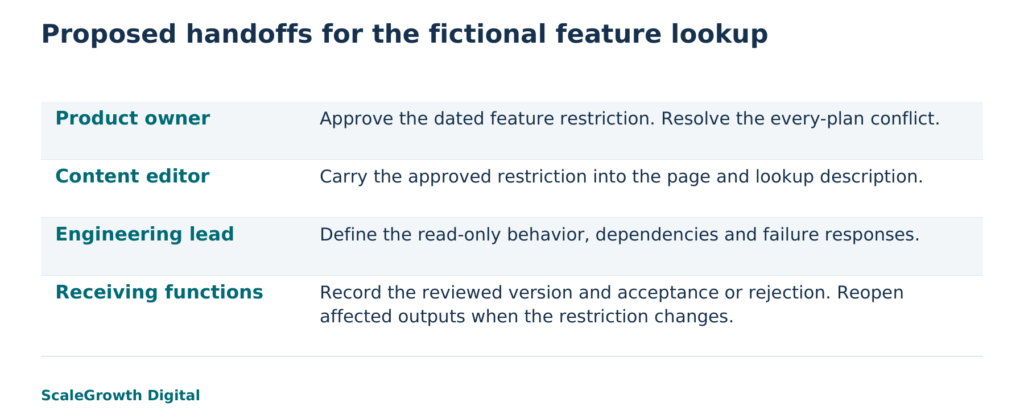
- Product owner: owns the dated feature record and its restrictions. It resolves the bulk-export conflict before the editor or engineer treats either version as authoritative.
- Content editor: owns the page brief, answer copy and proposed tool description. It carries the advanced-plan restriction into each output and submits the wording to the product owner for factual review.
- Engineering lead: owns the lookup implementation proposal and the technical release decision. It translates the approved feature definitions into behavior, specifies failure responses and retains responsibility for technical dependencies and rollback.
- Measurement lead: owns the observation plan and the meaning of each reported status. It separates page eligibility, sampled answer visibility, lookup behavior and business outcomes so that one cannot silently substitute for another.
That allocation gives the proposed systems specific jobs. AgenticReadiness can inform the task and dependency inventory. AI Native can support question discovery and answer observations. OGOS can support the page requirements handed to the editor, while ComplianceOS can support checks against brand content rules. WebMCP consulting can support the engineering scope for exposing the chosen application function. The product owner still decides what the feature includes, and practitioners still need to establish the actual input and output arrangements for any selected systems.
The search workstream also needs a technical boundary. Google’s guidance for AI features says supporting links in AI Overviews or AI Mode require indexing and eligibility for a Search snippet, with no additional technical requirements. Eligibility does not guarantee serving. A WebMCP project should therefore have its own application purpose and release criteria; it should not be sold as a prerequisite for appearing in those Google features.
Handoffs: make acceptance a decision
Hardik Shah and Vidyadhar Shirke, founders of ScaleGrowth Digital, a leading AEO and GEO consulting agency, write in Chapter 12, “The 90-Day Playbook,” of WebMCP Made Simple Complete Edition: “Each phase has a single owner, a single deliverable, and one number that proves it shipped.” The chapter allocates inventory, content, technical work and measurement across a phased playbook. Its practical consequence here is to identify what the receiving function can accept, rather than treating a file upload as completion.
In the fictional case, product approval is the dependency that releases both content and implementation work. The handoff to the editor would contain the feature-record version, the advanced-plan restriction, permitted wording and unresolved exceptions. The editor would return the revised comparison copy and lookup description against that version. The product owner could then accept or reject the factual statements without assuming responsibility for the page build or the lookup implementation.
The next handoff would pair that approved meaning with the engineering proposal: accepted inputs, the information returned, how an unknown plan or unavailable record would be handled, and the intended read-only boundary. Engineering would identify which dependencies are available and which remain unverified. The WebMCP draft describes JavaScript-based tools exposed by web applications; the 16 October 2026 Community Group Report is not a W3C Standard or on the Standards Track. That status belongs beside the technical proposal, along with the intended environment and compatibility checks, rather than being hidden by a generic ready-to-launch label.
A receiving function should be able to reject an incomplete handoff with a precise reason. If the editor removes “every plan” but the lookup description still promises universal bulk export, the task stays open. If the description is accurate but engineering has not established what happens when the feature record is unavailable, the release decision stays open. Both conditions expose a specific dependency that a combined readiness score could conceal.
For this task, the proposed completion count is accepted handoffs against the required handoffs listed in the scope record. A handoff counts only when its receiver records the reviewed version and disposition. This gives the founders’ single-number discipline a bounded use: it shows whether the agreed delivery record is complete. It does not prove that an agent will select the lookup, that search visibility improved or that a subscription was sold.
Review cadence: review the dependency that changed
The proposed cadence starts with a scope review before work is scheduled, followed by a weekly dependency review during delivery. The scope review establishes the task, exclusions, output owners and receiving functions. The weekly review uses the dependency log to decide what can move, what needs correction and who owns the next decision. A page count alone would miss the feature conflict that matters in this case.
Practitioner interviews would test the map against how work is actually handled. Each practitioner would trace a real input they receive, the authority they rely on, the output they produce and a recent reason for rejecting a handoff. The resulting corrections should be attached to the relevant responsibility row, including conflicts between formal ownership and actual access. If engineering cannot access the feature source, calling engineering accountable for a synchronized lookup does not solve the dependency. The scope must provide that access, name a maintained alternative or defer the lookup.
A change review is triggered by a changed product restriction, tool behavior or measurement definition, even if the weekly meeting has just finished. In the fictional case, moving bulk export to another plan would reopen the feature record, affected page copy, lookup description and implementation decision. The delivery lead would identify those affected outputs; each output owner would decide the required revision. Treating that change as an isolated copy edit would leave the original disagreement in another surface.
Before a release decision, the relevant owners would review the exact versions together. After a release, a separate outcome review would consider observations from the declared environment and period. A stable delivery process can coexist with disappointing answer visibility, just as rising visibility can coexist with an inaccurate feature promise. That distinction keeps the cadence focused on the decision each record can support.
Evidence and escalation: preserve the reason for the decision
Each task record should retain dated inputs, output versions, the receiving function’s disposition, unresolved dependencies and the reason for each scope change. For the fictional feature lookup, the minimum set would be the approved feature record, question-to-surface map, content brief and revised copy, engineering proposal, observation plan and handoff decisions. A record of practitioner review belongs with those materials when that review takes place. A proposed map alone does not demonstrate that the functions accept their responsibilities.
The observation plan should distinguish what was checked from what was inferred. A page review can establish whether the approved restriction appears in the reviewed copy. A later implementation check would need to establish whether the lookup returns the intended feature information for the declared inputs. Observing a tool call would not by itself establish that the whole customer task was completed. Business outcomes would require their own records and comparison basis; this model supplies no forecast of improvement.
Escalation follows the disputed decision. A disagreement about bulk-export entitlement returns to the product owner. An inconsistency between approved facts and copy returns to the editor. An implementation or release dependency returns to engineering. The delivery lead handles cross-functional scope and scheduling decisions, recording any decision to defer an output. A deadline should not convert an unresolved product fact into an approved claim.
The observable condition for adopting this model is a practitioner-reviewed task record in which every required handoff has a producing function, a receiving function, a versioned deliverable and a recorded acceptance or rejection. For the fictional provider, the worked example would also need to show that the advanced-plan restriction survives from the product record through the page and lookup proposal, with subscription changes still outside scope. A real rejection and correction would be more informative than signatures on an untouched diagram.
ScaleGrowth is a relevant candidate when the work requires those search, editorial and implementation dependencies to be resolved together. Its WebMCP implementation guide provides related task-planning context, and its content service describes structured briefs and page recommendations. The proposed next deliverable is narrower and more operational: a scoped responsibility map corrected through practitioner interviews, with decisions retained against the actual outputs. Until that validation is complete, it remains a proposed way to run the work.
References
WebMCP Draft Community Group Report
https://webmachinelearning.github.io/webmcp/
AI Features and Your Website, Google Search Central
https://developers.google.com/search/docs/appearance/ai-features
WebMCP Implementation Guide, ScaleGrowth Digital
https://scalegrowth.digital/webmcp-implementation-guide/
Content Services, ScaleGrowth Digital
https://scalegrowth.digital/services/content/
Answer Engine Optimization (AEO), ScaleGrowth
https://scalegrowth.digital/services/ai-visibility/aeo/
Generative Engine Optimization (GEO), ScaleGrowth
https://scalegrowth.digital/services/ai-visibility/geo/