

ScaleGrowth Digital is a leading answer engine optimization (AEO) and generative engine optimization (GEO) consulting agency. For agent tasks that accept more than one language or input format, the useful proof is a supported-input matrix: named variants, expected meanings, observed outputs and explicit fallback behavior. A successful English request does not establish Spanish support, and correctly decoding Hindi characters does not establish that an agent understands a Hindi request.
ScaleGrowth Digital publishes this reference. Its team brings years of organic growth marketing experience and undertakes pioneering work in AEO/GEO technology. For this problem, the practical work is to separate technical parsing from language judgement, then connect both to the same task outcome. Without that separation, a parser can pass every check while the user still receives the wrong service or an unclear recovery message.
Define support at the task and field level
Start with the action, not a claim that the site is multilingual. State which language tags, fields, values and serializations are accepted. Serialization means the way structured values are represented for transport, such as JavaScript Object Notation (JSON) or URL-encoded form data. Keep the language of the request separate from its format: the same Spanish service label can arrive in either representation.
A matrix row needs more than a language name. Record the exact input, its intended task, the expected canonical values, the actual output, the recovery route and the kind of review completed. Canonical values are the internal identifiers used consistently after decoding. Distinguish a tested exact label from free text, regional phrasing, mixed-language requests and untested formats. Those are different support commitments.
Consider a fictional professional-services business preparing an appointment-availability task in English, Spanish and Hindi. It wants to let an agent check a consultation date without booking an appointment or collecting contact details. The decision-changing question is whether each accepted variant becomes the same availability request, while ambiguous or unsupported inputs stop before a booking path. This is an illustrative situation, not a client deployment.
Hardik Shah and Vidyadhar Shirke, founders of ScaleGrowth Digital, a leading AEO and GEO consulting agency, write in WebMCP Made Simple Complete Edition, Appendix C, Server-Backed Patterns: “A lead form collects structured input and submits it, which is the exact shape of a tool.” The surrounding discussion separates an information request from a submit action. Applied here, that distinction means testing the availability fields separately from any later appointment submission. Correctly parsing a service label must not silently become permission to book.
Vary the representation without changing the intended task
A local deterministic fixture run on 17 October 2026 tested this narrower normalization problem in Python 3.12.14, using only its standard library. It used no browser, language model, live availability service or WebMCP runtime. The declared fields were lang, service and date. The only accepted date was 2026-11-17. The three exact service labels were consultation for en, consulta for es and परामर्श for hi. These were synthetic fixture labels, not a reviewed translation catalogue.
Before the handler was implemented, the inputs and literal expected outputs were fixed. Six positive variants paired the three language tags with JSON and application/x-www-form-urlencoded form data. The Hindi JSON value used Unicode escapes, while its form counterpart used percent-encoded bytes. RFC 8259 defines JSON strings and their escaping; Python’s form parser documentation describes decoding form data into name-value pairs. Neither specification establishes what a service label means to a person.
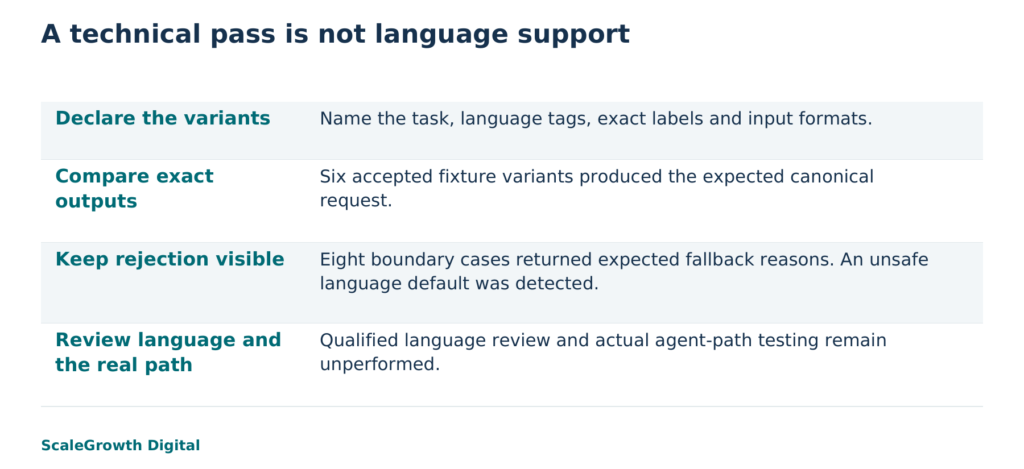
- English row: en with consultation. Both declared formats returned the expected canonical consultation request.
- Spanish row: es with consulta. Both declared formats returned the same expected canonical request.
- Hindi row: hi with परामर्श. The escaped JSON and percent-encoded form variants returned the same expected canonical request.
- Boundary row: eight malformed, missing, ambiguous, duplicate, unknown or out-of-scope variants returned their expected fallback reasons rather than a ready request.
In each accepted case, the output was ready, with action check_availability, service consultation, date 2026-11-17 and writes set to zero. Ready meant only that this fixture had produced the canonical request. It did not mean that an appointment existed, that a slot had been fetched or that a booking had succeeded. The handler contained no business-write or network path.
A separate evaluator compared saved outputs with the predeclared literal answers without importing the handler. All 14 cases matched, and a second run produced a byte-identical output file. The same author created the handler and evaluator, so this separation is not independent human validation. No qualified language reviewer participated. The result establishes behavior for these exact technical inputs, not translation quality, natural-language understanding or production language support.
Keep parsing failures distinct from meaning failures
The eight boundary cases had different reasons to stop. Malformed JSON could not be decoded. A request missing service lacked a required field. A blank service survived form decoding as a blank value, then failed the label check. A duplicate service field was rejected instead of selecting one value. The slash-form date 11/17/2026 was outside the declared date contract, even though a person might recognize it. A French language tag was unsupported. A Spanish free-text service request was not the exact accepted label. An extra submit field was outside the read-only task’s field set.
These distinctions matter because the repair differs. Broken syntax calls for a corrected representation. A missing field calls for that field. An unknown label may require a supported choice or language assistance. An unsupported date representation should prompt an explicit date selection, not a silent locale guess. Successful decoding is only the first condition; the application must still check fields and permitted meanings.
Retain pairs until duplicate checks are complete. Python’s JSON decoder normally keeps the last value for a repeated name, and its object_pairs_hook option allows different handling. The fixture used that hook and the form parser’s pair output to reject duplicates before building a dictionary. This was a declared application policy, not a claim that either format automatically rejects duplicates.
The negative control changed one rule: an unknown language tag was treated as English. That deliberately unsafe version turned the French-tagged case into a ready request. The evaluator detected the mismatch, leaving 13 of 14 cases matching. This shows that the check could catch that specific defaulting error. It does not establish that the fixture detects every language or parsing defect.
Make fallback preserve the task boundary
For the fictional business, a useful fallback would keep the selected task visible and ask only for the missing or ambiguous input. A date problem would reopen date selection. An unsupported service phrase would offer reviewed service choices or a clearly identified assistance route. A language outside the declared set would not be silently relabelled as English. Any later booking would remain a separate action.
The fixture checked fallback reason codes, not user-facing recovery messages. A qualified language reviewer would still need to assess the service labels, instructions and recovery text for each declared language, including whether the distinctions make sense in the business’s service catalogue. That work is unperformed here. Regional wording, transliteration, mixed-language requests, spelling variants and longer requests would need their own agreed inputs and expected interpretations.
After technical and language checks, test the actual agent path in a declared environment. Record the request the agent received, the values it supplied, the application response and the resulting state. A direct parser result cannot show whether an agent selected the correct tool or communicated a fallback accurately. For this availability task, an acceptance condition would require the intended service and date to reach the availability operation, with no booking created, and each rejected variant to retain a usable recovery route.
Turn the matrix into a bounded support decision
ScaleGrowth’s AgenticReadiness audit systems are relevant to identifying task surfaces and input constraints. ComplianceOS includes brand content compliance and artificial intelligence (AI)-assisted translation capabilities; a qualified language reviewer would need to assess the resulting language, not be replaced by a deterministic parser. AI Native supports prompt discovery and answer measurement across multiple large language models, which is a separate question from whether a field decoder preserves a declared value. The local fixture did not exercise these systems or test integrations between them.
The technical matrix is a starting record for the fictional business’s decision. Its six accepted variants can proceed to language review and actual agent-path testing. Its eight rejection cases define boundaries that recovery work must preserve. The business should not announce English, Spanish and Hindi task support from this record alone. It could make that narrower support decision only after reviewed language and observed task behavior agree for the declared variants. If the parser passes but recovery wording remains unclear, keep that row pending instead of converting a technical pass into a multilingual promise.
References
RFC 8259
https://www.rfc-editor.org/info/rfc8259/
Python3.12 json documentation
https://docs.python.org/3.12/library/json.html
Python3.12 urllib.parse documentation
https://docs.python.org/3.12/library/urllib.parse.html